
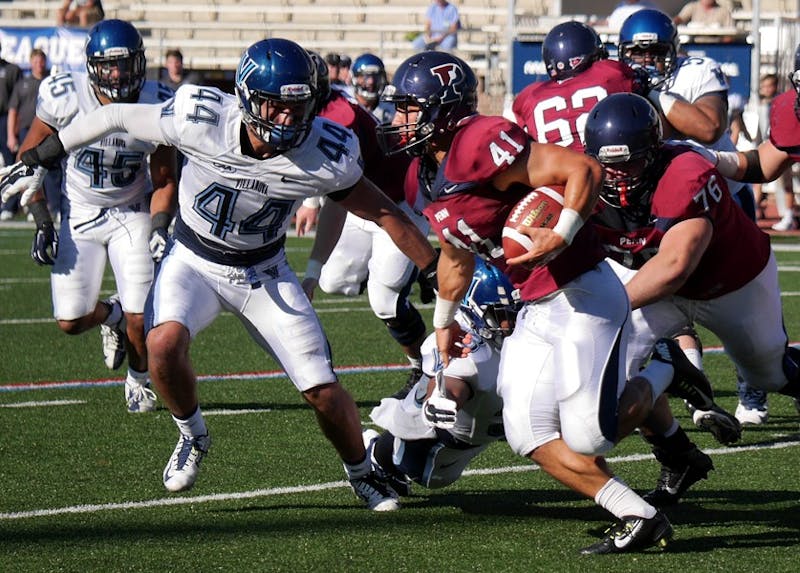
The timing could not be better — the return of a yearly matchup between the Philadelphia schools would help usher in a new era of Penn football.
By Conor Smith
6 minutes ago
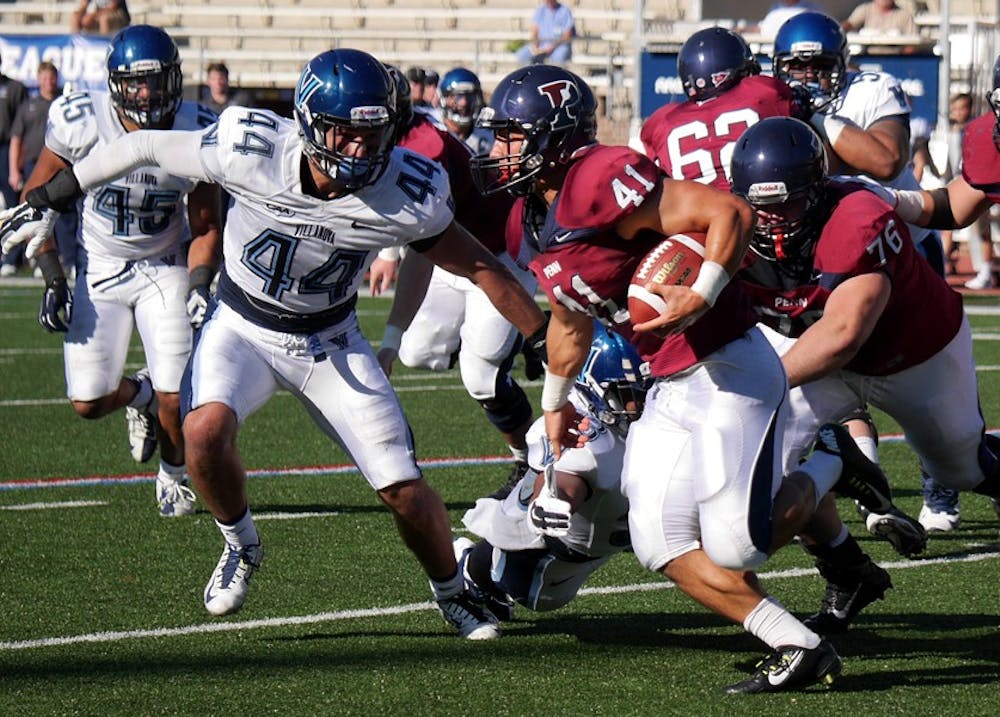
Penn football loses their first home game of the season to Villanova, 41-7.
Credit: Zoe Gan , Zoe Gan
Ten years ago, Penn football did the unthinkable: The team beat Villanova.
On Sept. 24, 2015, the Quakers stunned Villanova, 24-13. The win over the Wildcats marked the program’s first against their Philadelphia foe in 104 years. The star of the game? Then-sophomore wide receiver Justin Watson.
Many know Watson, who now plays for the Houston Texans, as an eight-year NFL veteran with three Super Bowl victories. For the fans who clambered into Villanova Stadium 10 years ago, he may be remembered as the receiver who finally put Penn over Villanova. He logged 87 yards and Penn’s two offensive touchdowns.
Along with being Penn’s first victory against Villanova since 1911, the victory also marked coach Ray Priore’s first collegiate win in the role. Priore took the moment to make a lighthearted jab at student sports reporters who picked the Quakers to continue their losing streak.
“The school paper said we needed a Hail Mary. Well, God was on our side today,” he told The Daily Pennsylvanian in 2015.
One would think that Penn’s win would reignite the rivalry, which at this point, saw the teams face off in 12 straight seasons. They would be wrong. Penn and Villanova have not played since.
Now is the perfect time to bring the rivalry back.
From Penn’s perspective, the timing could not make more sense. Following a successful proposal by the Ivy League Student-Athlete Advisory Committee, the conference announced in December that it would begin participation in the FCS playoffs. Before this, Ivy League schools were barred from the postseason, spanning back to the 1945 Ivy Group Agreement, which also banned athletic scholarships.
“It’s a step, which we feel is great not only for Penn football but the league itself, and to get a chance to see us on the national stage,” Priore said following the announcement.
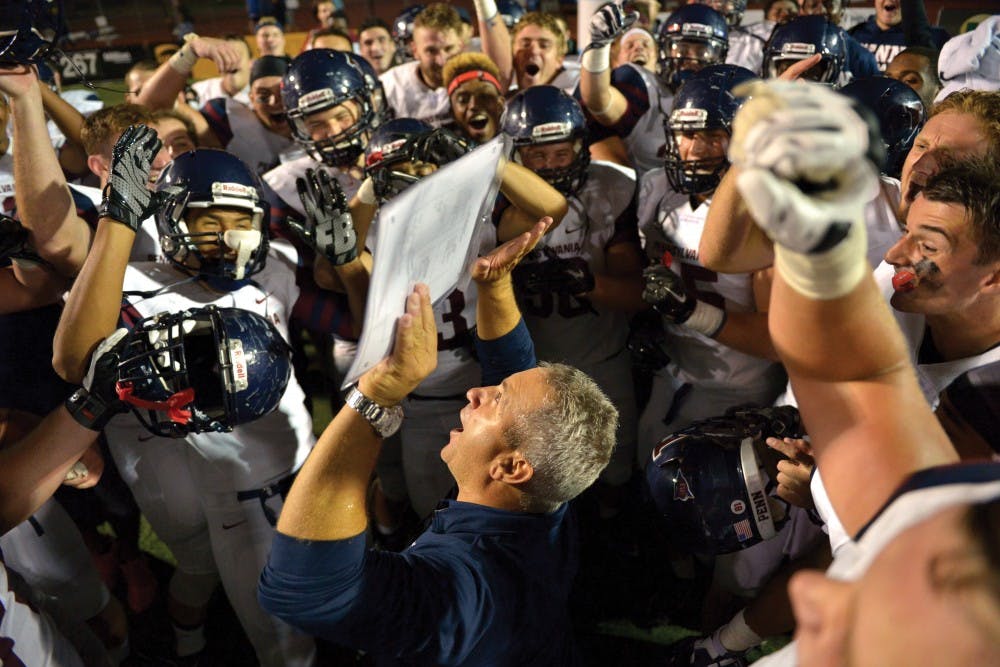
Credit: Courtesy of Penn Athletics
and
PHILADELPHIA, PA – JANUARY 18: Penn eat Villanova 24-13 at Villanova Stadium September 24, 2015 in Villanova, Pennsylvania. (Photo by Drew Hallowell)
With this major change for the Ivy League schools, it has been speculated by some (myself included) that the league’s 10-game schedule could be the next tradition to go. In June, the NCAA adopted a proposal for the FCS to play standardized 12-game seasons starting in 2026. However, the NCAA’s guidance is still just a “recommendation” for FCS teams and conferences, meaning Ivy League schools are not required to add two games to their schedules.
The speculation that the Ivy League will take the recommendation is fueled by its schools’ recent willingness to break away from the antiquated Ivy Group Agreement. It seems the conference is looking to further align itself with its FCS contemporaries. If this occurs, Penn will seek marquee matchups to fill out its extended schedule.
Enter Villanova.
The return of a yearly matchup between the Philadelphia programs would help usher in a new era of Penn football. Unlike Philadelphia college basketball’s Big 5 Conference, there is no association of Philadelphia-area football teams. With only Penn, Villanova, and Temple fielding teams, the city doesn’t have enough football programs to form a conference. Additionally, the Owls play in the FCS, making a consistent slew of games against Penn and Villanova very improbable. Temple may be awful by FCS standards, but its team would consistently trounce their Philadelphia counterparts.
Having a true city rival in Villanova again would excite Penn fans who would otherwise check out during nonconference play. The data is there. A DP analysis of Penn football attendance found that the most-attended Penn home game since 2003 was against Villanova.
On Sept. 24, 2005, 23,257 attendees watched the Quakers take on the Wildcats at Franklin Field. Last season, the most-attended home game was against Harvard and garnered 12,286 attendees. In total, Penn hosted over 20,000 fans five times since 2003 – twice against Villanova and three times against Princeton. The Tigers’ matchups all landed on Homecoming, a game that is known to bring in non-football fans every year.
Even though Penn was not winning the games, Villanova sure brought fans to Franklin Field.
Speaking of, there is reason to believe that the next chapter of the rivalry would be much less lopsided than the past. As Penn and the Ivy League are now playing for an FCS title, recruiting will likely see a bump. Players care about winning a real championship, not splitting an Ivy title three ways. Penn’s further integration into a legitimate FCS team will raise the level of play. Priore would agree.
Sign up for our newsletter
Get our newsletter, DP Daybreak, delivered to your inbox every weekday morning.
“I think it’s great for Ivy League football, and I think it’s great for kids that we’re trying to recruit — they want to see themselves play at the next level,” he told The Philadelphia Inquirer in April.
With recent changes to the Ivy League and the FCS, it is finally time for Penn and Villanova to face off again. This time around, things should be different.
CONOR SMITH is a College senior from Mount Royal, N.J. studying communications. He formerly served as the DP’s summer deputy sports editor. All comments should be directed to dpsports@thedp.com.
The Daily Pennsylvanian is an independent, student-run newspaper. Please consider making a donation to support the coverage that shapes the University. Your generosity ensures a future of strong journalism at Penn.