
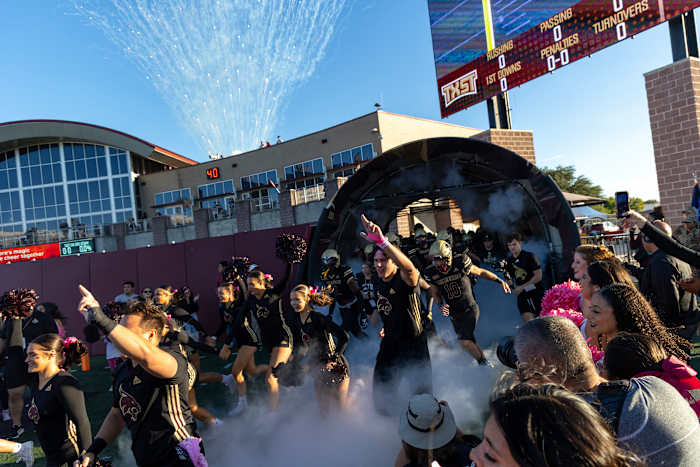
SAN MARCOS, Texas – Texas State’s move to the Pac-12 Conference is more than just a competition upgrade. It’s a substantial shift in what travel looks like for the entire Bobcats athletic department.
When the Bobcats officially join the league on July 1, 2026, every conference game will require getting on a plane. The closest Pac-12 school, Colorado State, is nearly 1,000 miles (997) from San Marcos. The furthest future opponent, Oregon State, is more than 2,000 miles (2,096) away.
Currently, the Bobcats are accustomed to traveling by bus to games in Louisiana, Arkansas or Mississippi as part of the Sun Belt Conference. Their future reality means longer trips, more missed class time and a much larger travel budget.
The impact of extended travel
In one year’s time, Texas State will go from the westernmost member of the Sun Belt and become the easternmost member of the new Pac-12. The Bobcats’ athletics department will likely feel the change the most in their travel budget.
Most of Texas State’s current Sun Belt games are within fewer than 500 miles of San Marcos, which allows teams to bus to its conference opponents dotted along multiple southern states.
However, the Pac-12’s footprint — truer to its regionality — is much more spread out as far west as the Pacific Ocean. Travel distances to games stretch from San Diego, California, to Pullman, Washington, which is nearly 2,000 miles away.
Pac-12 travel distance to opponents from San Marcos. (KSAT)
Every Pac-12 opponent is outside reasonable driving distance from San Marcos, or more than 500 miles away. The closest future league opponent being Colorado State, which is 997 miles away. The furthest the Bobcats will travel is Oregon State, located 2,096 miles from home.
Oregon State University: 2,096 miles from Texas State
Gonzaga University (non-football): 2,024 miles from Texas State
Washington State University: 1,952 miles from Texas State
Boise State University: 1,654 miles from Texas State
Fresno State University: 1,599 miles from Texas State
Utah State University: 1,400 miles from Texas State
San Diego State University: 1,287 miles from Texas State
Colorado State University: 997 miles from Texas State
Texas State athletic director Don Coryell said he doesn’t anticipate much change for the student-athletes.
“We don’t think there will be much of a difference for the athletes overall,” Coryell said. “It’s going to be more expensive — there’s no doubt about that.”
While the move out west will cost more, the Pac-12’s new media deal offers a reported $7 million to $10 million per year for each school — compared to the $2 million Texas State currently receives with the Sun Belt media deal.
A boost for recruiting
Even with the traveling challenges, Texas State officials shared their excitement about the recruiting opportunities the Pac-12 will bring.
Moving into the new league will give the Bobcats greater national exposure with more games airing on over-the-air, free TV networks such as CBS and The CW.
The added visibility could help Texas State attract talent that may have not considered the university or San Marcos before.
Head football coach G.J. Kinne said the move “opens up more doors.”
“You’re recruiting to a higher-caliber university,” Kinne said. “It’s not just football — it’s the universities you’re playing against.”
“This move is going to help us retain our student-athletes — they are beyond excited to compete in the Pac-12,” Coryell said.
A different level of competition
Texas State’s move to the Pac-12 also means facing more established programs.
In 2023 — when schools such as Oregon, Washington, UCLA and USC were in the league — Oregon State and Washington State finished in the top 50 nationally in recruiting rankings.
Last season, Boise State went to the College Football Playoff thanks to running back Ashton Jeanty. The then-junior put up video game numbers en route to becoming the Heisman Trophy runner-up and a top-10 pick in the 2025 NFL Draft.
Texas State’s move to the Pac-12 represents new terrain not yet explored for its football team and other athletic programs.
While the travel challenges may have an impact on the student-athletes, the opportunity to compete on a bigger stage will undoubtedly reshape the program’s future.
More local sports coverage on KSAT:
Copyright 2025 by KSAT – All rights reserved.