
It takes some special concoction of bad luck and bad decisions to go nearly a quarter century without a playoff win.
And yet the Dolphins have found a way to remain masters of mediocrity, prolonging the NFL’s longest playoff win drought with a combination of misfortune and missteps.
Often times for Miami, the bad decisions and bad luck intersect at the same position. The question is whether that’s happening again; the answer to those questions will help shape Year 6 of the post-2019 Great Tank.
With the season opening Sunday in Indianapolis (1 p.m., CBS-4), examining four areas where the Dolphins have been unlucky and now must hope that their second-guess-worthy decisions prove to be prudent ones:
Cornerback
The bad luck: Losing Kader Kohou, their best cornerback, to a season-ending injury in training camp.
The potentially dubious decisions: Not acting more proactively at the position to start free agency, odd behavior for a general manager who has said historically that “you can never have enough cornerbacks.”
The Dolphins knew in the spring that Jalen Ramsey’s tardiness and surliness did not fit the culture that the organization wanted to build. The Dolphins also knew that it needed to replace Kendall Fuller, who was released and remains unemployed.
By restructuring Tua Tagovailoa’s contract or executing several other moves, Miami could have created the cap space to make bids to sign one of the top corners in free agency: Byron Murphy (who took three years, $66 million to re-sign with Minnesota on first day of free agency); Carlton Davis (left Detroit for three-year, $60 million deal with New England), D.J. Reed (left the Jets to sign a three-year, $48 million contract with Detroit) or Charvarius Ward (left the 49ers to take three years, $60 million with the Colts).
Instead, the Dolphins left themselves with what ESPN’s Mina Kimes called the worst cornerback group in the league before they added Jack Jones and Rasul Douglas, two players who have been very good at times but also permitted brutal passer ratings of 115.8 and 123.7, respectively, last season.
Per Pro Football Focus, Jones’ 10 TD passes allowed were the most in the league last season, while Douglas permitted 76.9 percent of passes in his coverage area to be caught, fifth-highest among corners who relinquished at least 40 receptions last season.
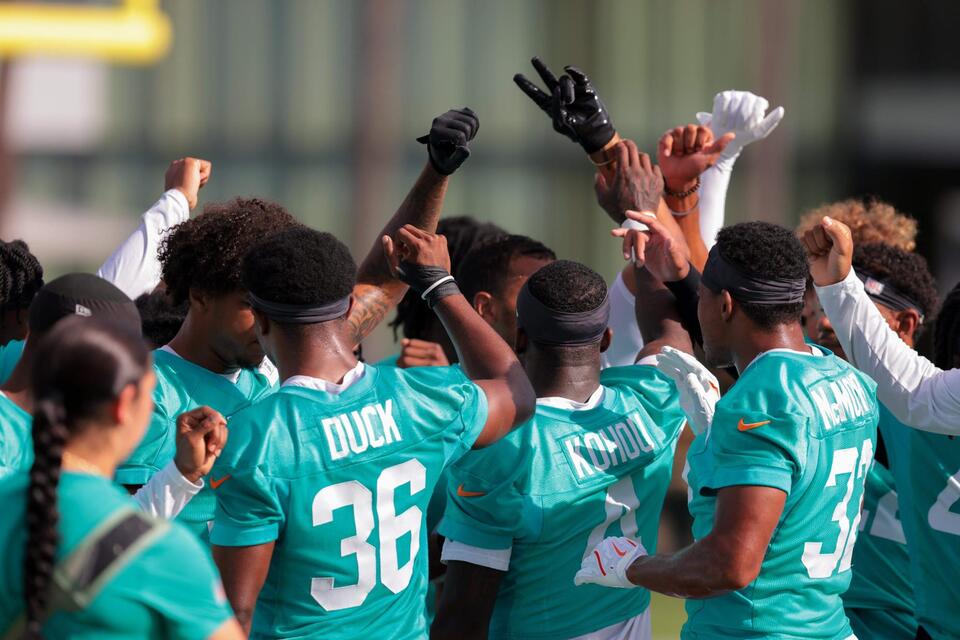
Perhaps a cornerback group of an undrafted second-year player (Storm Duck), a fifth-round pick getting on the job training at nickel corner (Jason Marshall Jr.), veterans with much to prove (Butler and Jones) and eventually, Ethan Bonner and oft-injured Cam Smith and Juju Brents, will work out. But it’s a risky way of doing business.
Offensive line
The bad luck: Backups Andrew Meyer and Liam Eichenberg remain out indefinitely with injuries; Meyer looked like Miami’s best reserve lineman during the first two weeks of camp. Key right guard addition James Daniels sustained an ankle injury during Thursday’s practice, missed Friday’s session and is questionable for Sunday.
The potentially dubious decisions: Larry Borom has improved after a dismal start to camp, but why did Miami entrust the No. 3 tackle job on a player who permitted seven sacks in just 237 pass blocking snaps last season (among the worst ratios in the league) and 20 over the past four years?
Here’s the problem spanning several administrations: Miami hasn’t found a quality multiyear offensive line starter on the third day of the draft or in rookie free agency this entire century — among the reasons why they’re always seemingly scrambling for help at the position.
Even finding quality offensive linemen in the third round has been next to impossible. In 2022, the Dolphins drafted linebacker Channing Tindall 102nd overall. He played 21 defensive snaps in three years and was released last week.
Eight picks later, at No. 110, Baltimore drafted Minnesota offensive lineman Daniel Faalele, who started 17 games at right guard for the Ravens last season and allowed only one sack. Pro Football Focus rated him 70th of 136 guards in 2024. Conversely, Miami’s right guard, Liam Eichenberg — who cost the Dolphins a future third-round pick in a 2021 draft trade-up – was ranked 106th of 136.
Are they Dolphins justified in gambling that Kion Smith would become a functional backup in his fourth year on the team? That’s unclear. It’s also too soon to evaluate the decisions to draft left tackle Patrick Paul (who looked very good in camp) and trade up to draft left guard Jonah Savaiinaea, who had an uneven preseason but packs plenty of promise. Paul looks the part and Savaiinaea has the footwork and athleticism needed to thrive in this zone-blocking scheme.
Perhaps Borom – better suited to Miami’s system than Chicago’s – and late addition Kendall Lamm, Smith and Daniel Brunskill will be a competent backup offensive line. But once again, Miami looks shaky at the position.
Tight end
The bad luck: Jonnu Smith’s decision to demand a contract extension instead of playing this season out. And Darren Waller sustaining a hip strain five days before the opener.
The potentially dubious decisions: Miami could have done more to appease a player who set franchise single season records for receptions, yards and touchdowns.
The Steelers gave Smith a $12 million extension for 2026 but guaranteed only $7.7 million of that. As perspective, that’s only $1.7 million more than Miami guaranteed Zach Wilson, who has the third-lowest passer rating among active quarterbacks.
Whether the Dolphins should have paid that or not is debatable; a strong case could be made that he was worth it.
But after the decision was made to trade Smith, why not top Cincinnati’s modest offer for Noah Fant, who accepted a one-year, $2.75 million contract with another $1.5 million in incentives?
Fant, 27, — who has 300 receptions, 15 TDs and 83 starts in seven seasons — visited Miami and instantly would have become Miami’s best in-his-prime tight end and wouldn’t have left Miami reliant on Waller.
With Waller now out, the Dolphins are left with arguably the worst tight end room in the league. It was always a risk to gamble on a player coming out of retirement, and the Waller decision so far looks dubious.
Short-yardage running
The bad luck: Alexander Mattison, who has very good career short-yardage metrics, sustained a season-ending neck injury.
The bad decision: There is no issue here with Miami’s free agent and draft decisions at the position; Ollie Gordon II, selected in the sixth round, could prove to be an effective short-yardage back, and Jaylen Wright — now injured and out a few weeks — deserves a second season before fully judging him. De’Von Achane was an excellent draft pick.
Instead, the bad decision here can be traced to Mike McDaniel’s short-yardage packages.
Analytics guru Warren Sharp had a fascinating piece discussing the “impact of Miami’s negligence [with] their short yardage game and why it’s No. 32 in the NFL and costing them wins.”
Among his findings:
▪ Over the past two seasons, the Dolphins have led the NFL in short yardage attempts (where 1 or 2 yards are needed for a first down) out of 21 personnel, which features two running backs, two receivers and a tight end.
With one or two yards to go for a first down, Miami has used 21 personnel on 43 percent of its rushes, which is most in the NFL, with nobody even close to that volume. But those runs mostly haven’t been successful; Miami was 25th in success and 20th yards per carry running out of 21 personnel in short yardage.
▪ Conversely, when the Dolphins operated out of 11 personnel (one running back, tight end, three receivers) over the past two years, they’re No. 2 in success and No. 1 in yards per carry on short-yardage rushing attempts.
▪ Last season specifically on short-yardage rushing attempts, Miami was 28th in yards per carry (a measly 2.0/28th in the league) on 41 carries (third most in the league) when it had two or fewer receivers on the field.
But when the Dolphins had three or more receivers on the field, they averaged 4.1 yards per carry (10th in the league) and had a much higher conversion rate (86 to 49 percent) than when it had two or fewer receivers on the field. Yet Miami attempted just seven short-yardage runs in that formation, third-fewest in the league.
As Sharp summarized on X: “Long term, ideally, they’d invest more in the offensive line and have better run blockers, and they’d add a more adept short yardage back. But it’s August, so that’s not happening in 2025. However, the solution is staring them RIGHT IN THE FACE. Miami could EASILY run the ball more from 11 personnel in short yardage if they wanted to. And that alone would go a long way to fixing their short yardage woes.”
You could add the decision to sign Wilson, a draft bust, as their backup quarterback, to this list, but there weren’t exactly clearly superior No. 2 quarterback options in free agency.
If all of these decisions work out — and Miami avoids major injuries to key players — there’s enough talent on this team to be a wild card contender. But the Dolphins cannot allow bad decisions to doom them at positions where they’ve had tough luck. We’ll know soon enough if that’s happening to them again.