
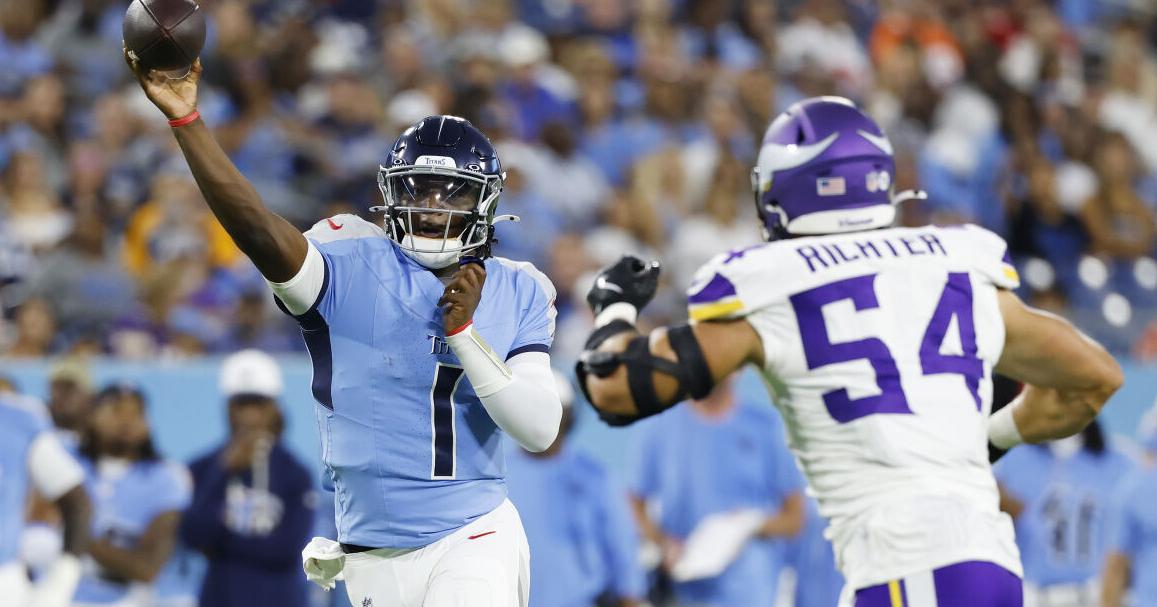
The odds were stacked against rookie quarterback Cam Ward leading the Titans to victory in his NFL debut Sunday.
He didn’t do enough to overcome them on his own.
Nor did his offensive teammates give Ward nearly enough help.
Ward was attempting to become just the fifth of 20 rookie quarterbacks drafted No. 1 since 1967 to lead their team to victory in Week 1, joining Chicago’s Caleb Williams (2024), Houston’s David Carr (2002), Denver’s John Elway (1983) and New England’s Jim Plunkett (1971).
Instead, Ward suffered through a rough afternoon in the Titans’ 20-12 loss in Denver, completing just 12-of-28 passes for 112 yards. The former University of Miami standout was sacked six times, committed one intentional grounding penalty and finished with a quarterback rating of just 54.5.
It didn’t help that Titans receivers dropped a minimum of three passes — two by Calvin Ridley and one by Elic Ayomanor — or that penalties and an inadequate rushing attack left Ward in third-and-long on too many occasions.
“The moment [was] not too big for him,” Titans coach Brian Callahan told reporters. “He was poised, he was calm. He saw things well. There’s a lot of positives from his demeanor and how he handled himself on the sideline in between series and on the field. So I think he’ll improve at a rapid rate.”
One of Ward’s brightest moments came just three plays into the contest, when — on third-and-10 — he somehow escaped heavy pressure and completed a short pass to Tony Pollard, who gained 29 yards.
But after two incompletions and a surprising third-and-10 run call, the Titans had to settle for a field goal.
Things looked promising on Ward’s second drive as well, as he connected with rookie tight end Gunnar Helm for a 16-yard pickup and then scrambled 11 yards for an apparent first down. But a holding call negated Ward’s run and led to a punt, which is when things began to go downhill.
Ward guided the Titans to just seven first downs overall, and Tennessee managed more than one first down on only one of 14 possessions. The Titans were held to -1 net yards of offense in the final two quarters.
“We didn’t score a touchdown,” Ward said. “That’s really the biggest frustration. [Shot] ourselves in the foot, just staying in long situations [on third downs] … End of the day, we just got to continue to get better. That’s only Game 1 and we got a long road ahead of us. We got 16 more to try to win.”
Ward used his elusiveness to advantage at times, but predictably in his first NFL game, he was guilty of holding the ball too often at times as well.
In the fourth quarter, for instance, Ward was sacked twice in a row, meaning a Titans drive that had started on Denver’s 24-yard-line wound up as a fourth-and-35. Instead of at least getting a field goal following a Broncos muffed punt, the Titans themselves had to punt.
“Just got to be better situationally, know when we are on the edge of field goal range, not taking a bad sack,” Ward said. “[It’s] just getting the ball out, whether it’s `dirting’ it or having to get out of the pocket and throw it away. So, just being better situationally.”
We addressed the Titans’ horrendous penalty problems in a separate article, but here are nine more takeaways from the game:
Failure to capitalize: A Titans team that produced only 18 takeaways in 17 games last season piled up four in the opener.
It was the Titans’ first game with four or more takeaways since collecting four interceptions against Jacksonville on Dec. 12, 2021.
Roger McCreary and Xavier Woods each posted interceptions, Sebastian Joseph-Day recovered a strip sack caused by Jeffery Simmons, and rookie Dorian Mausi recovered a muffed Denver punt.
Those turnovers gave the Titans the ball at the Tennessee 46-yard-line, the Denver 38, the Denver 26 and the Denver 24. But the Titans somehow managed to produce just six points out of those turnovers, coming away scoreless twice — once due to Pollard’s fumble and once due to the previously mentioned back-to-back sacks of Ward.
“Incredibly frustrating,” Callahan said. “Those are opportunities to score points and put the game away and we didn’t do it.”
The Titans’ defense also gave the offense the ball by stopping Denver’s last two drives on downs. But Tennessee managed a combined -2 yards on seven plays during the team’s ensuing possessions.
Missing a challenge? With just under three minutes left in the third quarter, and the Titans facing first-and-20 from their own 31-yard line, Ward connected with rookie Elic Ayomanor down the right sideline.
Ayomanor landed with his elbow first — inbounds — which should have been a completion.
But officials ruled the play incomplete, and Callahan never challenged the call.
Why not?
“You’ve got to get a foot inbounds, too, which, we didn’t have a clean look at whether his foot was down as well,” Callahan said. “Elbow [in] doesn’t equal two feet. So his foot would have had to come down as well … So the call from upstairs is that it wasn’t worth challenging.”
But as later pointed out by Titans reporter Paul Kuharsky, one elbow inbounds did indeed make the catch legal — as the rule states that the receiver must touch the ground “inbounds with both feet or with any part of his body other than his hands.”
Instead of gaining a first down, the Titans wound up throwing incompletions on the next two plays and punting.
Strange series: With the Titans holding a 6-3 lead late in the first half over the heavily favored Broncos, Tennessee took over possession on its own 7-yard line with just 47 seconds left in the half.
Had the Titans simply run the ball three times, Denver would have been forced to take its final two timeouts and Tennessee might have been able to sneak into the locker room with that three-point lead.
Instead, Callahan chose to pass three straight times in the shadow of his own goal line, with a rookie quarterback facing a defense that led the league in sacks last season.
Ward threw a pair of incompletions, and then was sacked for a six-yard loss on third down, narrowly avoiding a safety.
Two plays after the Titans punted, Denver scored a touchdown to go up 10-6.
Why didn’t Callahan play it safer on that series?
“I was trying to be aggressive, see if I can get the ball moved out from [close to the end zone],” Callahan said. “We’d kind of gotten a little bit of a rhythm, so trying to take advantage of some momentum potentially and it didn’t really work out in our favor at that point.”
Dike delivers: The Titans only officially announced that rookie receiver Chimere Dike had won the team’s return job in the days leading up to the season opener.
Special teams coordinator John Fassel explained that the Titans wanted to make sure Dike — who had plenty of experience as a kick and punt returner in college — won the position, as opposed to simply giving the job to a rookie.
But Dike looked like a polished pro against the Broncos, returning a kick 71 yards to set the Titans up for a field goal in the closing seconds of the first half.
It was the Titans’ longest kickoff return since Darius Jennings returned a kick 94 yards for a touchdown on Sept. 9, 2018 at Miami.
Rough day for Ridley: Ridley spent much of the afternoon getting blanketed by Denver cornerback Pat Surtain II, the AFC’s reigning defensive player of the year.
At the half, Ridley had just one catch for a single yard.
Ward tried him seven times in the second half, but the two only connected three more times for 26 yards.
One of Ridley’s drops occurred in the third quarter, when he failed to hold onto a second-and-nine attempt that would have given the Titans a first down. Tennessee punted two plays later.
Ridley fumbled another attempt on the Titans’ final series, again failing to hold onto a pass that would have given his team — needing a touchdown drive — a good boost with under one minute remaining.
Instead, the Titans’ possession ended two plays later when Ward took a strip sack.
Sneed returns, sort of: Titans cornerback L’Jarius Sneed played for the first time since the fifth game of the 2024 season, after overcoming a severe quad injury last year and undergoing a “clean-up” knee surgery procedure in May.
Sneed started the game but alternated regularly with Darrell Baker Jr. in the first half, playing 19 snaps, per ESPN.
He didn’t play at all in the second half, but Callahan said that wasn’t unexpected.
Sneed, after all, has only been practicing for a few weeks after returning from the knee injury.
“That was about his pitch count,” Callahan said. “He was [scheduled for] between 20 and 25 snaps in the game.”
Pollard’s heavy use: In the absence of injured Tyjae Spears, Pollard was on the field for 51 of the offense’s 57 snaps, an 89.5 percent snap rate that was the highest by a running back over the first 14 games of Week 1, per Pro Football Focus.
Julius Chestnut got just six snaps in the backup role, carrying twice for two yards.
It was not an impressive overall ground attack for the Titans, as Tennessee managed 21 carries for 71 yards, averaging 3.4 yards per attempt.
Pollard also lost a fumble, something he did only once in 16 contests last season.
But Pollard seemed to channel the fumble into aggression, as he carried three straight times for 23 yards in a later Titans drive that led to a field goal.
He finished with 18 carries for 60 yards, and Pollard’s lone catch — which went for 29 yards — was enough to lead all Titans receivers.
Injuries suffered: Rookie running back Kaleel Mullings had been listed as questionable for the contest with an ankle injury. He played, but left in the second quarter with an ankle injury.
Starting right tackle JC Latham left the game in the fourth quarter with a hip injury, and backup Uli Udoh struggled in pass protection on at least a couple of plays afterward.
Defensive lineman T’Vondre Sweat appeared to injure his left ankle late in the contest, and cornerback Jarvis Brownlee also left the game in the fourth quarter with an undisclosed injury.
Cornerback Darrell Baker Jr. left the game briefly in the fourth quarter, but returned.
Newcomers sit: Four of the Titans’ most recent additions were inactive against the Broncos.
All had been added to the team following the announcement of the original 53-man roster.
Among the healthy scratches were defensive lineman Shy Tuttle (signed as a free agent); cornerback Jalyn Armour-Davis (claimed off waivers from Baltimore); cornerback Samuel Womack (claimed off waivers from Indianapolis); and defensive lineman CJ Ravenell (claimed off waivers from Baltimore).
The only newcomer to play was Mausi, claimed off waivers from Minnesota, who recovered a muffed punt.
Other Titans scratches against Denver were rookie offensive linemen Jackson Slater and Brandon Crenshaw-Dickson, as well as rookie safety Kevin Winston, who’d been listed as doubtful with a hamstring injury.