
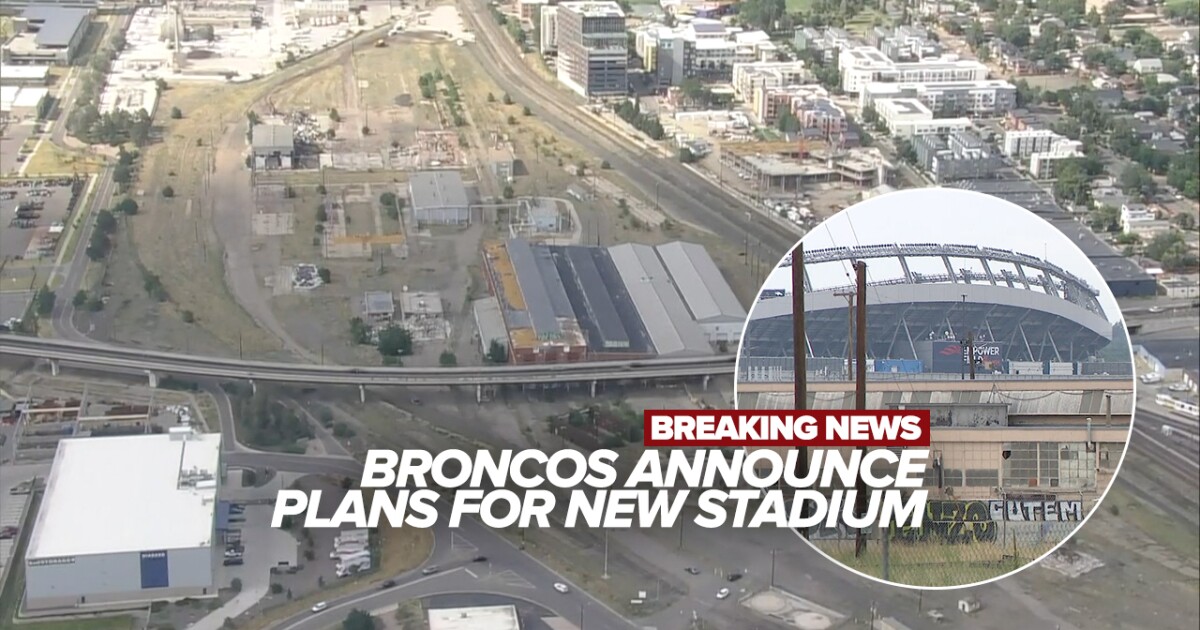
DENVER — Burnham Yard, a former railyard with a deep history for working-class Denverites dating back to the 1940 and 50s, was named Tuesday as the preferred site for a new Broncos stadium.
Located in an industrial corridor near the South Platte River and I-25, Broncos owners Greg and Carrie Walton Penner, Denver Mayor Mike Johnston, and Gov. Jared Polis, said in a news release the acquisition of Burnham Yard marked “an important step forward in a shared vision” for the Denver Broncos, the city of Denver, and the state of Colorado.
In announcing the purchase of the land, officials said the new stadium would feature a “world-class retractable roof stadium,” which would anchor “a dynamic mixed-use district,” aimed at reconnecting historic neighborhoods — “with no new taxes.”
“Today is not yet a celebration but rather a meaningful checkpoint reflecting years of research, collaboration and planning as well as necessary land agreements and feasibility studies,” officials said. “While this is an exciting milestone, we recognize there is much more work to be done ahead of a targeted stadium completion for the 2031 NFL season.”
Broncos ownership, the city’s mayor and Gov. Polis said the announcement also marked “the beginning of a much deeper and transparent phase of broader engagement with our neighbors.”
Rumors about Burnham Yard being the site of a new Broncos stadium began to spread after the Walton-Penner group — the richest owners in the NFL — took control of the Denver Broncos in 2022.
Our news partners at The Denver Post reported back in June on a series of property acquisitions near Burnham Yard by groups purportedly linked to the NFL franchise that fueled speculation of a potential move to the area on the southwestern outskirts of downtown.
Adding fuel to those rumors was Denver Mayor Mike Johnston’s clear message to Denver7 chief investigator Tony Kovaleski about a potential move of the Broncos outside of Denver: “Over my dead body.”
“[The Broncos] are a critical cultural institution of this city and this state, and we think they belong in Denver,” he said. “I’ve been working for years with the ownership group there at the Broncos. I think they are great people who are committed to the city long term, and I think they want the same things that we want. So I’m very optimistic we’ll get to a good outcome.”
The City and County of Denver plans to spend $140 million on road infrastructure improvements near Burnham Yard if voters approve the Vibrant Denver bond package this fall. City officials said the infrastructure repairs are long overdue, but Patrick Riley, the Vibrant Denver bond program manager, acknowledged to city council members last week that the Broncos could be a factor.
“It is impossible to ignore the Broncos as a thing in Denver, so telling you that there’s no weight there, or that there’s no consideration there, would be insulting to everybody at this table,” Riley told Denver7 a few months back.
ACQUISITION COMES AMID CONCERNS FROM COMMUNITY MEMBERS
Some community members demanded accountability after parts of Burnham Yard were torn down earlier this summer, telling Denver7 the move was a loss for Denver’s historic sites and came without warning.
Speaking to Denver7’s Brandon Richard, John Deffenbaugh, the president and CEO of Historic Denver, said buildings that were demolished were used by women and Black workers during the 1940s and 1950s.
“It’s not just the buildings that have been lost here, but the stories being lost as well,” Deffenbaugh said, at the time.
The sentiment was shared by David Riggs, with the La Alma Lincoln Park Neighborhood Association, who also told Denver7 the demolition of those buildings was disrespectful.
“The neighborhood association had no warning that these historic buildings were going to be torn down. The demolition of these historic buildings shows enormous disrespect for the history of our neighborhood,” Riggs said. “Many of our neighbors had family members who worked at Burnham Yard. This action is an insult to the history of the community and disrespectful of the influence that the railroads had on the growth of Denver.”
But in a statement to Denver7 last summer, officials from the Colorado Department of Transportation (CDOT) — who bought the property for $50 million in 2021 with the hop that it could be used to help expand I-25 and meet other critical transportation needs (plans that didn’t pan out, in the end) — said none of the buildings found to be historically significant were torn down.
Coloradans making a difference | Denver7 featured videos
Denver7 is committed to making a difference in our community by standing up for what’s right, listening, lending a helping hand and following through on promises. See that work in action, in the videos above.