
Week 1 both clarified and muddied the 2025 fantasy football picture. Some not-so-big surprises were only surprises due to fantasy hype, such as Braelon Allen’s lack of production and Breece Hall’s lead-back performance. Then, of course, there’s the shockers. Justin Fields, Daniel Jones and Justin Herbert all finished as top-five fantasy quarterbacks in Week 1.
But here, we talk numbers — touches, air yards, team target percentage, and more — the predictive stats that can show how and how often a player is being utilized by his NFL team in order to get in front of future trends. Broken down by skill position, this report analyzes the meaningful metrics that can help you with the waiver wire, start/sit decisions and much more. After each positional breakdown, we’ve included the full positional usage report for any additional research.
Let’s get to it!
Stats are via TruMedia. Roster rates are from Yahoo as of Week 1. Players must be under 50% for waiver wire and streaming consideration.
* Denotes a suggested waiver wire addition or streamer for the coming week.
Quarterbacks
What a week for Fields and Jones, two quarterbacks who entered Week 1 with much criticism and many questions about whether they could lead the Jets and Colts, respectively, this season. Fields finished as the No. 2 QB in fantasy points this week (29.52), with a 72.7% completion percentage and a league-leading 28.6% designed QB rushes. Jones was right behind Fields in fantasy points with 29.48 and had an incredible 75.9% Comp% (his regular-season career completion percentage is 64.3%). *Jones is only 5% rostered but gets a tough matchup against the Broncos in Week 2; however, of the QBs on the wire, his Week 1 performance was among the most inspiring. Temper expectations as a Week 2 fantasy starter, make the dart throw if you must, but keep him on the roster for better matchups in future weeks.
Other eye-catchers
*Geno Smith, LV | 10.6 Yards Per Attempt (YPA): YPA is a trusted predictive stat when it comes to fantasy success. For example, of the top-six quarterbacks in this category (Lamar Jackson, Smith, Fields, Justin Herbert, Jones, Josh Allen), Smith (QB13) is the only one who finished outside the top six in fantasy points. Given that YPA often reflects a team’s preferred offensive game plan (how willing they are to throw downfield), Vegas’ QB could have higher fantasy finishes ahead.
Smith’s 10.6 YPA in Week 1 ranked just under Lamar Jackson, and the Raiders led for much of the second half. Only 21% rostered, Smith gets a tough matchup in Week 2 (the Los Angeles Chargers), but depending on league depth, he still has streaming value considering the other QBs under 50% rostered are few.
Brock Purdy, SF | 0.34 Expected Points Added per Dropback (EPA/DB): EPA/DB is another predictive measurement that tracks how a QB should perform for fantasy managers based on historical comparisons. While not flashy, Purdy finished among the top 10 (along with other notables Michael Penix and Jordan Love) and showed promising metrics against the Seahawks, such as a 74.3% completion percentage, 7.9 YPA, six pass attempts inside the 10-yard line (second in Week 1) and a 92.2 passer rating, despite being outside the top 10 in fantasy points. There’s a caveat here that he emerged from Week 1 dinged up, and will definitely be without TE George Kittle (IR) and possibly WR Jauan Jennings if Purdy does play Week 2.
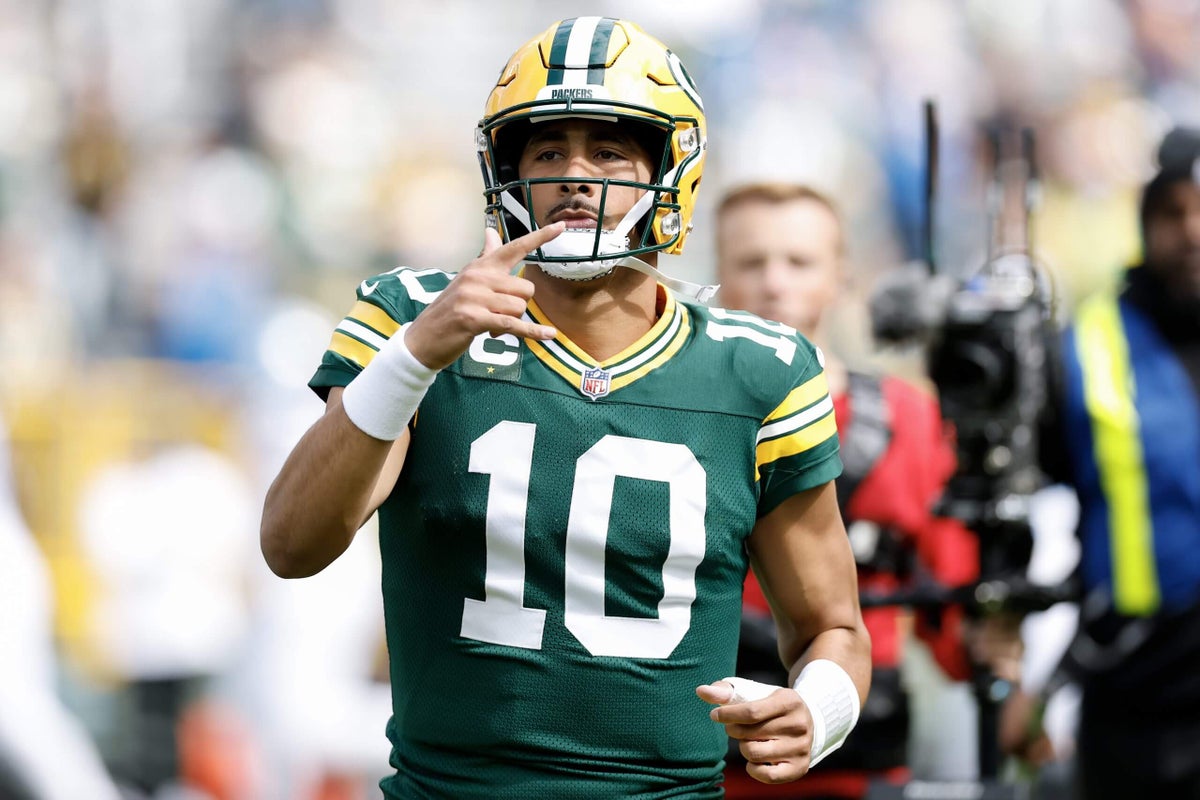
Jordan Love, GB | 36.4% Passing Attempts Over 15 Yards (AttAY15+%): Love impressively tossed more than a third of his throws over 15 yards with a 72.7% completion rate and a 128.6 passer rating against the Lions. That depth is interesting because the Packers dominated the game, indicating Love took deep shots because the Packers wanted to rather than needed to. Although he only scored 15.92 fantasy points, his deep passing efficiency signals a desire to throw more in the upcoming matchup. And while his receiving corps may see their scoring fluctuate on an individual basis from game to game (Hello, Matthew Golden? Are you there?), Love managers don’t need to worry about that so long as someone hauls in those deep balls.
Kyler Murray, ARI | 7.3% Designed Rush Percentage (Designed Rush%): With a 7.3% designed rush percentage (seventh among QBs in Week 1), QB12 Murray added 38 rushing yards to his game, providing a fantasy floor thanks to the relatively reliable cushion rushing points provide QBs. Despite his 5.6 YPA needing improvement, his rushing ability promises increased production in future weeks.
Red flags
Cam Ward, TEN | 2.48 Fantasy Points (FPTS): This is not an advanced metric, but one of the best predictors of future fantasy point production is past fantasy point production. (See, it’s not all rocket science.) Ward struggled to produce, contrasting with his league-leading 39.3% of attempts over 15 yards in Week 1. His aggressive play style may yield better results as he progresses. Pessimistically, though, Ward was rock-bottom among QBs in Week 1 with a 42.9% completion rate. Yes, deep throws can signal fantasy potential, but only deep completions lead to fantasy production.
Russell Wilson, NYG | 45.9% Completion Percentage (Comp%): Perhaps more unimpressive than Ward was Wilson, who had a career-low completion rate, failing to match his usual 64.6%. Wilson completed only 17 passes for 168 yards, and his head coach refused to back him after the Giants’ Week 1 drubbing. If rookie QB Jaxson Dart is on waivers in your Superflex or 2QB league, grab him now.
Other streaming QBs for Week 2
Michael Penix, ATL (32% rostered): Penix was fantasy’s QB10 in Week 1 with 24.02 FPTS and finished eighth in EPA/DB (0.34). Penix faces the Vikings, who gave up 24 points to a misfiring Caleb Williams and the Bears.
Aaron Rodgers, PIT (14%): I know, we all have Rodgers fatigue, but he was fantasy’s QB7 in Week 1 and gets the Seahawks in Week 2, one of the better matchups for QBs under 50% rostered that played well Week 1. He can barely move but completed 73.3% of his passes in his Steelers’ debut (seventh) and had a healthy 8.1 YPA.
Running backs
There were a few surprises at the running back position in Week 1, and Javonte Williams’ RB5 finish is one of them. Jaydon Blue was inactive ahead of the game, and Williams took 78.9% of RB rushes for the Cowboys.
The Browns’ *Dylan Sampson (RB9 in PPR points) outshone Jerome Ford and looks like the fantasy RB1 for Cleveland until Quinshon Judkins’ arrives. Even if the rookie Judkins takes over some work, Sampson looks primed as the pass-catching option with eight targets and 66.7% of RB touches. He could even be the RB1a to Judkins’ RB1b, but time will tell. Either way, if you drafted Sampson with the last pick, he can now be safely slotted into starting lineups, ideally in the Flex position with RB2 potential.
Other eye-catchers
Chase Brown, CIN | 92% RB Touch Percentage (RB Touch%): Volume is king in fantasy football, and a Week 1 monarch was Brown, who finished behind only the Bears’ D’Andre Swift. While Brown only scored 13.1 FPTS and finished as RB21, bigger weeks are ahead. The top six in Touch% also included Tony Pollard and Kyren Williams (tied at 90.5%), along with the top two rookie running backs of the 2025 class, Omarion Hampton (89.5%) and Ashton Jeanty (87.5%).
Javonte Williams, DAL | 6.7% Stuff percentage (Stuff%): Stuff% refers to how often a defense stops a rushing play at or behind the line of scrimmage. Williams put the fantasy community on notice in the first game of the 2025 regular season last Thursday night, cashing two touchdowns. Less obvious was his success in gaining positive yards. Of his 15 carries, only one resulted in a gain of zero or negative yards. That 6.7% rate was the best of all RBs with at least 10 carries. He was also the most efficient rusher per carry (0.21) in expected points added per rush (EPA/Rush) in Week 1 among RBs with 10+ carries.
Christian McCaffrey, SF; Jahmyr Gibbs, DET | 10 Targets: The search for PPR gold at the RB position took us to obvious places in Week 1, with McCaffrey and Jahmyr Gibbs opening the year on brand by leading the RB class with 10 targets. But running a not-so-distant third was Sampson, who caught all eight of his targets for 64 yards.
De’Von Achane, MIA | 1.65 PPR points per touch (PPR FPTS/Touch): Last season, Achane finished third in PPR points per touch behind Gibbs (1.21) and James Cook (1.12), among RBs who handled at least 150 touches (rushes and receptions). Only five RBs finished the season with over 1.00 PPR FPTS/Touch. Given the preseason hype around rookie Ollie Gordon, those with stock in Achane watched Week 1 closely to see how Miami’s presumptive RB1 would perform, and perform he did. In Week 1, Achane was the leader among RBs, with 10+ touches and a 1.65 mark. Henry (1.54), JCM (1.42), Bijan Robinson (1.36), Javonte Williams (1.20), Cook (1.18), Jaylen Warren (1.07), Alvin Kamara (1.05) and TreVeyon Henderson (1.01) were the other RBs to reach the 1.00 threshold.
Red flags
Kenneth Walker, SEA | 50% Stuff%, 52% RB Touch%: It’s probably not a surprise, based on his rushing numbers (10 carries, 20 yards), that Kenneth Walker had the highest Stuff% among all RBs with 10+ carries in Week 1, gaining zero or negative yards on half his carries. Walker gets another Mr. Yuck sticker in RB Touch%. A consensus mid-teens pick at RB in preseason drafts, Walker handled just 52% of Seattle’s backfield touches compared to 48% for backfield teammate Zach Charbonnet, who went in the mid-30s at the position in ADP. Based on the results — 10.7 PPR points for Charbonnet compared to 5.4 for Walker — it could potentially get worse for Walker.
Tyler Allgeier, ATL | 0.24 PPR FPTS/Touch: Tyler Allgeier clocked in with the fewest fantasy points per touch (0.24) among RBs with at least 10 touches. All his touches were rushes, and he averaged just 2.4 yards per tote. Teammate Bijan Robinson was actually worse in that department, averaging just 2.0 YPC on his 12 rushes. It’s an indictment of Atlanta’s run blocking, for sure, but at least Bijan made hay in the passing game with a line of 6/100/1.
Other waiver wire RBs
Trey Benson, ARI (39% rostered): Benson’s Snap% of 34.4 in Week 1 was more than double last year’s rate (16.8). And his 52-yard run against the Saints on Sunday could keep him prominently in the Cardinals’ backfield mix to offer 30-year-old James Conner a little more rest.
Kenneth Gainwell, PIT (1%): Much to the dismay of Jaylen Warren and Kaleb Johnson managers, Gainwell led the Steelers’ backfield with a Snap% of 51.9 (Warren was at 46.3). Gainwell finished with a lousy average of just 2.3 yards on his 10 touches, but the usage is worth watching and, if it continues, Gainwell could become an attractive Flex option in matchups that are a little more friendly than the New York Jets.
Wide receivers
Another beneficiary of the Monday Night Football shootout was Zay Flowers, fantasy’s WR1 in Week 1. With 28.1 points and 47.4% of team targets (second only to Jaxon Smith-Njigba) and a 90.4% air yards reception percentage (also No. 2 to JSN), Flowers went off with 7 receptions and 143 yards. He elevated himself into WR1/2 consideration, and Smith-Njigba has solidified his spot there.
Other eye-catchers
*Marquise Brown, ARI | 42.1% Team Target Percentage (TeamTgt%): TeamTgt% refers to the percentage of a team’s passing targets a pass-catcher receives and directly correlates to fantasy points, as more targets equals more catches equals more yards and possibilities for scores. Rostered in just a quarter of Yahoo leagues, Brown’s placement in this week’s top 5 in target percentage was notable. Of course, Xavier Worthy’s exit on the Chiefs’ first drive against the Chargers in Brazil helps explain Brown’s increased involvement. We don’t know yet when Worthy will return, and we know Rashee Rice is out until Week 7. Opportunity could keep knocking for Brown in the first few weeks of 2025. Washington’s Deebo Samuel was another intriguing top target, garnering 34.5% of the team’s pass attempts. His 10 total targets netted him 7 catches and 77 yards, and he also took a carry 19 yards for a touchdown.
*Calvin Austin, PIT | 65.6% air yards reception percentage (AYRec%): If you are among the 2% rostering Pittsburgh’s Roman Wilson in hopes he can secure the No. 2 receiver role, you can feel free to cut him loose this week, perhaps for Pittsburgh’s actual No. 2 receiver, Austin. While Wilson managed just 10 snaps in Week 1, Austin soaked up 65.6% of the team’s air yards, third-best among WRs, behind Smith-Njigba’s ridiculous 90.4% mark and Malik Nabers’ 69.7%. Austin finished with a WR16 line of 4/70/1.
Ricky Pearsall, SF | 3.09 Yards Per Route Run (YPRR): Our Jacob Robinson alluded last week to YPRR being predictive for fantasy football success. That bodes well for Pearsall, who finished Week 1 seventh (3.09) in the metric among WRs with at least five targets. Flowers, Puka Nacua, JSN, Garrett Wilson, Jayden Reed and CeeDee Lamb were the only wideouts to finish ahead of him.
Red flags
A.J. Brown, PHI | 5% TeamTgt%: While it’s certainly an anomaly, it’s worth noting that Brown was targeted just once in his 32 routes run, finishing with just 5% of Philly’s targets.
Matthew Golden, GB | 9.1% TeamTgt%: On a similar note in Green Bay, rookie receiver Golden had a relatively anonymous debut in the Packers’ passing game, with less than a 10th of his team’s targets. Given there was talk Golden could be the Packers’ No. 1 receiving option this season, that’s a concerning early stat.
Brian Thomas, Travis Hunter, JAX | -0.76, -0.72 Expected Points Added Per Target (EPA/Tgt): Liam Coen’s impact on the Jaguars’ passing game will apparently be a work in progress, as Thomas and Hunter finished in the bottom five in efficiency per target among wideouts with at least five targets. The duo combined for a receiving line of 7/44/0 on 15 targets against a Carolina defense that allowed the 10th-most PPR points per game to the position in 2024.
Other waiver wire WRs
Quentin Johnston, LAC (9% rostered): Johnston was just third among Chargers receivers in target percentage, but it was at least a healthy 20.6%. QB Justin Herbert targeted his top three receivers a combined 26 times, with just eight targets to the others. With two touchdowns in Week 1, Johnston now has 10 TDs in his past 15 regular-season games, at a rate of a TD every 5.7 catches.
Cedric Tillman, CLE (28%): Tillman finished even with teammate Jerry Jeudy in routes run (44), targets (8) and catches (5). But he pulled ahead of Jeudy on the fantasy ledger in Week 1 thanks to receiving a red zone target, which he cashed for 6 points en route to a WR17 PPR finish.
Kayshon Boutte, NE (1%): Boutte rained on Stefon Diggs’ Patriots debut by leading the Pats’ receivers in routes run (44), target percentage (17.8%) and PPR points (16.3).
Tight ends
Juwan Johnson was the surprise TE1 in Week 1 with 15.6 points, overcoming Brock Bowers (15.3), who spent time on the sidelines with a knee injury. Rookie Tyler Warren finished as TE4, and while that may not have surprised anyone who watched him play in college, he’s looking like a fantasy draft-day steal after … one week.
Other notable highs
Dallas Goedert, PHI | 35% TeamTgt%: Goedert finished with the highest team target percentage among tight ends. While he finished as TE14 in PPR FPTS, such a number in this category means he could push into TE1 territory any given week. However, Brown’s 5% TeamTgt% will certainly increase, so this may not be replicable each week.
Tyler Warren, IND | 31% TeamTgt%: Warren tied with Trey McBride for second with 31% of team targets. With Daniel Jones under center in Indy, Warren could undoubtedly be a top-five tight end this season.
Juwan Johnson, NO | 11 Targets: Johnson didn’t make the top three in TeamTgt%, but he still secured 26.8% of the available targets and led all TEs in total targets with 11 and routes (47) and finished second in receiving air yards (89).
*Harold Fannin, CLE | 27.8% AYRec%: Fannin had some hype coming into the season and lived up to it with a TE6 (13.3 PPR PTS) finish Sunday. He also came in fourth in team air yards share behind only Goedert, Hunter Henry and Johnson, and he secured 21.4% of team targets. With seven receptions on nine targets, Fannin won’t be on the waiver wire after this week, so take your chance on him now. He’ll face Baltimore in Week 2, who gave up the third-most PPR points to TEs in Week 1, and chances are, Cleveland will have to pass a lot to keep up with the Ravens.
Red flags
Travis Kelce, KC; Evan Engram, JAX | 10.5%, 10.8% TeamTgt%: The highs were high, and the lows were low. Travis Kelce (10.5%) and Evan Engram (10.8%) finished with less than 11% of team targets, but Kelce finished as TE8, while Engram finished as TE28. Though Kelce turned in a 12.7 PPR performance, his target share (with Rashee Rice and Xavier Worthy sidelined) is notable.
Mark Andrews, BAL | 1.5 PPR FPTS: Andrews finished near the bottom in nearly every category, but the one that matters most is fantasy points. He also ran only 15 routes (compared to Johnson’s 47, Kyle Pitts’ 39 and Mason Taylor’s 21), was targeted only once (5.3% TeamTgt%) and had 0.33 YPRR. Andrews’ performance was abysmal, no matter the category, and he didn’t capitalize on Isaiah Likely’s absence. If there’s anywhere to find a silver lining (and I’m not sure there is), Jackson only had 19 pass attempts and 209 total yards, most of which went to Zay Flowers. Against a different opponent with a different game plan, Andrews could fare better in future weeks.
Other streaming TEs
Zach Ertz, WAS (50% rostered): Ertz still has it. He finished just outside TE1 territory with 11.6 PPR PTS and 17.2% of team targets.
Brenton Strange, JAX (22%): Strange was TE17 in Week 1 but led the Jags in receiving. His TeamTgt% was lowest in this group at only 13.8, but Week 1 is a little like the preseason, and his target share could increase, though he will compete with wide receivers Brian Thomas and Travis Hunter. In his favor? Trevor Lawrence only threw for 5.7 YPA, which falls within the typical TE target range.
(Photo of Jordan Love: John Fisher/Getty Images)