
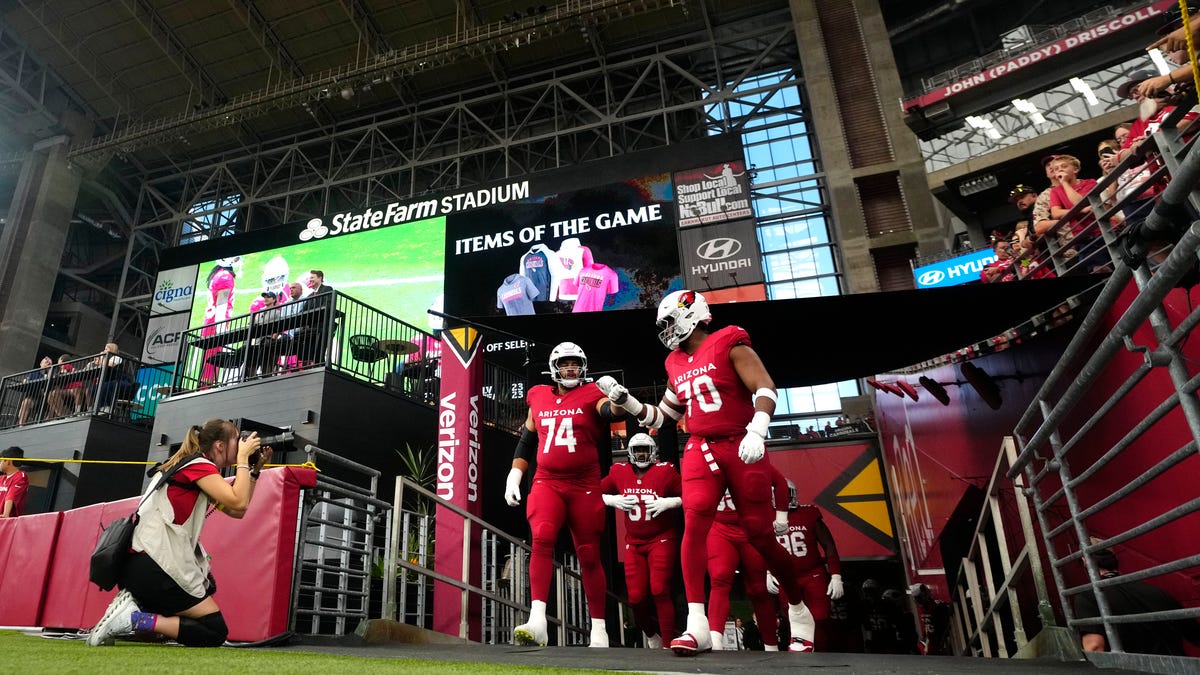


Cardinals’ Campbell was called to lead team huddle in New Orleans
Defensive lineman Calais Campbell was called to lead the Arizona Cardinals’ huddle in the locker room in New Orleans.
When a team allows five sacks in its first game of the season, there will, inevitably, be some concern. That’s only amplified when, like the Arizona Cardinals, that team didn’t upgrade its offensive line in the offseason, instead returning four starters and promoting one backup to join that group.
Blaming those five up front is an understandable instinct. On the list of most sacked quarterbacks in Week 1, only Cam Ward is above Kyler Murray.
But if you ask the Arizona Cardinals coaching staff, there’s no concern. Head coach Jonathan Gannon said the line was “pretty firm” overall. Offensive coordinator Drew Petzing added that he “thought they did a really nice job.”
In rewatching the game tape, it’s easy to see why Gannon and Petzing are so assured. The Cardinals (per Pro Football Focus tracking) only allowed 10 pressures, the eighth-fewest of any offense — and one of those was actually a designed run. The other nine broadly fit into three buckets, only one of which is the responsibility of the offensive line.
Unblocked pressures
The Cardinals allowed four pressures to unblocked defenders. In the course of a game, these are inevitable. When a defense shows a look with more potential pass rushers than the offense has pass protectors, the offense has to make a pre-snap determination on who to leave unblocked. If that defender then rushes the passer, the quarterback will be under immediate pressure.
Petzing, in his weekly press conference, said he was not concerned about those unblocked pressures.
“Definitely just something that happens,” Petzing said.
Re-watching the game, the idea that the pass pro was bad because of the five sacks doesn’t hold up.
Cards allowed 10 pressures per PFF (and one was really a designed run). Only three were on the blocking.
Four were unblocked b/c of scheme, which Petzing said he’s okay with. pic.twitter.com/iCPoPMgIYQ
— Theo Mackie (@theo_mackie) September 10, 2025
On the first two plays here, the offensive line slides right, leaving an unblocked rusher coming off the left side. Both times, Murray uses his legs to escape.
On the first, he could have checked down to James Conner, but instead attempted to make a more explosive play himself, even if he only picked up four yards. On the second, he found room up the middle, ultimately sucking in both linebackers and clearing a hole in the defense for Trey McBride.
Teams with less mobile pocket passers might instruct their quarterback to pass over these unblocked rushers, but the Cardinals trust Murray to make plays with his legs.
“You have to live with that,” Petzing said. “It’s something that he does at such an elite level, I never want to take that away from his game.”
The final two plays here were ones that the Cardinals dealt with poorly — but not because of their offensive line.
On the first drive of the game, the Cardinals designed a play-action pass to McBride in the flat, but McBride briefly collided with Tip Reiman at the line of scrimmage. That disrupted the timing of the play, limiting McBride’s ability to chip the Saints‘ unblocked rusher, Cameron Jordan. Jordan is then able to get into the backfield quicker than planned, preventing Murray from finding his tight end.
“I’d put that on me,” Petzing said.
The final play here is the Cardinals’ final offensive play of the game. On a crucial third-and-4, the Saints show seven pass rushers. The Cardinals left the slot cornerback unblocked because he was the furthest player from Murray, which follows common pass protection rules. The problem here was that, despite a straight dropback, Murray didn’t have any routes that were designed to come open immediately against the blitz.
“Whether or not you have time to get it off depends on how well they time it up, who comes free and when and what they look like on the back end,” Petzing said.
That last play was part of another trend, which also had little to do with the offensive line.
Coverage pressures
Two of the Cardinals’ pressures happened because Murray didn’t have any open receivers.
Two were because Kyler didn’t have anyone open and scrambled. You can quibble with the play design but the protection holds up.
Marv might’ve very briefly come open on the second but that’s not where the progression of Kyler’s reads takes him. Can’t look everywhere at once. pic.twitter.com/OhPuavIHwq
— Theo Mackie (@theo_mackie) September 10, 2025
On the first of these plays, the Cardinals ran a play-action look with Murray rolling to his left as McBride released into the flat. They ran three nearly identical versions of this play in the first quarter, and the Saints caught on. Here, they had two defenders taking McBride away.
Murray could have potentially had Marvin Harrison Jr. open on a deep out if he stepped back into the pocket, but the pass protection was designed for him to roll left, making that risky. He instead scrambled for no gain, which officially goes down as a sack.
The second play was also a scramble that was officially recorded as a sack. The offensive line protected well for Murray, but he had nowhere to go with the ball.
His first read was Michael Wilson, who was tightly covered in man with a safety over top. On the other side of the field, there might have been a brief window to hit Harrison, who had a cornerback playing underneath his go route and a safety playing over the top. But by the time Murray’s progression arrived at Harrison, the window was gone — a quarterback can’t have his eyes on every receiver at once. So instead, his internal clock told him to take off. Like the previous play, it’s an understandable decision as Murray avoids losing yardage.
“I guess that’s technically a sack, but whatever,” Petzing said, his level of concern clearly minimal.
Actual pressures against the offensive line
The final three pressures were the ones for which the offensive line was culpable — and two of them could also be pinned on the downfield coverage.
That leaves three plays where you can blame the pass protection. And on the first two here, Murray has some time before the OL loses, he just doesn’t have any open receivers.
Really, the last play here was the only time all game that the OL gave up quick pressure. pic.twitter.com/zcVvq41cTd
— Theo Mackie (@theo_mackie) September 10, 2025
On one third-quarter sack, right tackle Jonah Williams was pushed back by edge rusher Cameron Jordan, who got to Murray. The sack, though, took more than three seconds, leading Petzing to describe it as a “coverage sack.” None of the Cardinals four downfield receivers came open against well-executed man coverage.
A few plays later, center Hjalte Froholdt wasn’t able to hold his block against defensive tackle Davon Godchaux, enabling Godchaux to penetrate the pocket. But again, Murray had time to throw before Froholdt lost the rep — he just didn’t have anywhere to throw, as Harrison was bracketed downfield. Instead, Murray spun away from Godchaux and picked up 11 yards on a scramble, showing how valuable his legs can be.
In the entire game — which consisted of 38 dropbacks — there was only one example of an offensive lineman allowing instant pressure. That snap, which is the final play of this clip, comes on third-and-12 from the Saints 24-yard line.
Right guard Isaiah Adams was caught off balance by a well-executed rush from defensive tackle Bryan Bresee, creating pressure right as Harrison came open on a corner route. Instead of a potential touchdown, the Cardinals had to settle for three points.
It was a reminder of the impact that pressure can create. It was also a reminder of how rarely the Cardinals’ offensive line allowed that pressure — no matter what five sacks may indicate.