
Cam Ward’s NFL debut last week wasn’t one that had football historians scrambling for the record books.
Unlike in 2015, when former Titans quarterback Marcus Mariota threw for four touchdowns and posted a perfect quarterback rating of 158.3 in his Week 1 opener, Ward’s initial performance was honestly pretty quiet.
There were a couple of highlights during his 12-for-28 afternoon (no touchdowns, no interceptions) and a couple of lowlights on his way to a 54.5 NFL quarterback rating.
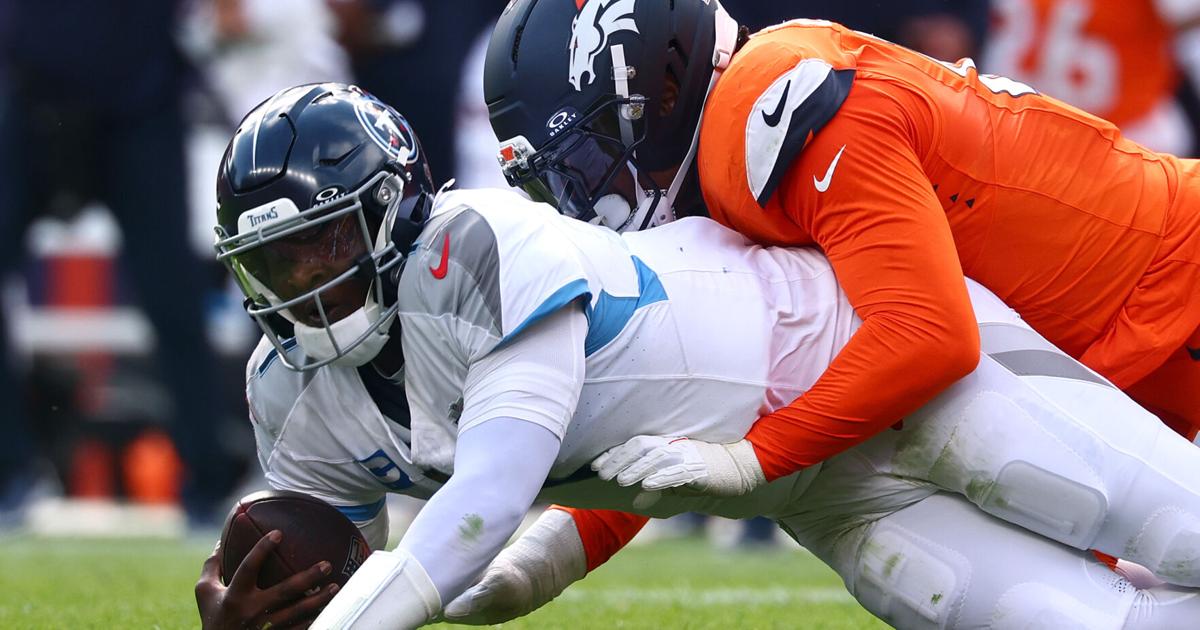
That’s not necessarily a bad review, considering he was opening in Denver against a 2024 playoff team that piled up an NFL-best 63 sacks last season.
But as Ward himself acknowledged after the 20-12 loss, there has to be more production going forward, as the Titans were held out of the end zone and managed a combined six points following four Broncos turnovers.
So what’s the evaluation of the No. 1 pick in the draft look like?
Here are five stats that offer a bigger picture of Ward’s overall performance:
Desire didn’t match reality
One thing we can say for sure about Ward: He wasn’t scared to push the ball downfield, as 12 of his 28 pass attempts went for 10-or-more yards — including three attempts of 20 yards or more.
Unfortunately, the production on those pass attempts didn’t follow, to say the least. Ward was 1-for-12 on passes of 10-or-more yards (for 16 yards), including 0-for-3 on passes of 20 yards or more.
A couple of disclaimers here: Two of those downfield pass attempts were dropped, and another — the long sideline incompletion to Elic Ayomanor in the third quarter — may well have been ruled a catch if it had been correctly challenged by coach Brian Callahan and his assistants.
Still, the contrast between what Ward wanted and what he got was stark: He led the NFL in air yards per attempt (10.8) in Week 1, but finished seventh worst in the league in average air yards completed (3.7), per Pro Football Reference.
The drops hurt
Speaking of those drops, the Titans’ total of three in Week 1 ranked tied for third in the NFL, trailing only Dallas (four) and Cleveland (four).
Even more disappointing was that the team’s best receiver, Calvin Ridley, accounted for two of those drops on his eight targets, while Ayomanor suffered one in his first NFL game.
So in total, three of Ward’s 15 on-target pass attempts were dropped, a 20 percent rate that led the NFL in Week 1, per Pro Football Focus.
Keep in mind the drop total didn’t include an additional pass attempt that had virtually no chance of completion, as Ward — on a screen play just before the half — was forced to throw the ball into the feet of a pack of three pass catchers near the right sideline.
All three players — Ridley, Tyler Lockett and Chig Okonkwo — thought they were blocking on the play, so none were turned toward Ward when the ball was thrown.
One more stat in this department: Titans receivers went 0-for-3 on contested catches, with Ridley going 0-for-2 and Ayomanor 0-for-1.
How about a little help for the rookie, guys?
Timely throws
One of the few concerns about Ward heading into the NFL Draft was that there were times in college he tended to hold on to the ball too long, usually while trying to buy time to make plays.
While at Miami in 2024, Ward’s average time to throw was 2.92 seconds, which was 22nd slowest among 93 qualifying quarterbacks.
But Ward had a solid day in this department against Denver, as he took 2.82 seconds on average to throw, a middle-of-the-pack number among all Week 1 NFL quarterbacks.
For the sake of comparison, Pittsburgh’s Aaron Rodgers notched the quickest average time to throw in Week 1 (2.29 seconds), while Philadelphia’s Jalen Hurts, a far more mobile quarterback, had the slowest average time to throw (3.67 seconds).
No interceptions, but no big-time throws
No Titans fan will soon forget the quarterback turnover horrors of the 2024 season, when Will Levis suffered 12 interceptions and seven lost fumbles, while Mason Rudolph chipped in with nine interceptions and three lost fumbles.
One of the Titans’ biggest goals this season, obviously, was getting that problem under control.
Despite being pressured regularly, Ward fared pretty well on the turnover front in Week 1. He did suffer one lost fumble on a desperation, fourth-and-10 strip sack at the end of the contest.
But Ward didn’t throw a pick in 28 attempts, and he was one of only 12 Week 1 quarterbacks who didn’t record what PFF calls “a turnover-worthy play” — which is defined as either a pass that has a high percentage chance to be intercepted or a player doing a poor job of taking care of the ball and fumbling.
On the flip side, Ward was one of just 10 quarterbacks who didn’t record any “big-time throws,” which PFF refers to as a pass with excellent ball location and timing, generally thrown farther down the field than otherwise and/or into a tighter than normal window.
Not to beat a dead horse, but if the long incompletion to Ayomanor had been reviewed and reversed, that almost certainly would have qualified as a big-time throw for Ward.
Pressure proved problematic
Playing against a Denver team that led the NFL in sacks last season — by a wide margin — Ward was pressured on a whopping 52.9 percent of his dropbacks in Week 1, which was the highest rate in the NFL.
When under pressure, Ward completed 5-of-12 passes (including two drops) for 52 yards, posting an NFL quarterback rating of 54.5. His average time to throw under pressure was 3.30 seconds, which was 12th-fastest in the league.
Ward was sacked six times, and PFF attributed two of those sacks to Ward, which was tied for most among NFL quarterbacks after one week.
Given all the circumstances of Week 1, it’s fair to say Ward did at least a decent job of handling himself under pressure.
The Titans’ hope going forward is that he won’t have to worry about pressure quite as much, and that he’ll be more productive when faced with it.