
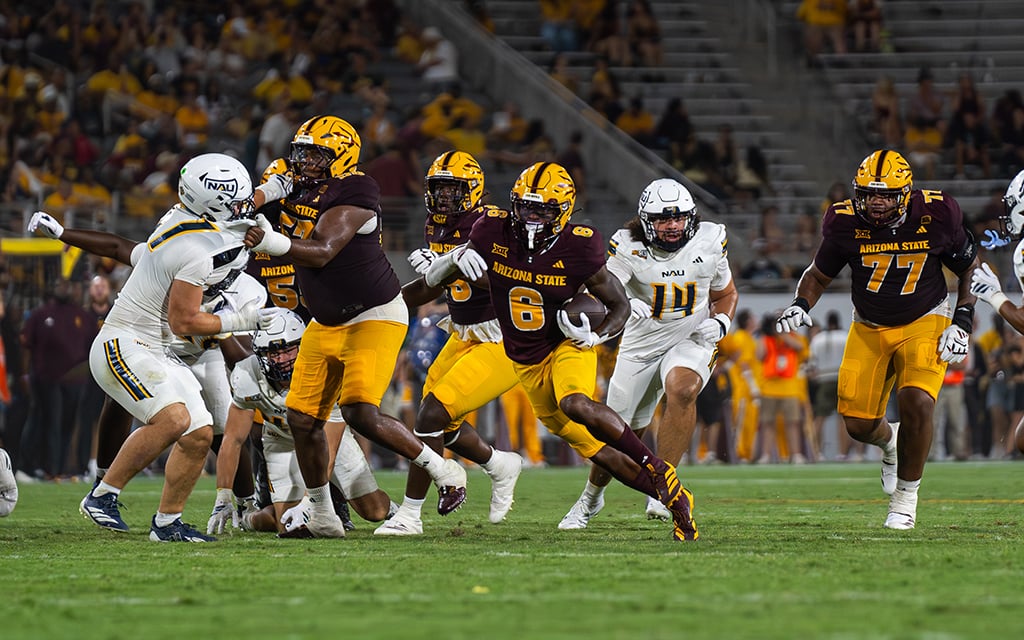
Arizona State running back Kanye Udoh could be a difference-maker against a Texas State defense that ranks 116th in the nation against the run. (Photo by Hana Kaufman/Cronkite News)
TEMPE — Inside the cool confines of the Verne Dickey Dome, it was business as usual at practice for Arizona State sophomore quarterback Sam Leavitt, who dropped back and zipped a pass to senior receiver Malik McClain.
The throw?
Slightly off the mark, as Leavitt hurled it behind McClain, cascading off his hands and fluttering to the turf below.
The errant pass encapsulated the inconsistencies of the Arizona State offense, which for most of its spry 2025 campaign has seemed slightly out of sync.
While the offense through two games has displayed an ability to move the ball up and down the field in spurts, it also has looked disjointed at times. Primarily, it has struggled to develop consistency in marrying a high-flying passing game with a physical downhill rushing attack, leaving the team devoid of a clear identity on offense.
“I think we’ve got to find that balance this year in what that (identity) is,” ASU coach Kenny Dillingham said at his Monday press conference as the Sun Devils look to pick up the pieces from their 24-20 loss to Mississippi State last Saturday that dropped them to 1-1 and out of the AP Top 25 rankings.
“To say that we have it would obviously be incorrect. We’ve got to find it. But I definitely think we’re trending to figuring us out.”
Dillingham hopes to have an answer to his offense’s identity crisis by Saturday when ASU hosts Texas State (2-0). Against a Bobcats defense that ranks 116th in the nation against the run (388 yards per game) through two games, it may resort to a more run-heavy approach.
Coming into the season, the Devils’ aerial attack was expected to lead the way. After all, Leavitt and junior wide receiver Jordyn Tyson earned heaps of preseason recognition, including spots on the preseason All-Big 12 first team with Leavitt named the conference’s Preseason Offensive Player of the Year.
However, a dominant display from the ASU ground game in the second half against Mississippi State, as the Sun Devils tried to claw back from a 17-3 deficit, provided a glimmer of what an emphasized rushing attack could look like.
.@KanyeUdoh6 with his first touchdown as a Sun Devil 🫡
📺 ESPN2 pic.twitter.com/rmPlKYeYKk
— Sun Devil Football (@ASUFootball) September 7, 2025
Following a Week 1 win over Northern Arizona in which ASU’s stable of running backs accumulated only 14 carries, the Sun Devils handed it off to their group of tailbacks a whopping 43 times in Week 2. And, when factoring in eight carries from Leavitt, the squad totaled over 50 rushes on the night – the most rushing attempts by Arizona State since it last played MSU just over a year ago.
“I feel like we had to run the ball to open up the offense,” Brown told reporters after the loss. “That was our game plan in the second half. To run the ball and get downhill.”
With the Bulldogs’ defense bruised and battered in the fourth quarter, ASU flexed its muscles, piecing together a 17-play, 95-yard drive that chewed up nearly nine minutes off the clock. Of those 17 plays, 15 were runs.
The thunder and lightning combo of junior running backs Kanye Udoh and Raleek Brown knifed through a helpless Mississippi State defense that knew what was heading its way, but simply couldn’t stop the Sun Devils rushing attack.
“We’ve proven that we can run the football, and I think that was probably our biggest question going into the year. … Now it’s ‘What is our identity?”And then how do you build it from there?” Dillingham said.
Nonetheless, in order to unlock the offense’s full potential, Dillingham and his staff will need to correct its struggling passing game.
It starts with Leavitt, the quarterback who’s been honest about his struggles throughout the front half of non-conference play. Last Saturday, he tossed two interceptions to pair with only 82 passing yards – his second-lowest passing mark since earning the starting role in Tempe.
“There are a lot of things I’ve got to clean up,” Leavitt said. “Quite frankly, I didn’t play very well.”
Over the offseason, much was made about the newfound freedom gifted to Leavitt in his second year in the offense. With a better grasp of the system, Dillingham and offensive coordinator Marcus Arroyo aimed to open up the playbook for Leavitt, allowing him to take control more at the line of scrimmage.
But with great power comes great responsibility.
For instance, last season, former Sun Devils center Leif Fautanu barked out orders directing the offensive line, helping the unit navigate around blitzes.
This season? Much of that responsibility falls upon Leavitt, as he’s working with graduate center Ben Coleman, who recently made the move to the center position.
“It was like (we had) three centers,” Coleman said about ASU’s offensive line last year. “We all understood where to go. … Anytime you have older guys like that, you understand the concepts, you understand where stuff is supposed to be and it works out a little bit better. This year, we have to be even better about communication.”
Additionally, in early down situations, a handoff to recently departed running back Cam Skattebo seemed like a sure-fire proposition. But with Skattebo gone, the Sun Devils have opted to pass more on first and second down in an effort to put the ball in the hands of their two most dynamic playmakers – Leavitt and Tyson.
This has placed an immense amount of pressure, perhaps too much, on the shoulders of the sophomore signal-caller. Leavitt has struggled to find a rhythm, or many other receivers other than Tyson, in the passing game through the first two games of the season.
“I don’t think I’ve done a good enough job in putting him (Leavitt) in positions to have easy success,” Dillingham said. “I think one of the best things that I’ve done in my past is giving quarterbacks the ability to just operate, and then when they need to make special plays, make it.”
“I think we’ve got to give him some easy completions earlier.”
An increased emphasis on the short passing and screen game could be an outlet for the Sun Devils to generate more momentum on offense, while also getting other playmakers involved. When matched with a potent running attack, it could help the Sun Devils develop an offensive identity.
Yet, even though simplification of the offense seems easy in theory, with a new set of pass catchers and a retooled offensive line, it may take some time before ASU finds its groove.
Still, Leavitt remains confident that he, along with his offense, will find the way back on track moving forward.
“I’ve got to have that confidence in myself,” Leavitt said. “That’s something that’s never wavered within me. … I don’t really care about the outside noise. It’s one game. I’m not tripping at all.”