
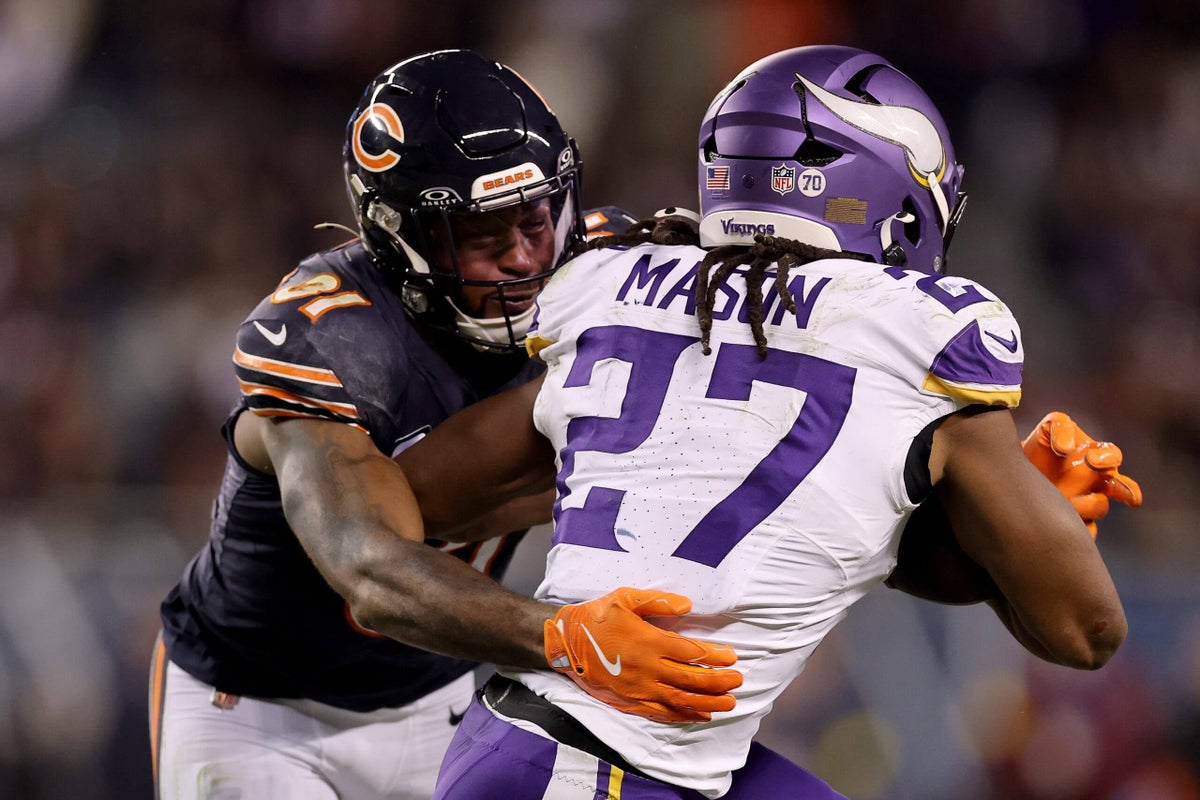
EAGAN, Minn. — The start of the fourth quarter was the definitive line of demarcation.
During the first three quarters of Monday night’s thrilling victory over the Chicago Bears, Minnesota Vikings fans watching their offense likely could have used a serving or two of Pepto-Bismol. But in the fourth quarter, the floodgates opened.
What changed? Well, the first play of the final stanza was a warning.
Searching for any semblance of rhythm, the Vikings lined up in 12 personnel, a heavy formation that is typically advantageous for the run game. Young quarterback J.J. McCarthy checked the play at the line of scrimmage. He then handed the ball off to running back Jordan Mason, who knifed his way through a crease on the offensive line and tumbled forward for 7 yards.
If that didn’t establish a tone, the ensuing play did.
Same personnel grouping. Different run scheme. This time, the Vikings had left guard Donovan Jackson and tight end T.J. Hockenson pull and lead the way. Mason waited patiently. He then exploded through a hole and bounced the run outside, rising and glancing over at the sideline with a facial expression that almost mirrored the famous Kylo Ren meme: More.
“It’s just so fun when you watch a guy run,” McCarthy said, “and you’re like, ‘Oh, that’s not a tackle.’ Before it happens.”
Would McCarthy have earned the chance to ignite Monday’s thrilling comeback if not for Mason’s burst? Probably not. Mason mowed over would-be tacklers. He generated yards that did not seem to exist. He was physical and efficient, the two traits coach Kevin O’Connell has long sought for a ground game that has never been his team’s calling card.
Mason finished with 68 rushing yards on 15 carries, a stat line that does not do justice to his overall impact. All it takes is a look under the hood at some of the more advanced metrics.
Only three NFL running backs posted a higher EPA per rush in Week 1, according to TruMedia: Breece Hall, Javonte Williams and Derrick Henry. Only Henry, Hall and Travis Etienne amassed a higher total of average yards created after contact than Mason. And only Henry, Hall, Etienne and Jacory Croskey-Merritt tallied more rushing yards over expected, according to Next Gen Stats.
“That efficiency set up a lot of things,” O’Connell said, “and it allowed us to make some plays in the pass game.”
The Vikings had a win probability of 7.7% with 1:34 remaining in the third quarter down 17-6, per @NextGenStats
They outscored the Bears 21-7 the rest of the way#SKOL pic.twitter.com/K1A55uSD09
— NFL+ (@NFLPlus) September 9, 2025
How effective was Mason? His 3.86 average yards after contact was the best mark a Vikings running back has posted since O’Connell was hired in 2022. Fellow back Aaron Jones came close to the figure last year against the Texans, but before that, you’d have to go back to Dalvin Cook in the 2022 season opener against the Green Bay Packers.
Any skepticism about running back value should account for this as an example. It’s not that the Vikings’ offensive line didn’t play a critical role in Mason’s performance — to the contrary. It’s more that this is what’s possible when you combine blocking effectiveness with a back who has the skills to hit above the football version of the Mendoza line.
Perhaps the wildest aspect of Mason’s night was how unsurprising it was. The Vikings acquired him in March from the San Francisco 49ers, believing that he was one of the more underrated runners in football. It’s worth noting that last year, Mason forced a missed tackle on 37.3 percent of his carries, the highest mark in the NFL. From Weeks 1 to 8, while 49ers starter Christian McCaffrey was injured, Mason’s 51 forced missed tackles led the league. The only two running backs with a higher average of rushing yards over expected per attempt were Henry and Saquon Barkley.
General manager Kwesi Adofo-Mensah didn’t hide his excitement over the Mason acquisition.
“We got to see him play against us, obviously, and that kind of impressed us,” Adofo-Mensah said this spring. “And obviously, I’ve been in that building and know how they evaluate running backs, and the tutelage he’ll get with a guy like (49ers running backs coach) Bobby Turner, who is, I think, the best in the league, maybe one of the best the sport has ever seen at that position.”
Neither the Vikings coaches nor teammates could contain their optimism once Mason arrived. But some important questions remained. How would the carries be split between him and Jones? Would the Vikings’ revamped offensive line do what they thought it could do? And could O’Connell stick with the run game for an extended period?
One game does not offer definitive answers to any of those, but there are hints. Mason received 30 snaps, while Jones played 28. A 50-50 split may eventually teeter more toward Mason, especially if he can pass-protect the way he did on McCarthy’s touchdown pass to Justin Jefferson. Minnesota’s offensive line had some leakage, especially at left tackle with fill-in Justin Skule, but he and Jackson executed vertical double-teams, providing optimism for when elite left tackle Christian Darrisaw returns from injury.
And, perhaps as interesting as anything else, O’Connell ran the ball on 53.1 percent of the team’s snaps Monday night, the second-highest rate in a game since he became the team’s head coach.
“Probably should’ve run the football more in the first half,” O’Connell said afterward, “and that’s where I’ve got to grow and get better as well. This is a total look inward at how we improve. And it starts with me. But I’m a big fan of not having that figure-it-outness on Tuesday morning.”
In the first three quarters, Mason ran the rock a total of six times. In the fourth quarter, Mason received nine carries. Coincidence? Not a chance.
Given the opportunity to be the bell cow the Vikings have not had in years, Mason delivered. He’ll have to for this team and this offense to be as good as it can be.
(Photo: Michael Reaves / Getty Images)