
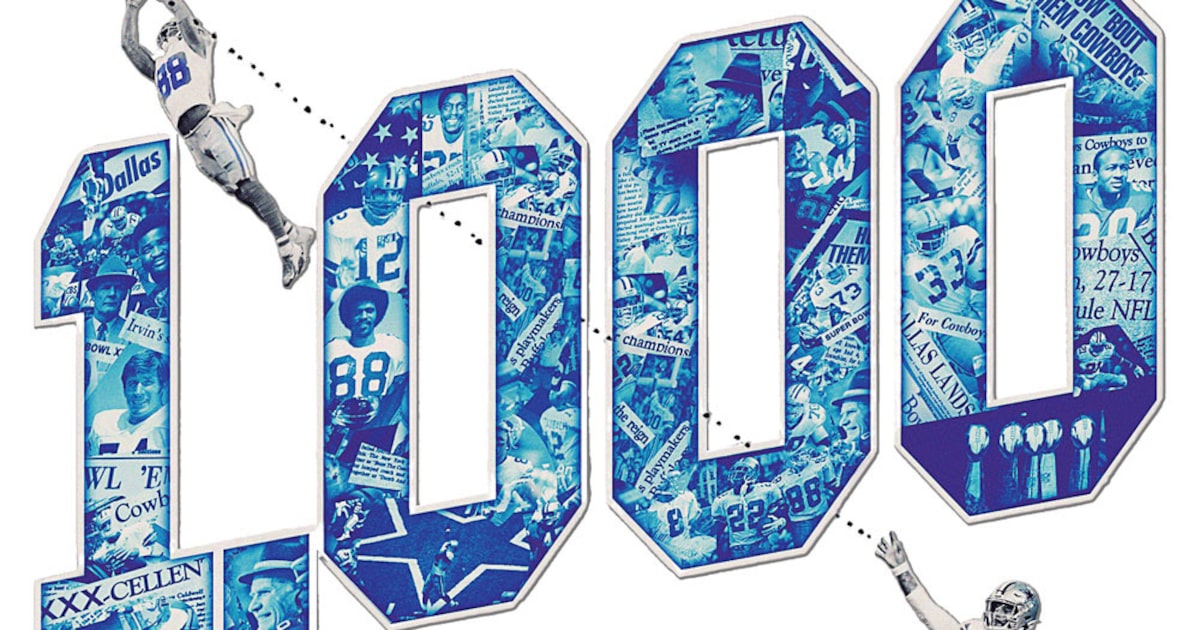
On Sunday at JerryWorld the Cowboys will play their 1,000th regular season game, a milestone that snuck up on me as milestones will, which the lovely wife would no doubt testify.
The anniversary gives the game a little oomph the Giants appear incapable of providing while furnishing us reason to pause and reflect.
Did you know Bobby Layne threw four touchdown passes in the Cowboys’ first game, a 35-28 loss to the Steelers?
Did you know Peyton Manning threw seven in the Cowboys’ 500th game, a 51-48 loss to the Broncos?
Cowboys
Come to think of it, maybe you should make a prop bet on Russell Wilson and the Giants, at that.
For some of us, anyway, there was actually life before the Cowboys, supplying us the necessary perspective going into this historic game to boil the world’s most valuable sports franchise down to two distinct periods in its evolution to soap opera status:
The Tom Landry/Tex Schramm/Gil Brandt foundation.
And the Jerry Jones era.
Or error, depending on your tolerance level.
Here’s perhaps the most startling aspect for us old-timers: Jerry has owned the Cowboys longer than Clint Murchison and Bum Bright combined, and it’s not particularly close at 36 years and counting. This remains a difficult thing to wrap your head around. One minute, some cornball you never heard of is crowing about “socks and jocks” and dispatching an icon; the next, Netflix spends eight episodes on a series that doesn’t even offer a reward at the end.
For better or worse — and I’m guessing the public sentiment leans toward the latter after the last 30 years — Jerry made the Cowboys over in his image. He took a brand Tex had meticulously curated over three decades — America’s Team, the cheerleaders, a star on the helmet — and ratcheted up the marketing aspect 10 times over. This is perhaps the most striking similarity between the opposing eras. Both men understood the power of branding better than anyone in the history of professional sports, which explains how an organization from outside New York, Los Angeles and Chicago managed what teams from those megamarkets couldn’t. Winning is vital, but both Tex and Jerry understood it takes more. The goal is to be ubiquitous.
And that’s pretty much where the similarities end.
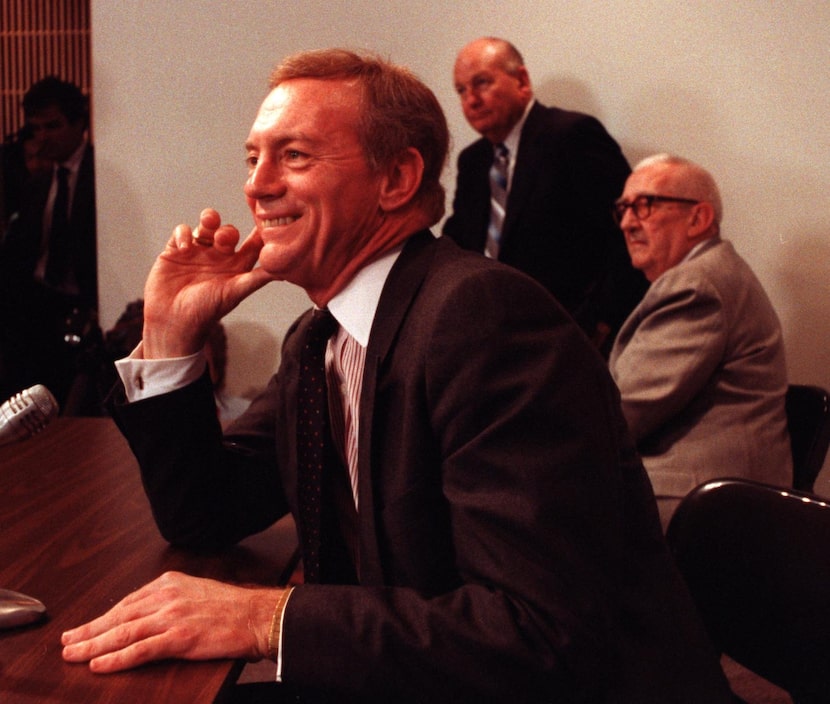
Jerry Jones takes a question from the press during a press conference announcing him as the new owner of The Cowboys. Tex Schramm and Bum Bright are in the background.
Richard Michael Pruitt – DMN
Tex’s chutzpah wasn’t inconsequential, but he understood the parameters of an organizational chart. Tom coached, Gil found talent and Clint financed everything while Tex handled the big picture. Each knew his limits. Doesn’t mean it was friction-free. No good organization is.
For the most part, Tom, Tex and Gil kept their egos from getting in the way of a good thing for nearly three decades, a considerable accomplishment.
You could accuse the Cowboys’ foundational era of taking too long to win a Super Bowl, then allowing it to grow a little long in the tooth. But, other than Tom’s fickle nature with quarterbacks, Pete Gent’s take in “North Dallas Forty” and the general perception of more than a little organizational arrogance, there wasn’t a lot to complain about.
Once the Cowboys got going, it looked like they’d never stop.
Twenty winning seasons in a row from 1966-85, including 13 divisional titles and a dozen appearances in conference championship games.
The longest winning streak in the 36-year Jerry era?
Six.
Division titles?
Thirteen.
Conference title games?
Four.
One guess which coach collected most of the above.
Jerry holds the edge in Lombardi Trophies, 3-2, but otherwise, the former era lapped the current. The Cowboys posted a 19-13 record in the playoffs over their first three decades. After getting off to a 12-5 mark in the ‘90s, Jerry’s teams have gone 5-13 this century.
The evidence above suggests why so many of Jerry’s detractors believe the Cowboys will never win another Super Bowl as long as he’s in charge. Thirty years is a long time to wait, and Cowboys fans were never a patient bunch. The Cotton Bowl crowds booed Don Meredith into an early retirement and smirked along with smart-aleck sportswriters who crowned the Cowboys “Next Year’s Champions.”
Jerry’s detractors say he cares more about money than winning, but the charge fails on two counts. First, he wants to prove he can win a Lombardi without Jimmy Johnson’s fingerprints all over it. And the simple, unassailable fact is the more he wins, the richer he gets.
As noted previously, both Tex and Jerry understood the power of the brand, but here’s where Jerry one-upped his predecessor: He super-sized it. His thirst for promoting the organization’s image is not only unquenchable, it’s the greatest public relations story in sports. Maybe ever. If you don’t believe that, let me tell you a quick story.
One of Jerry’s heroes was Al Davis, another owner who shook up the status quo. Except Davis was a true genius, the only person in NFL history to serve as a scout, assistant general manager, GM, assistant coach, head coach, commissioner and owner. Occasionally three at once. Like Jerry, Davis won three Super Bowls and built his Raiders into a counter-culture fixture. But, after losing the Super Bowl following the 2002 season, the Raiders fell into a long slump. By the time of his death in 2011 at 82, Davis was considered washed-up, outdated, an anachronism.
The Cowboys haven’t been to a Super Bowl in 30 years, yet Jerry, who turns 83 next month, remains as culturally relevant as the day he grabbed a revered organization by the throat and shook it for all its worth. The secret, as he noted in the Netflix series that championed him, was making the Cowboys “a soap opera 365 days a year.” Even Tex didn’t think of that, God bless him.
Twitter/X: @KSherringtonDMN
Find more Cowboys coverage from The Dallas Morning News here.