
ORCHARD PARK — There’s a pattern within Sean McDermott’s defensive strategy.
The Buffalo Bills want smart players who won’t get caught out of position often. It’s a scheme designed to force opponents to play conservatively and capitalize when quarterbacks get greedy. They are willing to trade two 10-yard gains to prevent a 40-yarder.
It’s why the Bills are consistently among the NFL leaders in fewest 40-yard passing plays allowed and most turnovers forced. But it’s also why they have been susceptible to getting gashed against the run on occasion.
Ten times since McDermott became head coach in 2017 have the Bills allowed 200 yards rushing, including twice to the Baltimore Ravens in less than a calendar year. At times it seemed the Bills were never going to stop running back Derrick Henry, but reality was a bit different.
Twelve of Baltimore’s 29 rushing attempts went 3 yards or less. The problem was that nine went for 10 yards or more, resulting in allowing 238 on 8.2 yards per carry by the end of the game.
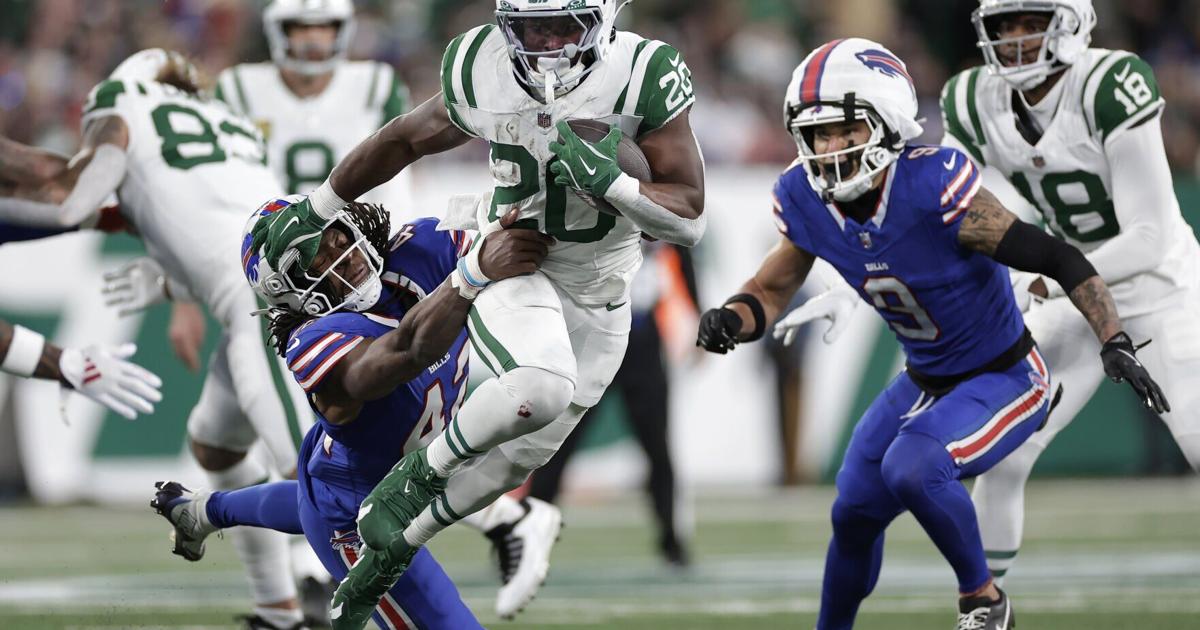
Now the Bills are tasked to stop a New York Jets offense that has a similar quarterback-running back dynamic with Justin Fields and Breece Hall. No team in the NFL matched New York’s 39 rushing attempts Week 1.
And the Bills have to stop the Jets without defensive tackle Ed Oliver — who had three tackles for a loss — with whom they are 2-5 in games he doesn’t play. But when the Bills do get run over, they usually rebound the next week.
After allowing 200 yards on the ground, the Bills have averaged 103 on 3.9 yards per carry in the ensuing week. That includes six games in which they held opponents to fewer than 100 yards.
“We celebrate the good things and are very firm with the things that need to be corrected,” Bills defensive coordinator Bobby Babich said. “… There was a lot of good (Sunday), but the in between wasn’t good and we need to get that corrected quickly.”
A big difference from the Ravens offense is that the Jets aren’t as dynamic in the passing game. Not only is Fields not the passer Lamar Jackson is, the Jets don’t have the same caliber weapons outside, except for receiver Garrett Wilson, who has quietly become one of the best in the league.
The Ravens run a unique offense by NFL standards, but the Jets showed similar personnel usage. Baltimore was without fullback Patrick Ricard so it used a third tight end more often and used at least two tight ends on 25 of 50 plays.
The Jets used two tight ends on 20 of 62 plays, the 10th-highest usage rate in the league during week one and then used two running backs on another six plays. And the Bills feel like seeing a similar brand of football two weeks in a row is helpful.
“A few different concepts and schematic stuff, but similar themes,” Bills linebacker Terrel Bernard said. “So it’s helpful to be able to learn from what we did right, what we did wrong last week. And really just learn and ground and build after that.”
The days of having a statuesque quarterback in the NFL are finished, but many teams are still reluctant to install designed quarterback runs as a major part of the offensive strategy. Of the 166 rushing attempts by quarterbacks in Week 1, 55.4% came on scrambles.
Fields, however, is a quarterback whose running ability is built into the offense and it’s been that way from his 38 starts in three seasons after being a first-round pick in Chicago and his six starts in Pittsburgh last season. Nearly 42% of Fields’ 418 rushing attempts during his first four seasons were designed calls.
That trend continued in his first game with the Jets, as Fields ran the ball 12 times for 48 yards. His 12 rushing attempts were second among quarterbacks to Josh Allen’s 14, while he tied Allen for the most designed runs (9).
The Bills have typically fared well against running quarterbacks under McDermott, but the attacking nature of their defense is sometimes costly. Just like the Bills have been attacked on screens because of their penetrating defensive line, quarterbacks have squirted free on read-option plays.
Jackson ran for 70 yards against the Bills and 51 came on designed runs. Oftentimes it wasn’t because they were fooled by the fake handoff, but because the backside defensive end drifted too far inside and Jackson was able to easily get around the edge.
“You want to attack, attack, attack,” Bills defensive end Javon Solomon said. “But you have to trust your eyes, you have to trust the call so if we got something in the call telling us what to do, we just have to make sure we match it. As much as we want to hit (the quarterback), there comes a time when you just have to be able to do your job.”
And when it comes to containing Hall — who has a pair of 100-yard games against the Bills at MetLife — it’s making sure defenders have their eyes in the right location. Too often did linebackers overrun the play or safeties took a poor angle in run support against the Ravens.
Too often over the last few seasons has the defensive line strung out a run to the sideline and the running back slips through a crevice because a linebacker or safety isn’t there to fill the hole and make a tackle. Ninety-seven of Henry’s 169 yards came from bouncing runs off the right side of the line, while Hall had an 83-yard run around the right end in the 2023 season opener at MetLife and a 42-yarder around left end last year.
Sometimes those runs occur because Bernard and weakside linebacker Matt Milano are under 230 pounds and nickelback Taron Johnson is 192 and can get mauled by offensive linemen one-on-one. The Bills, who have played at least five defensive backs on 97% of the snaps the last two years, brought in a third linebacker to combat heavy personnel on 35% of the snaps Week 1.
“The more you increase the number of people not doing their jobs, the worse the result’s going to be,” Babich said. “If we can get 11 people doing their jobs and understanding what the strengths and weaknesses of each (offense) are play-in and play-out, we’ll be in pretty good job. But those plays that you saw in between that didn’t look good, that’s usually a result of that.”