
Imagine a world where a football game is played out on a chessboard. Or, better yet, think back to the old Tudor Electric Football, which allowed Baby Boomers the freedom (and noisy frustration) to live out their gridiron (albeit meticulous) dreams.
Save for the intensely detailed rules, the basic premise revolves around positioning. Experts of the game can prepare and set up their players as best they can, yet the randomness of electric football reigns supreme.
Sometimes, a one-on-one battle produces an unexpected result. This is no different from the general idea of actual football, as one-on-one battles often play out unexpectedly.
Has this randomness been torched?
It’s a whole new ball game
There isn’t one football fan who would argue that physicality hasn’t been somewhat removed from the National Football League. While, at its core, football will forever feature physical elements, the way in which things have changed allows for a fresh mindset.
It’s a two-pronged change, really, that has drastically altered the game for the better part of the last two decades:
Rule changes to decrease the level of physicality, courtesy of the understandably worrisome concussion/player health concern.
Rule changes to increase offensive production, courtesy of wanting more excitement.
Decreasing the physicality decreases the overall randomness of the chess piece’s movement.
In the old days, offensive coordinators dealt with much more randomness in one-on-one situations. These days, with decreased physicality that emphasizes the more predictable speed element, specific offensive schemes can work much more consistently—no matter the names on the back of the uniforms.
It roughly began when Bill Belichick’s New England Patriots mugged Peyton Manning’s receivers in the playoffs. Though not immediate, the NFL ultimately emphasized illegal contact and defensive holding, which propelled the 2009 season to a new record of 335.1 offensive yards per game.
In fact, the top 14 offensive-producing NFL years feature the last 14 chronological seasons, with 2020’s mark of 359.0 yards per game reigning supreme.
Around the time Rex Ryan was doing his ground-and-pound, blitz-the-quarterback-relentlessly thing with the New York Jets, the rules to drastically decrease the game’s physicality took hold. Unbelievably, the party responsible for pushing us to this modern look is the Miami Dolphins.
Painted into a corner against Belichick’s New England Patriots, the Fins unleashed the Wildcat, led by Ronnie Brown and Rickey Williams. Suddenly, the NFL looked around, wondering what this was.
“Wait, so you’re saying my team could implement this while saving an extra blocker in the rushing game?” offensive coordinators asked themselves.
Yes. And that’s precisely what transpired. Those located around these parts remember those Brad Smith packages.
The Wildcat allowed offenses to deploy an extra blocker—considering the quarterback’s uselessness had been removed—and forced east-west EDGE pressure on the defense. One thing led to another, and Robert Griffin III, Tim Tebow, and Colin Kaepernick began leading the read-option revolution in the early 2010s.
Long story short, the New York Jets are the latest example to hop on this craze—the running-quarterback evolution that head coach Aaron Glenn calculated to be best for his franchise.
The Jets join the party
Make no mistake about it: The 2025 New York Jets deploy a cheat-code offense.
Thanks to Justin Fields and Aaron Glenn’s vision, the Jets’ offense is akin to that of the Baltimore Ravens and Philadelphia Eagles. While few will confuse Fields with Lamar Jackson or Jalen Hurts at this point, the idea that New York’s offense isn’t in line with Baltimore’s or Philly’s doesn’t wash.
It’s simple, really: Glenn understands the modern NFL. By choosing Fields, he built his program around the idea that his offense would have a head start in every game.
By simply placing Fields’s athleticism on the field, defenses would be forced to remove players from run fits and pass coverages. That’s just the way it is. He chose to devalue the quarterback position through pocket passing and comeback ability, while simultaneously focusing on the meat and potatoes of football: the trenches.
Instead of relying on a pre-snap maestro like Aaron Rodgers—who did a masterful job against the Jets in Week 1—he left the bulk of the offense’s control in the coaching staff’s hands. While yes, this offense can run with several athletic quarterbacks, the coaching staff better be superb.
Fortunately for Glenn’s Jets, offensive coordinator Tanner Engstrand and offensive line coach Steve Heiden know precisely what they’re doing. The Jets’ first play of the season featured that idea.
Rushing advantages
Deception
The season’s first play went in the books as an 18-yard rip by Breece Hall. Better yet, it goes down in the film as a tremendous example of what this New York Jets’ rushing attack is all about.
Not only does right guard Joe Tippmann go beast mode while the entire offensive line dominates the trenches (pushing the Pittsburgh Steelers’ front back a couple of yards while washing down the line), but the play also showcases the Jets’ deceptive ways.
This is not a power-rushing scheme or bully ball. It’s about strategic deception in every way.
Take note of the right side of the offense, how Garrett Wilson and Mason Taylor move. Instead of mixing it up in the rushing game, both players sell the pass by getting out into routes.
As long as they sell it, it’s a beautiful thing. Not only does it move defenders further away from the play, but it also gives the entire defense another element to consider on the next play.
Why? Well …
It’s all about the short-passing game and RPO (run-pass option) opportunities.
Short-passing game wherewithal (off RPO)
Sure, the NFL is still a “passing league,” but how many are aware of how different today’s passing league actually is? The days of run, run, play-action deep shot are over.
The NFL’s single-season record for lowest pass-per-completion is a paltry 10.9. Amazingly, three seasons have produced that record, creating a three-way tie.
Would you like to guess which seasons those three are?
The last three NFL seasons have produced a historical low of 10.9 yards per completion. While the NFL is still undoubtedly a “passing league” purely by technicality, it’s a drastically different type of passing league by nature.
What began with the Wildcat and ultimately morphed into the read-option offense has pushed us into the added element of the RPO (run-pass option). Older heads didn’t witness Randall Cunningham running zone reads off the EDGE in the late 1980s due to the game’s physical nature.
In other words, Lawrence Taylor would have sent him directly to the nearest hospital. (Hey, just ask Justin Fields after the play that saw him drilled by T.J. Watt in this much less physical league.)
The following play is an example of an RPO:
Fields has the option to hand it off to Breece on the zone concept to the right, hit Arian Smith on the bubble screen to the right, or find Garrett Wilson on the speed out at the sticks.
Combining each of these elements makes it a near-impossible task for the defense.
Read-option advantages
Speaking of deception and the RPO, let us never forget about the run-pass option’s little brother: the read-option (or zone-read when running within a zone concept).
First and foremost, understanding what the read-option does is the most pertinent. Not only does it give the offense an extra run option on the play—the quarterback going against the grain, usually to the EDGE—but it naturally widens the defense front, which allows more room between the tackles.
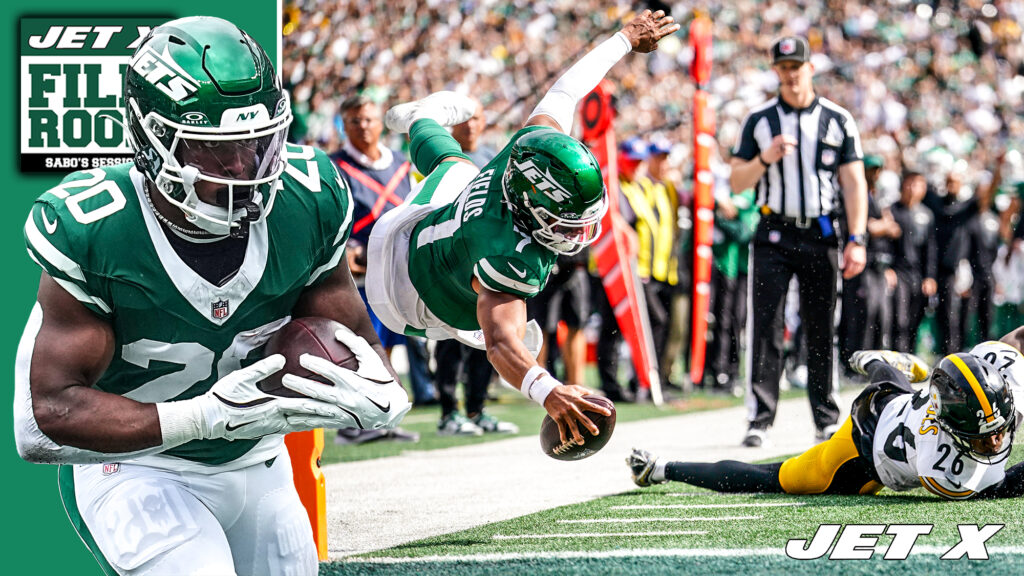
Braleon Allen’s touchdown is a great example of just that. Despite this play not representing an RPO example, the EDGE defenders are naturally widened, allowing the classical rushing attack more room to operate:
Moreover, if the defense decides to switch option responsibilities, that could work to the offense’s advantage.
This Hall rush shows T.J. Watt chasing him down from the backside, while Patrick Queen is the man who’s forced to remove himself from the play. With Watt having the freedom to crash down the line and chase, Queen must widen to take Fields if he pulls the ball.
Just when the defensive coordinator thought he had tightened everything up, his defense simply could not keep up with the quarterback.
On this play, Watt does a generally acceptable job as the EDGE defender, but Fields torches him to the outside:
Kudos to the coaching job on this play. Mason Taylor’s first step to the inside may have been just enough to get Watt to stick his nose to the interior.
Whether it’s a quarterback draw or a straight-ahead sneak, any designed quarterback rush attempt provides the offense with an extra blocker.
Harkening back to the start of this wild ride, per the Wildcat, not wasting the hand-off man in the rushing game is a significant advantage. Jets fans will understand this concept the more the 2025 season chugs along.
The following example isn’t just a designed quarterback draw, but it’s also an RPO:
Fields has the option to throw the swing screen to his right or take it right up the gut. If the offensive line does its job (inside-out), all Fields has to do is read the 0-tech’s hat.
Here, the nose tackle moves to Josh Myers’s right, so Fields takes off through the right-side A-gap.
Passing advantages
Pass-rushing responsibility
The most significant advantage in the passing game is realized when the defense deploys its pass rush. Not even the greatest all-time pass rushers can be let loose against this type of offense.
If Reggie White decided to freelance his one-on-one matchup against the tackle, he would be letting down his team badly.
Thanks to the quarterback’s legs, the pass rush must remain responsible. The EDGE rushers cannot get too far downhill and can never get beyond the quarterback. A more physical rush must commence by squeezing at a 45-degree angle.
This completion to Tyler Johnson features exactly that idea:
Scrambling, off-schedule
When an EDGE rusher does venture too far downhill, forget about it:
On this play, Alex Highsmith screws the pooch. He tries to beat Olu Fashanu to the outside, so the Penn State stalwart easily guides him into deeper muck.
Fields feels this and does his scrambling thing.
He ultimately finds Wilson, who almost hits pay dirt.
Lighter coverage to spy
By way of mere desperation, coverages are lighter against a Fields-led scheme (and thus, this Jets offense).
Defensive coordinators must remove defenders from coverage to spy on the quarterback. While defenses are still trying to find new hybrid ways to do this, it’s still tough sledding.
This example shows Pittsburgh sends a blitz while allowing hybrid spies at the second level to take form. This leaves the coverage incredibly light down the field, which Fields and Wilson use to their advantage.
Shots against a heavy box
Lastly, never compare this scheme to the old Rex Ryan ground-and-pound days. When defenses loaded the box against Mark Sanchez, the Jets’ offense had little to work with.
The team’s current scheme not only forces defenses to load the box but also holds the attention of the east-west defenders—thanks to Fields’s legs.
If Justin Fields can grow as a passer, as seen in the following breakdown, Tanner Engstrand will have everything at his disposal.
Granted, this is a relatively easy read and pass for an NFL quarterback. Completing a big chunk on a Yankee concept against Cover 1 should be a walk in the park.
However, the idea that he recognized the coverage pre-snap and got his team into the proper position is everything.
Full video breakdown
The full video breakdown can be seen below or on Jets X-Factor’s official YouTube channel.
It contains 12 plays from the New York Jets’ Week 1 loss to the Pittsburgh Steelers, and runs for over an hour.