
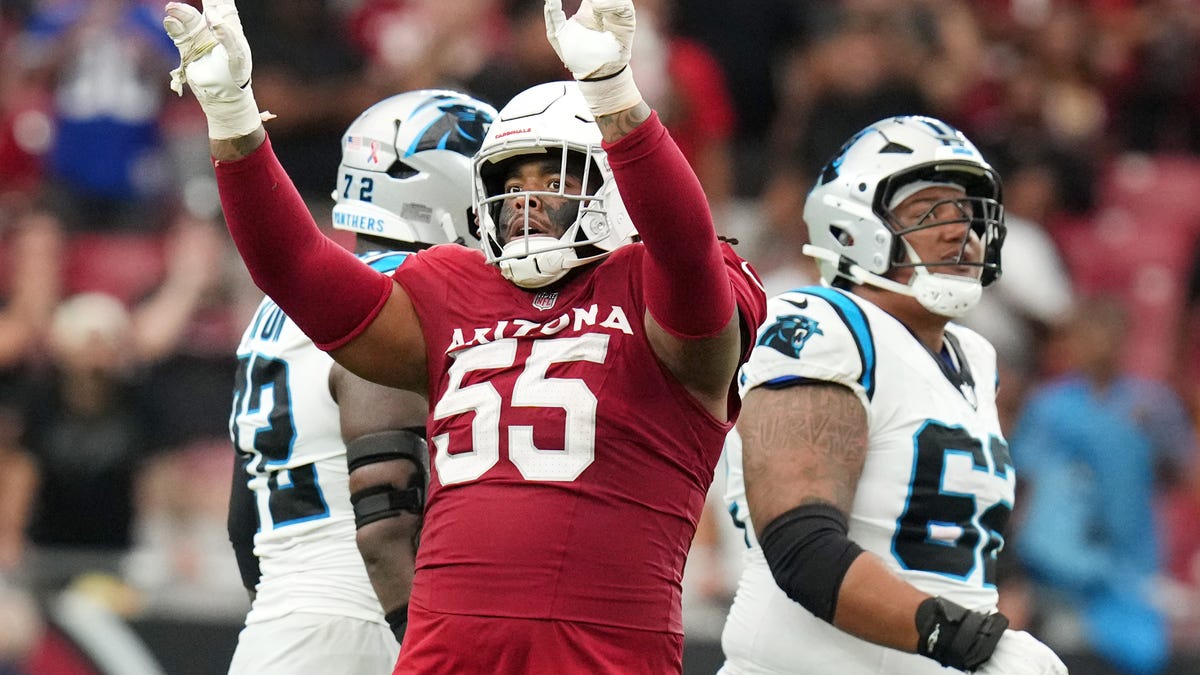
In the end, the Arizona Cardinals needed their defense one more time.
With the game on the line, they had the Carolina Panthers pinned back into a fourth-and-15. It’s the type of situation that calls for a defense to bring four pass rushers and drop seven players into coverage. It’s the type of situation that they spent all offseason building for.
A year ago, the Cardinals could not consistently generate pressure with four pass rushers. For all the results they were able to produce with defensive coordinator Nick Rallis’ creative schemes, this was a limiting factor. Sometimes, a defense just needs its players to make plays.
“Any time you can affect the quarterback with four guys, that’s awesome,” Rallis said back in training camp. “Because you can do things you want to do in coverage.”
Against the Panthers, when it mattered most, that’s exactly what happened.
On that crucial fourth down, Calais Campbell burst off the line of scrimmage, powered into the offensive line, and shoved right tackle Taylor Moton aside. Before Bryce Young had time to scan his options downfield, Campbell was in the backfield, ripping him to the ground and vanquishing the Panthers’ hopes of a miraculous comeback.
The Cardinals’ 27-22 win was not, in totality, a clean game from their defense. Up 27-3, they allowed three consecutive touchdown drives, each of at least 12 plays and 76 yards.
“We didn’t do a good enough job,” Jonathan Gannon said afterward, as frustrated as he ever will be after a win.
But despite their near collapse in the second half, the Cardinals showed what the vision of their revamped defense looks like — although they now face significant health concerns in their secondary after all three starting cornerbacks exited with injuries against Carolina.
In Week 1, against the New Orleans Saints, the Cardinals’ strategy was one of containment. Saints quarterback Spencer Rattler wanted to throw fast, so the Cardinals focused on preventing big plays, forcing him to work his way down the field with minimal gains. It worked, but it was not as if their defense grabbed the game by the throat. They managed just one sack and did not force a single turnover.
Week 2 was a different story. In the first half — and again on the final drive — the Cardinals defense took over, with game-altering play after game-altering play. This time, they finished with three sacks and two takeaways — numbers that would put them near the top of the league if repeated over a full season.
“I mean, we started the game off with a sack fumble touchdown,” Campbell said, laughing.
That play, which came on a third-and-7, epitomized the Cardinals’ new marriage of talent and schematic creativity.
Rallis showed seven rushers pre-snap, complicating the picture for Young and the Panthers’ offensive line. At the snap, two of those players dropped into coverage, including edge rusher Baron Browning on the right side, which is where the offensive line had its focus.
Meanwhile, Josh Sweat and Zaven Collins aligned to the left, putting two of the Cardinals’ most dangerous edge rushers next to each other. With the offensive line confused by the scheme, those two went to work, as Sweat came free up the middle on a stunt.
Sweat, who the Cardinals paid $76 million this offseason to be their top pass rusher, isn’t going to miss that type of opportunity. He got to Young and ripped the ball out with his right hand, setting up Collins for the fumble recovery touchdown.
“(Young) ain’t see me on that one,” Sweat said. “He just started drifting. I was like, bro, how do you not see me right there? But hey, got it.”
The Panthers’ next drive ended similarly.
Facing third-and-11, the Cardinals again showed seven rushers. Again, they dropped two into coverage, including Browning, whose versatility has become a key element of Rallis’ scheme. Again, that confusion freed up a free rusher.
This time, the free rusher was linebacker Mack Wilson Sr., who hit Young as he threw, popping the ball up for Browning to secure an easy interception.
“With me, Zaven and the way (Nick Rallis) moves us around, it creates those mismatches,” Browning said. “And the way we have other guys mugged up, they might not know where to slide the protection. So shout out Nick.”
Even in a win that soon turned ugly, those moments were encouraging. They were a glimpse into a defense that can become a game-changing unit, one that plays on the front foot and dictates proceedings on its terms.
That, after all, was the game plan against the Panthers. The Cardinals were wary of Young’s threat as a passer after he diced them apart last December. They knew they had to do something to make him uncomfortable.
“If you contain rush, all you’re gonna really watch him do is complete passes,” Sweat said. “As you can see, he can throw the ball. … So we just had a mentality, we’ve just gotta go get him. Get him off his spot and make him make a play.”
That aggression disappeared in the second half, as the Cardinals conservatively focused on protecting their lead. It was nearly their undoing. But in the end, they did just enough to win — and showed a tantalizing glimpse of their ultimate ceiling in the process.