
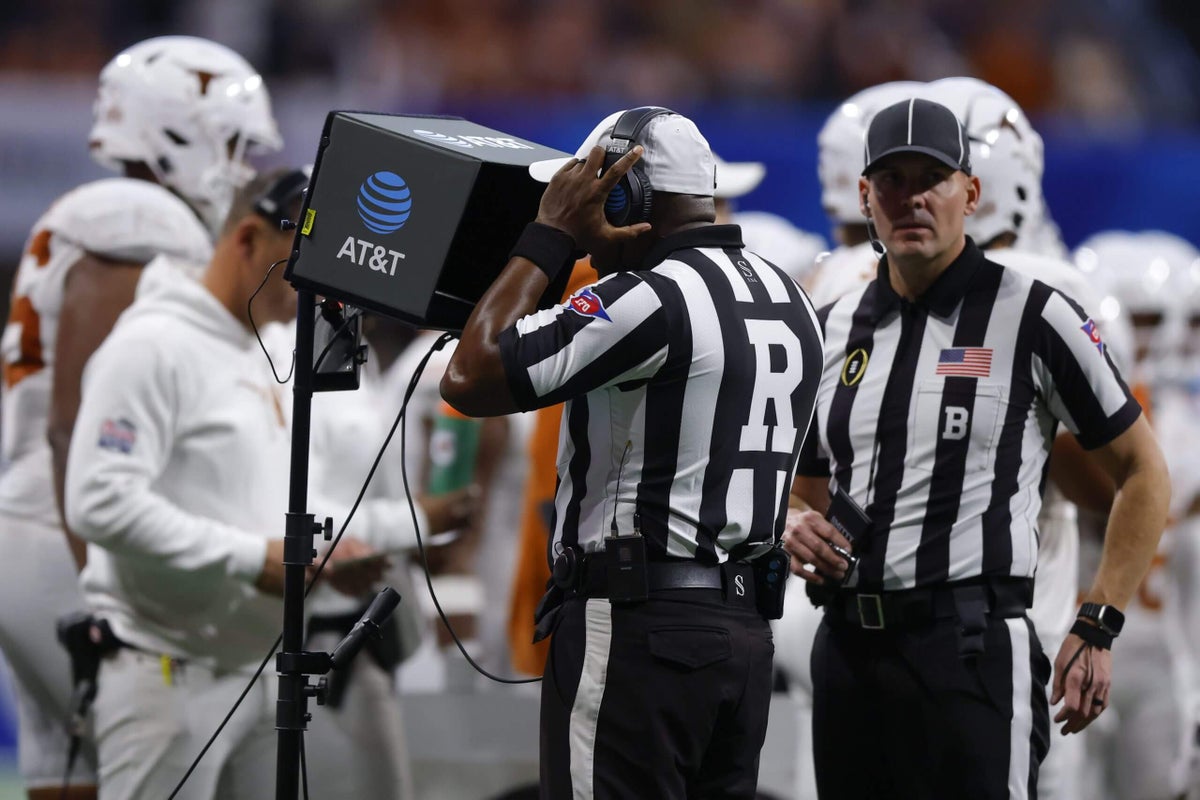
When you have been polluting the Internet with words as long as I have, you’re going to have some real groaners in your archive. I once argued that Gilbert Arenas would prove a more culturally relevant athlete than LeBron James (this turned out to be incorrect). One of the dumber predictions I ever made, though, was believing that when instant replay reviews were widely adapted, it would make life easier for referees and umpires.
This prediction was logical when I, and many others, made it. The whole point of instant replay was to give us concrete answers that were previously unavailable, to correct history’s mistakes before they were made — to save future Don Denkingers and Jim Joyces from being haunted forever. If a referee or an umpire made a bad call, well, no sweat: We have 80 high-definition cameras we can slow down to 240 frames per second that can tell us, definitively, what the human eye cannot. This is what replay was for: To answer the unanswerable. To get it right.
What we’ve learned in the age of replay, though, is that technology cannot give us the definite answer that we wanted, that there is nuance and ambiguity no matter how powerful a camera we might have at our disposal. In many ways, we even know less than we once did. Before instant replay, the question “What is a catch?” was a phrase that had never once entered my brain. I knew what a catch was, you knew what a catch was, dogs knew what a catch was. But when you can slow a play down to the millisecond, when you can see every blade of grass and every pore of every player’s fingertips, you start questioning the very nature of reality. By showing us more, we began to know less.
But we couldn’t be mad at the machines, or at least we couldn’t yell at them in any satisfying fashion. They can’t hear you, and they don’t care. (To paraphrase the late comedian Mitch Hedberg, no matter how good you are at tennis, you’ll never be as good as a wall.) So replay’s deficiencies ended up rebounding back on human beings. It’s a lot more fun to yell at a human being.
People have been watching sports for centuries, but the infuriating experience of living through a replay review is a relatively new fan sensation. We go through it all day, every Saturday:
See a close play.
Watch the referee make a half-hearted, unassured call (because they know a review is coming anyway).
Sit through several minutes of replays (rather than watching live actual players make live actual plays).
Conclude, after watching the play 40 times from five angles, that replay has finally given the definitive answer it was created to provide.
Scream when the replay officials make the opposite call.
I mean, this happens constantly, right? We only have so many minutes on this earth, and when I someday lie on my deathbed, I will do my best not to think of how many I spent waiting for replay decisions. It makes us madder than just getting the call wrong in the first place would have been. And we’ve got to be mad at someone. So we get mad at the refs.
To be clear: Getting mad at referees is a god-given right of any fan. One might even call it a sacred duty. Sports fans have been shrieking at the person in charge of deciding who is a competition’s winner since Thagg and Gruk were bonking each other on the head with rocks. I mean, “Casey at the Bat” features the phrase “Kill the Umpire!”, and that poem was written before basketball was invented.
When I am mad about my team not doing something I hoped it would do, I need an emotional release, because that’s what sports are. (If we were governed by logic rather than emotion, we’d be doing something other than watching sports. What fun would that be?) The easiest person to yell at is the ref; that is, honestly, a large part of their job. There isn’t a referee that doesn’t understand this, and I’d argue the worst attribute a ref or umpire can have is an inability to deal with it. If you can’t handle getting yelled at, well, may I recommend squash, or perhaps Mahjongg, or simply not leaving the house altogether?
But it is still worth remembering that these are your fellow citizens in these jobs, citizens who love the same sport you love. To be as close to it as possible, they actively choose, every week, to be screamed at and blamed for everything. It is easy to forget this humanity because part of any good referee’s code is to try to be invisible and anonymous. The maxim has always been that if you don’t notice a referee, they’re doing a good job.
The problem with this maxim is when you do notice a referee, you have little context with which to judge them; all you know about them is that they just screwed you and therefore must be destroyed. This is another thing that replay has altered. When we reduce officiating to It Must Find The Obvious Correct Answer, if we do not get what we believe to be the correct answer (or just the answer we had been wanting), our knee-jerk, emotional reaction is to assign nefariousness. And after sitting through replay after endless replay, waiting for someone we don’t know to pass a judgment we don’t understand, why wouldn’t we? What other explanation have you given us? We don’t even know who you are! Kill the umpire!
But last weekend, I have to say: I think we might have all stumbled on a path forward that might lead us, if not necessarily out of this vicious cycle, at least toward a more balanced future. The ACC has begun mic’ing the referees and the replay command center during reviews. (It should be said that the XFL did this first.)
If you haven’t seen the video yet, it’s well worth watching:
This is one of the coolest features that I have ever seen on a football broadcast
— Jake Marsh (@JakeMarsh18) September 13, 2025
I have difficulty coming up with an argument against this being adopted across the sport. Not only is it an obvious improvement over broadcasters simply guessing what the replay officials are thinking, but it is actively fun to listen to them walk their way through it. It provides transparency that’s instantly relatable. What’s striking about the conversation the referees and replay officials are having in the above clip is that it’s essentially the same conversation I was having with my friends when we were watching that play.
“He’s got a body part down, but the ball’s pinned against his lower leg there,” the replay official says, as the field official asks him to keep the video rolling. “See? He’s still fumbling with that ball.” The official then requests a higher angle, which seems to further confirm the judgment: “No control, incomplete pass.”
And that was the call. To my eyes, it’s the correct one. You might disagree. If you’re a Clemson fan, you really might disagree. That is your right. But what none of us can say is that the call came from a machine, or some disembodied drone, or someone screaming, “Wreck ’em, Tech!” as he tilts the scales for his Yellow Jackets. There is a human being, talking through the decision, thinking about it, trying to come up with the best answer. Not necessarily the correct answer, because sometimes, there isn’t one. But the best one. That is all you can ask of someone. Even if you think they’re wrong.
If I’m a Clemson fan, I can still be angry about the result of the play. But what I can’t do is claim ignorance or bias. I don’t have to wonder about nefarious, mysterious motives because they just told me what they were thinking and why they made the decision. I can’t come up with a conspiracy theory because I just watched them come to a decision. It’s not a conspiracy if I’m watching you do it. Or at least it’s a pretty bad one.
Mic’ing up the officials during a replay gets us closer to what we should have always been expecting replay reviews to be in the first place: Not as an all-knowing arbiter of right and wrong, but as a tool that helps flawed, confused humans make the best decisions they can make in a flawed, confusing world. I’d argue it solves almost all the problems with instant replay in one swoop: It demystifies it, it gives us insight, it shows us the human beings who might otherwise prefer to remain anonymous, it provides us something to do while waiting for a decision to be made and it still allows us to vent our spleens and scream bloody murder if we’re upset with the ultimate call that’s made.
It’s logical and emotional, and, in the most basic sense, it simply gives you more information than you had before. What you do with that information, well, that’s up to you.
(Photo: Tyler Kaufman / Getty Images)