
By Sam Khan Jr., Antonio Morales and Manny Navarro
Roster movement is almost a year-round affair in college football, thanks to the institution of the transfer portal and introduction of player compensation. In our best effort to keep you up to date on the rumblings around the country, here is the latest edition of The Athletic’s Portal Buzz.
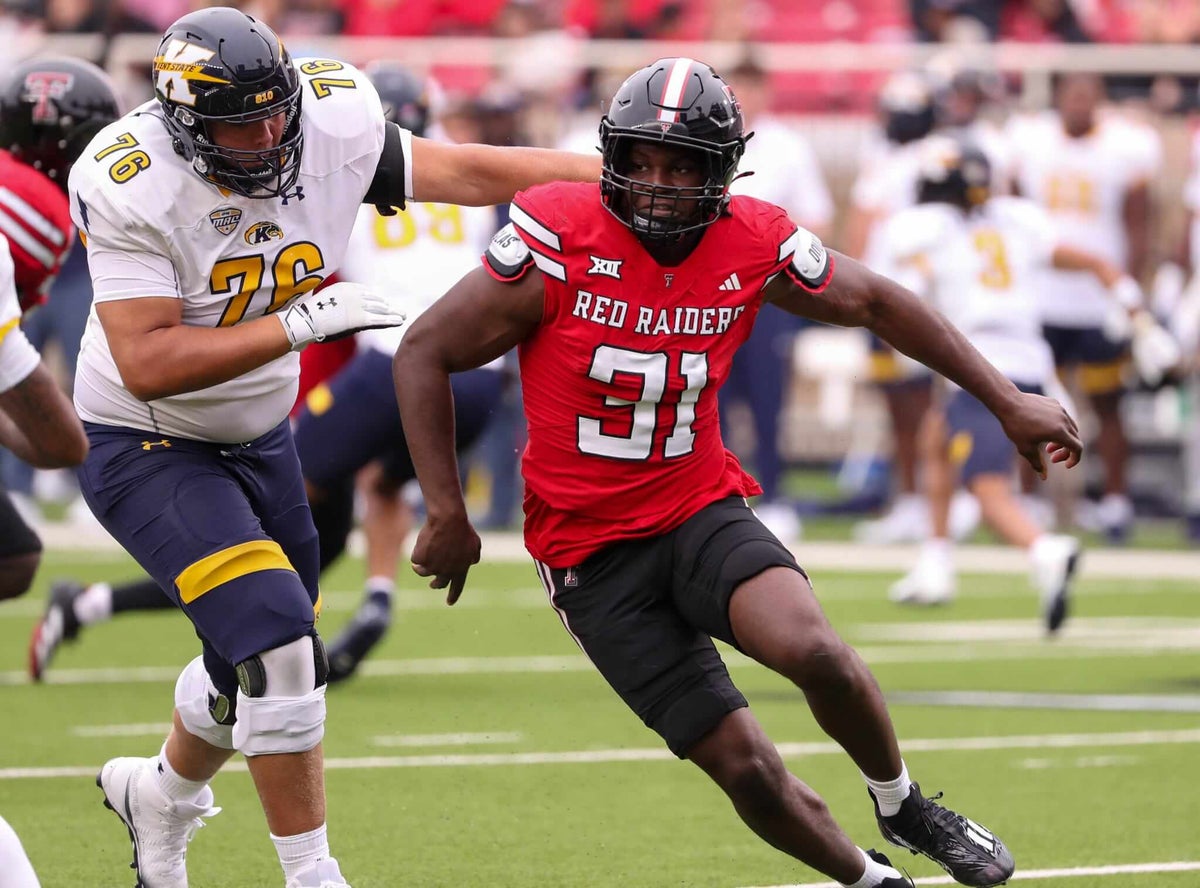
Texas Tech’s D-line investment
In college football, much like the NFL, the highest-paid players are typically the quarterbacks. But Saturday’s “Big Noon Kickoff” showdown between Big 12 contenders Texas Tech and Utah bucks that trend because of what the Red Raiders have invested at another premium position: the defensive line.
Texas Tech paid a pretty penny — more than $5 million combined — to acquire its defensive line transfers, which will be tasked with corralling Utah quarterback Devon Dampier, one of the season’s top transfer success stories.
As part of Texas Tech’s “open checkbook” offseason, in which the Red Raiders spent more than $12 million on 21 transfers as part of a roughly $25 million roster budget, many of the portal dollars were spent on the guys who get after opposing quarterbacks.
Unsurprisingly, all five D-line transfers — edge rushers David Bailey (Stanford) and Romello Height (Georgia Tech) and defensive tackles Lee Hunter (UCF), Skyler Gill-Howard (Northern Illinois) and A.J. Holmes (Houston) — have seen the most snaps up front this season. Bailey and Height have combined for 19 quarterback hurries and five sacks in their 80-plus snaps. Holmes, Hunter and Gill-Howard have combined for 26 tackles and 4.5 tackles for loss in their 60-plus snaps so far.
Hunter, a 2024 All-Big 12 selection, was one of the first dominoes to fall in Tech’s successful winter portal run. The Red Raiders offered Hunter roughly $1.6 million to secure his commitment, a source briefed on the discussions confirmed.
In the spring, a second source said that the Red Raiders went over $2 million to acquire Bailey, who transferred out of Stanford after Troy Taylor was fired. ESPN recently reported that Height is earning more than $1 million, and CBS Sports reported that Gill-Howard earned a deal worth $850,000, which a third source briefed on the deal confirmed. That’s at least $5.45 million between the quartet, not including what Holmes was offered.
#TexasTech EDGE David Bailey added 6 more pressures to his 16 total on the season. He’s trending towards a 30% pressure rate, which would put him in RARE company.
🎥 Get off, hand swipe, quick bend to win in an instant
HUGE test and must-watch matchup vs. Utah’s elite OTs.… pic.twitter.com/g3AenuLS4s
— Eric Galko (@EricGalko) September 18, 2025
Tech’s D-line will have its biggest test not only facing Dampier, but a Utah offensive line that features two potential first-round NFL Draft picks: left tackle Caleb Lomu and right tackle Spencer Fano. The Athletic’s Dane Brugler said both Fano and Lomu “have the goods to be top-20 picks” in next year’s draft.
The quarterbacks in Saturday’s game have been a bargain, comparatively speaking. Dampier, who has accounted for 826 combined passing and rushing yards and eight total touchdowns and hasn’t committed a turnover, is believed to be making below seven figures, according to two sources briefed on transfer player compensation. Texas Tech quarterback Behren Morton, who is tied for the national lead with 11 touchdown passes, is making more than $1 million this season, according to an On3 report.
But line of scrimmage talent is also a premium in the portal. It’s not unusual for top offensive or defensive linemen to get compensation in the high six-figure range, or even seven figures, especially if there’s a bidding war. Texas Tech general manager James Blanchard told The Athletic this summer that the Red Raiders were willing to go above and beyond what some consider “market value” since the program isn’t a blue blood.
“We can’t say, ‘Someone offered this player $500,000, so we’re going to match.’ That’s not gonna work,” Blanchard said. “You’ve got to put your ego and pride to the side and say, ‘If one of the top five schools in the country offered $500,000, for us to be equal, we have to offer $675,000.’
“Some people may say that’s over market value. No, I got the f—ing player.”
Hokies and Bruins to watch
With DeShaun Foster and Brent Pry getting fired last weekend, the rosters at UCLA and Virginia Tech have already begun to get analyzed by potential poachers. The coaching changes opened a 30-day window in which players from both teams could enter the transfer portal, and the sharks are circling, even if there hasn’t been much by way of official movement.
So far, only one player on the two teams has entered the portal: Virginia Tech third-year cornerback Dante Lovett, who started two games for the Hokies last season and played in three games this season before opting out and preserving two seasons of eligibility. Lovett has played 783 snaps in 29 career games since 2023, with a mix of defensive and special teams action.
By rule, players who enter the portal can’t play for another school this season, but other programs are allowed to communicate with them directly for 2026 roster purposes once they do. An agent who represents a player on one of the teams told The Athletic that schools are already reaching out to gauge interest from players who may enter the portal now or when the winter window opens, likely in January.
The Athletic spoke to a couple of personnel staffers to see which players on both rosters were of interest to them.
At UCLA, sophomore receiver Kwazi Gilmer and junior running back Jaivian Thomas were two names that came up. Gilmer, a 6-foot-2, 190-pound former four-star prospect, leads the Bruins in receiving (16 catches, 174 yards) and has 47 catches for 519 yards and two scores in 15 games at UCLA. Thomas has had a relatively quiet season to date — just 74 yards on 16 carries — but he rushed for 626 yards and seven touchdowns at Cal in 2024.
At Virginia Tech, sophomore safety Quentin Reddish, junior linebacker Caleb Woodson, junior tight end Benji Gosnell and several young offensive linemen, including center Kyle Altuner, were brought up. Gosnell has started 24 games in his career for the Hokies and has 49 receptions for 508 yards.
“I’m looking at guys that are either going to come in and play and start for us, or if I’m taking a young guy, it’s the young guy that is going to come here and play behind the main guy for a year, and then they get the job for the next two years,” one Power 4 staffer said of the approach to poaching players off these rosters. “You want to take guys that are going to make an impact, that are going to play. You don’t want to take guys like Alabama. They took 16 guys and two are playing.”
And just because a player hasn’t seen the field doesn’t mean he won’t be pursued by other programs.
“If a guy can run and shows that he could catch or could tackle or strike, and he’s physically good, but he hasn’t played much,” the Power 4 staffer continued, “then you’re gonna do the research and figure out why he’s not playing.”
So what about Nico?
UCLA quarterback Nico Iamaleava, who made a highly publicized transfer to the Bruins after contract discussions with Tennessee broke down in April, will undoubtedly be the player on these two teams who draws the most intrigue if he decides to enter the portal after the season.
Iamaleava has become as known for his off-the-field moves — landing a four-year, $8 million contract to sign with Tennessee, then entering the portal after the Vols balked at his camp’s attempts to get him a raise — as what he did on the field, helping the Vols to the College Football Playoff last year as their starting quarterback.
Iamaleava redshirted in 2023, his true freshman season at Tennessee, so he can’t take another redshirt this year and preserve a season of eligibility. So it stands to reason that he’ll play this season out and see where the UCLA coaching search lands before making a decision. Being back home in California has its appeal, even if the talent around him is lacking. And Iamaleava’s value on the open market seems unlikely to approach the $2 million-plus he was making annually at Tennessee. An agent who doesn’t represent Iamaleava speculated that, at this point, his value would range in the mid-six figures to $1 million if he were to re-enter the portal this winter.
Although Iamaleava can’t redshirt, the coming weeks will be a key time for those who can. Former UNLV quarterback Matthew Sluka and Alabama defensive lineman Jehiem Oatis were among the notable players to redshirt last season and preserve a year of eligibility before surpassing the four-game limit. Kelly Bryant, D’Eriq King and Jalen McCleskey are some of the bigger names who have utilized the four-game redshirt rule since its institution.
But some in the sport believe we could see fewer four-game redshirts this year than in the past. Many revenue-sharing contracts have language to claw back compensation if a player redshirts and doesn’t finish out the season, against a coach’s wishes. And that would obviously disincentivize players from sitting out two-thirds of the season.
And there may come a time when redshirting becomes moot. A class action lawsuit filed this summer against the NCAA seeks to eliminate the redshirt rule and allow players to play for five seasons. Currently, the NCAA allows players five years to play four.
Texas coach Steve Sarkisian said Thursday he would be in favor of such a move.
“Because of the length of the season, I would just go ahead and eliminate the redshirt and let them have five years to play,” he said. “I think that’ll eliminate what’s about to happen around the country — players holding out and not wanting to play to preserve their redshirt knowing they’re going to transfer at the end of the year. … When you do the no-redshirt year, you eliminate that.”
Arizona’s under-the-radar haul
Arizona’s transfer class didn’t include many recognizable names and, thus, didn’t receive a lot of hype. But the newcomers have made a significant impact en route to the Wildcats’ surprising 3-0 start.
Arizona’s leading rushers, Ismail Mahdi (Texas State) and Quincy Craig (Portland State), are transfers. So are its top two wideouts, Javin Whatley (Chattanooga) and Luke Wysong (New Mexico). And the offensive line consists of two transfers, Ty Buchanan (Texas Tech) and Ka’ena Decambra (Hawaii).
The Wildcats defense, which ranked 109th nationally in scoring last season (31.8 ppg), vastly improved early this season. Arizona gave up just two touchdowns in three games and is allowing 8.7 points per game, which ranks 10th nationally.
Coordinator Danny Gonzales deserves a large share of the credit, but there are seven key transfers making a big impact, most notably on the defensive line and in the secondary.
Arizona emphasized improving its team speed in the portal, as the additions of Whatley, Wysong and defensive backs Jay’vion Cole and Michael Dansby demonstrate, but head coach Brent Brennan and his staff also went all in on bringing in players who have proven production.
Mahdi was a 1,000-yard back at Texas State. Wysong posted more than 800 receiving yards at New Mexico last year. Whatley recorded 2,125 receiving yards across three seasons at the FCS level. Defensive lineman Malachi Bailey posted 28 sacks in 34 games at Alcorn State, and Cole and Dansby were productive at San Jose State.
It’s still early, but Brennan is off to a much-needed strong start after an underwhelming debut season in Tucson.
(Photo of David Bailey: Nathan Giese / USA Today Network via Imagn Images)