
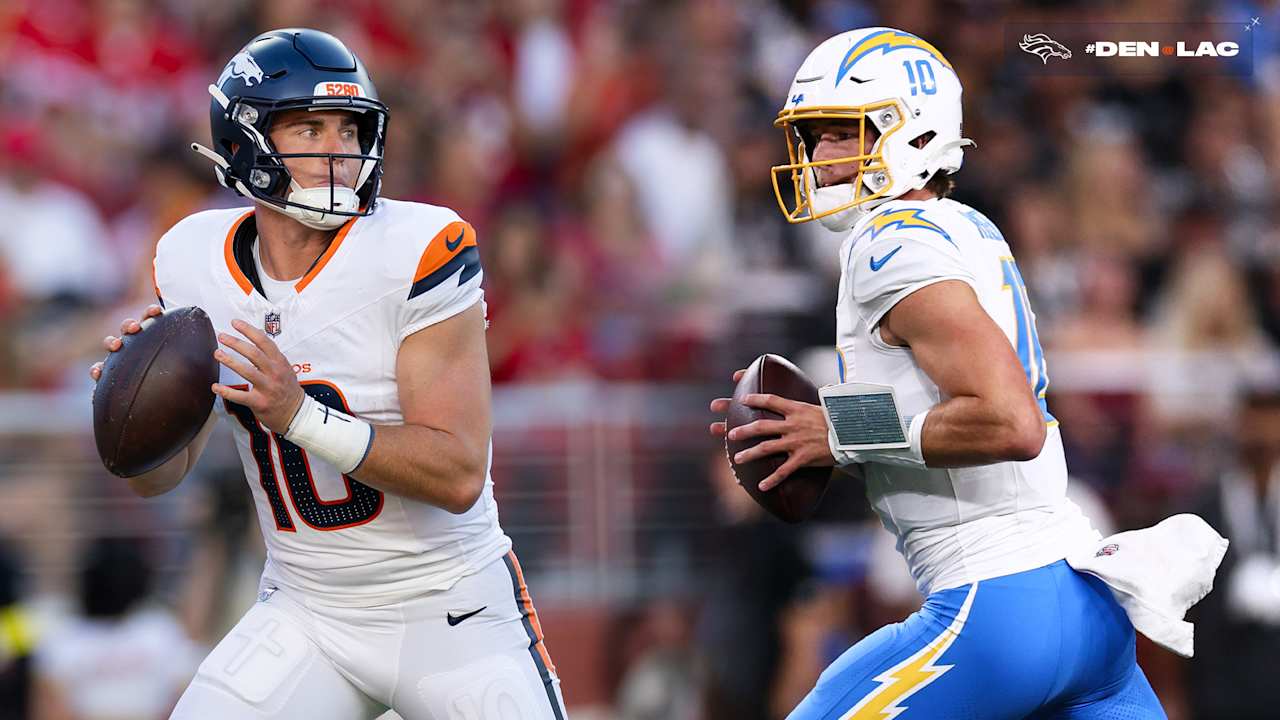
CAN THE BRONCOS SLOW JUSTIN HERBERT?
Chargers quarterback Justin Herbert is off to a fast start, as he’s thrown for five touchdowns and no interceptions while recording a 127.8 passer rating over the season’s first two weeks.
Herbert has posted a passer rating of at least 110 in five consecutive games and recorded four consecutive games with at least two touchdowns and no interceptions, which are both the longest active streaks in the NFL.
In the first two weeks, Herbert has also made plays with his legs. He iced a Week 1 win with a third-down scramble and has posted three consecutive games with at least 30 rush yards.
“He’s a special athlete,” Defensive Coordinator Vance Joseph said Thursday. “He’s playing at a high level right now. He’s probably the MVP right now after two games. He is accurate. He’s obviously a big man, so he can see over the pressure. He’s escaping on major downs, second-and-long and third downs, keeps drives alive. So, how we rush this guy is going to be key. How we cover the receiving targets and make him throw the ball is also going to be key. It’s a combination of rush and coverage to contain this quarterback. It’s a run-first offense. The balancing act between stopping the run and defending the pass is going to be critical.”
Herbert has spread the ball around to receivers Quentin Johnston, Keenan Allen and Ladd McConkey, as all three players have at least eight catches and 120 yards in two games this season. Johnston posted a 60-yard touchdown in Week 2, and Denver must find a way to prevent chunk yardage after allowing four plays of at least 40 yards vs. the Colts.
Herbert’s last regular-season interception came in Week 16 last season against the Broncos, and Denver will aim to force more mistakes in this matchup. The Broncos haven’t recorded an interception yet this season, but they’ll look to bounce back from a Week 2 performance that wasn’t up to their standard.
“The details, the small things matter,” outside linebacker Jonathon Cooper said. “Starting fast matters. I have no doubt that we’re going to bounce back and be even better.”
The Broncos’ key to success may start on first down. When Denver had early down stops against Indianapolis, the defense found ways to get stops. The Colts were just 1-of-7 on third-and-5 or longer in the Week 2 game. But when Indianapolis got to third-and-short, the Colts converted all but one of their six attempts.
If Denver can keep Herbert in check and force a few mistakes, it would certainly help the Broncos’ chances to grab a win in LA.
WHO WINS IN THE RED ZONE?
If the Broncos and Chargers are locked in a tight game on Sunday, any number of factors could ultimately make the difference. The turnover battle, certainly, looms large as Denver aims to be on the correct side of that equation for the first time this season.
The team’s performance inside the 20-yard line, though, may be just as important. In Week 2, the Broncos’ offense converted all three of its red-zone trips into touchdowns while holding the Colts to 2-of-6 in the red zone. Denver’s performance in that area helped negate Indianapolis’ ability to move the ball on offense and gave the Broncos a chance late in the game.
Both team’s defenses have been elite in the early weeks of the season, as the Chargers and Broncos rank first and third, respectively, in allowing touchdowns in that area of the field. The Chargers have allowed touchdowns on 1-of-6 red-zone possessions, while the Broncos have given up touchdowns in 2-of-8 red-zone trips.
“That’s always our goal,” Joseph said. “If you win red zone, it keeps the points to a minimum. That’s our goal each week, but obviously we have to fix what went wrong in the first half [vs. the Colts]. We can’t duck that — and we won’t duck that and we haven’t. We’ll fix those things and move on and get better from it.”
Offensively, the Broncos have scored on 4-of-6 (66.7%) red-zone trips, while the Chargers have found their way into the end zone on 3-of-7 (42.9%) opportunities.
In a close rivalry — five of the last six games have been decided by a touchdown or less — the team that can gain the edge in the red zone could very well come out ahead.