
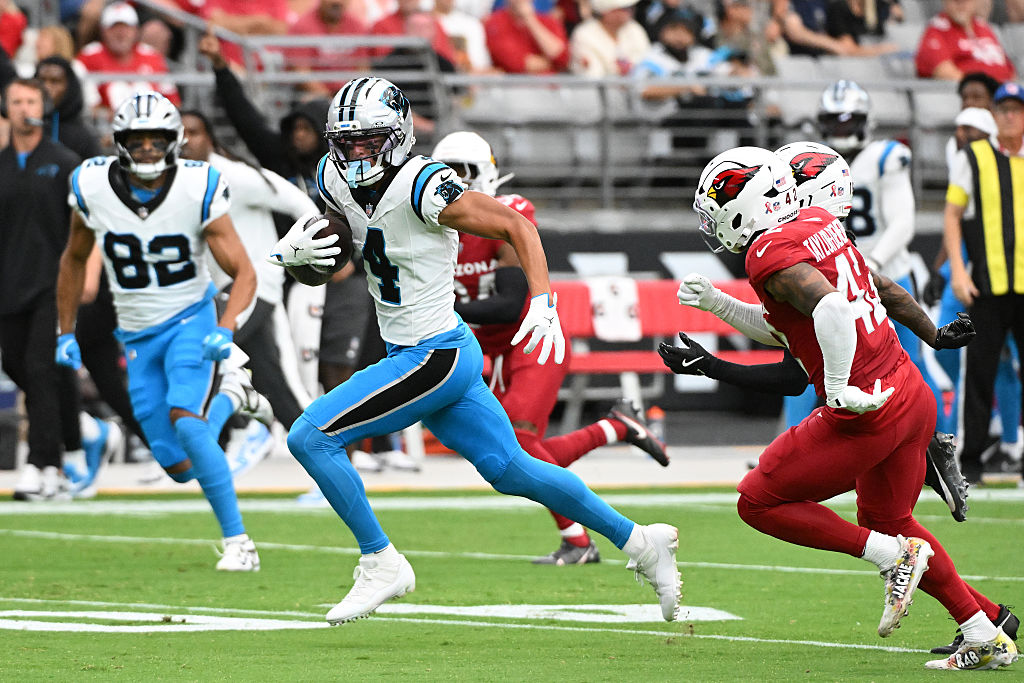
Dan Johnson takes you through his preview, prediction, and pick for NFL Week 3’s game between the Carolina Panthers and the Atlanta Falcons on Sunday.
Rivalry games tend to reveal who a team really is, and this one arrives at a telling moment for both NFC South outfits. The Atlanta Falcons bring a defense playing at a top-five clip and a run game that dictates terms; the Carolina Panthers counter with a pass-heavy identity, a home opener, and the urgency of an 0-2 start. Through two weeks the contrast is stark: Atlanta ranks 7th on defense and 15th on offense by power rating, while Carolina sits 28th on defense and 29th on offense; the Falcons thrive on balance and control, the Panthers lean into volume and volatility. Below is my prediction for NFL Week 3’s game between the Carolina Panthers and the Atlanta Falcons.
Here’s how I’ll play it. I’ll be pumping out these predictions for individual games all season, with plenty of coverage here on DraftKings Network. Follow my handle @dansby_edits for more betting plays.
Quarterback Michael Penix Jr. has been steady more than splashy for the Falcons, completing 63.5% for 433 yards with one touchdown and zero interceptions. His situational profile is disciplined—98.0 passer rating when kept clean, 69.4 under pressure—and he hasn’t posted a single turnover-worthy play. Atlanta’s plan reflects that restraint: a 45.8% run rate and 54.2% pass rate with an EPA per rush of -0.07 and an EPA per pass of 0.12. Running back Bijan Robinson has set the cadence with 167 rushing yards at 83.5 per game, and running back Tyler Allgeier has added 100 at 50.0 per game, while wide receiver Drake London (11 receptions, 104 yards) and tight end Kyle Pitts (11 receptions, 96 yards) handle the in-breaking stuff that converts first downs and bleeds clock. The structure is working between the 20s—342.0 yards per game—but a red-zone conversion lull has held the scoring to 21.0 points per game, which keeps totals in check even when field position tilts their way.
Quarterback Bryce Young is being asked to carry the load too much for the Panthers so far. Carolina has thrown on 73.3% of snaps and run on just 26.7%, which has produced 222.5 passing yards per game but only 81.0 rushing yards per game. The efficiency gap has been costly: the Panthers sit at -0.10 EPA per pass and -0.10 EPA per run. Young’s raw line—482 yards, four touchdowns, three interceptions on 58.9% completions—speaks to how often he’s pressed into tight-window throws, particularly on late, long downs. Wide receiver Tetairoa McMillan has flashed true No. 1 traits with 11 receptions for 168 yards, and wide receiver Hunter Renfrow has cashed in the red zone with two touchdowns, yet running back Chuba Hubbard’s 3.7 yards per carry and a retooled interior line have left the offense one-dimensional and vulnerable to game-script swings.
Atlanta’s defense is the swing piece, even with cornerback A.J. Terrell sidelined. Through two games the Falcons rank second in total yards allowed at 229.0 per game, second versus the pass at 139.5 per game, ninth versus the run at 89.5 per game, and second in points allowed at 14.5. Last Sunday they throttled Minnesota to 198 total yards, authored six sacks, and forced four takeaways, then turned those short fields into five Parker Romo field goals. Edge rusher Zach Harrison has opened with 1.5 sacks, safety Billy Bowman has a takeaway, and the group’s turnover margin sits at +3. Without Terrell, Atlanta will lean a touch more on split-safety and zone with Dee Alford and Clark Phillips III handling bigger snaps, which can concede a few efficiency bumps on the perimeter, but the front’s rush-and-cover sync still travels. Matched against a Carolina offense that has run exactly nineteen times in each of the first two games and now invites extra coverage bodies on early downs, that speed and cohesion in the back seven remain force multipliers.
Falcons vs. Panthers pick, best bet
Atlanta averages 74.5 offensive snaps, calls run at a rate that shortens games, and funnels targets into efficient, intermediate throws; Carolina’s pass-rate sprawl inflates attempts without lifting success rate, which is how you land on 16.0 points per game even with 26 first downs in Arizona. The Falcons’ big-play throttle—0.12 EPA per pass allowed on their side of the ball—meets the Panthers’ negative passing EPA, and that is usually the formula for three-point drives instead of seven-point haymakers. Layer in that Atlanta games have not cleared the total yet, Carolina’s offense has been capped under 30 in both outings, and divisional familiarity tends to compress red-zone creativity, and the game script narrows further.
The recent form lines echo it. Atlanta’s production splits—198.5 passing yards and 143.5 rushing yards per game on offense, 139.5 passing yards and 89.5 rushing yards allowed on defense—tell the story of complementary football. Carolina’s profile—222.5 passing yards, 81.0 rushing yards, and 26.5 points allowed per game—describes an outfit forced to chase and one that yields sustained drives on the other side. If the first quarter belongs to the Falcons’ front, second-and-longs will stack, and with them, punts and field goals.
The Terrell absence probably trims Atlanta’s cover edge. At -5.5, they project to win by about four to six points, which is right on market. At -4.5, you’re basically asking if Atlanta wins by a touchdown often enough to beat the vig. The Falcons have the stronger defense, the better run game, and the steadier quarterback play, but their red-zone efficiency has been weak—five Romo field goals last week instead of touchdowns—and that profile bleeds into spread results.
The difference-maker is running back Bijan Robinson in the four- and two-minute windows. His 83.5 rushing yards per game marries with real route value—nine catches for 125 yards and one touchdown—to keep Atlanta ahead of the sticks without telegraphing intent. When Carolina commits an extra defender, tight end Kyle Pitts and wide receiver Drake London punish leverage on crossers; when the Panthers stay light, Robinson hammers the crease and the clock. Either way, the snap-to-snap math bleeds minutes and mutes total possessions.
Call it Falcons 23, Panthers 17, but we’re going under, here. Atlanta’s defense is likely to cap explosives, the Falcons’ offense is likely to choose patient, clock-draining paths, and Carolina’s heavy pass volume is unlikely to translate into efficient scoring. With a rivalry that has recently played close to a coin flip, the spread sits near fair, but the identity clash makes the total the sharper edge more often than not.
Best bet: Panthers vs. Falcons u44.5 total points (-120)
Tail it with me in the DKN Betting Group here!
For a prop lean, Tetairoa McMillan 6+ receptions (+115). As noted earlier, wide receiver Tetairoa McMillan sits at eleven catches on nineteen targets for one hundred sixty-eight yards through two games, while quarterback Bryce Young has piled up ninety attempts and Carolina has run exactly nineteen times in each outing—bankable pass volume with a concentrated tree. With cornerback A.J. Terrell out, Atlanta is likelier to shade with split-safety/zone and play off on the boundary, trading explosives for completions; that funnels hitch, speed-out, and glance volume to the X, which is McMillan’s lane. The Falcons are second in pass yards allowed at one hundred thirty-nine and a half per game, which suppresses YPR but not catch counts, and negative script pressure pushes hurry-up snaps like the fifty-five attempts we saw against Arizona. I project eight to eleven targets and six to eight receptions for sixty to eighty yards. That sets a fair hit rate around fifty-five to sixty percent; at +115 implied 46.5%, we’re getting a real edge.
Best prop lean: Tetairoa McMillan 6+ receptions (+115)
Tail it with me in the DKN Betting Group here!