
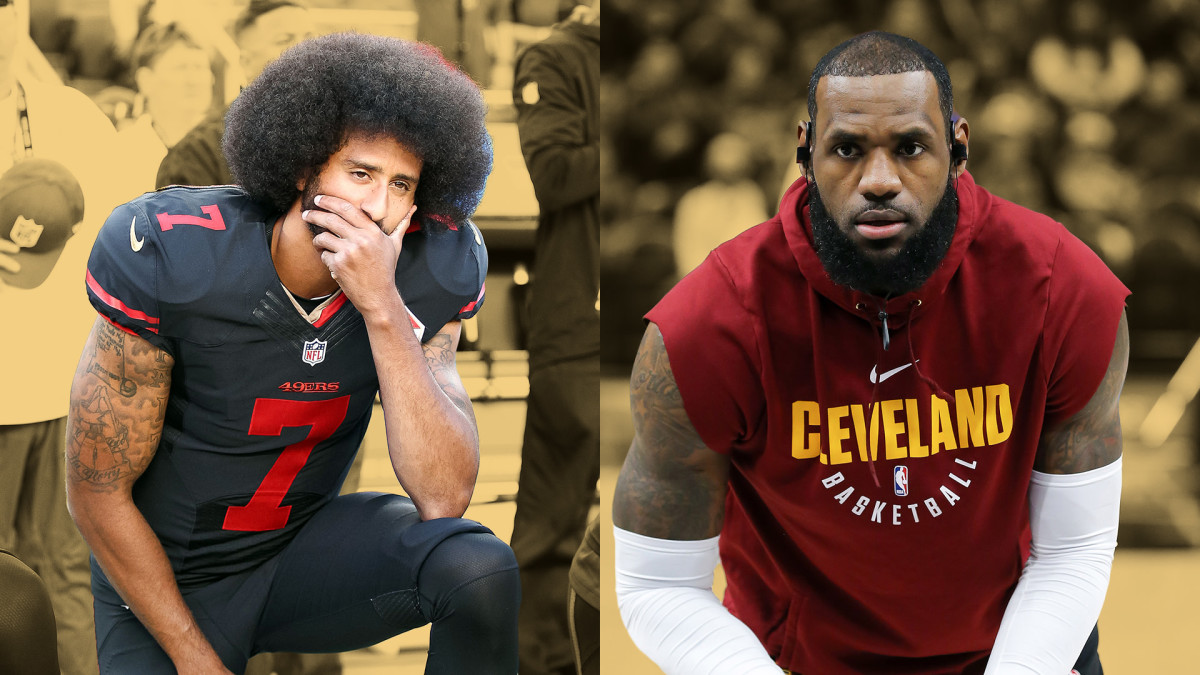
Colin Kaepernick had the tools to be one of the NFL’s elite when he joined the league in 2011 with the San Francisco 49ers. Gifted with speed and arm strength, this was on full display in his first four seasons in the league.
However, in 2015, Kaepernick’s career took a different turn. Changes within the Niners’ organization left him struggling and he lost his starting role. His situation got even worse in 2016 when he started his silent protests against racial discrimination by kneeling during the U.S. national anthem.
Advertisement
Kaepernick’s actions gained mixed reactions from different personalities. Some criticized him while others understood what he was trying to stand up for. One of them was LeBron James, who publicly expressed his admiration for standing what he believes is right.
“I salute Colin for being as powerful as he was,” James said via UPI. “I wish I owned an NFL team right now. I’d sign him today.”
It was a risky but courageous act on Kaepernick’s part. However, he clarified that his stance was not directed at the flag or the military. Rather, it was all about raising awareness on racial inequality and police brutality. He vowed to continue his protests at the time until he felt the American flag represented equality for all.
Advertisement
Kaepernick’s NFL downfall
Noble as Kaepernick’s stance may have been, it came at a steep price. He never played another NFL game after the 2016 season, with allegations that teams were blackballing the veteran QB.
Although most felt it was his activist role that led to teams avoiding him, critics felt otherwise. Some saw Kaepernick’s declining performance as the reason with teams opting to invest on younger players rather than on a veteran like Colin.
Advertisement
To date, Kaepernick remains hopeful of staging an NFL comeback despite already being 37. But not having played pro football for over 8 years, the odds of seeing Colin back on the field do not look good.
From Kaepernick’s kneel to LeBron’s stand
While Kaepernick’s NFL career took a hit, his protests resonated across the sports world. James was one of them, echoing his message through his platform. In fact, he had already been vocal on social issues way before Colin’s silent protests, voicing out after the deaths of Breonna Taylor, George Floyd and Eric Garner.
Advertisement
It was for this reason that he backed the Black Lives Matter movement. He stressed that it was a call for accountability and change.
“You don’t have to like black people or care what I talk about, or care if Black Lives Matter’s on the court. But you know what’s right is right, and what’s wrong is wrong,” James said.
Like Kaepernick, Bron also paid the price for standing up against racism. One of his Los Angeles homes was vandalized when a racial slur was spray-painted on the front gate in 2017.
Advertisement
The incident was treated as a hate crime by authorities.
Being away from home at the time, James was just relieved that no one in his family was harmed. However, he did point out that the attack was proof that racial discrimination still existed in America.
“Just shows that racism will always be a part of the world, part of America. Hate in America, especially for African-Americans, is living every day. It is hidden most days. It is alive every single day,” James said.
Advertisement
For Kaepernick, the stance cost him his NFL career.
As for James, it meant facing the hate while maintaining his level of play on the court.
Regardless, both undoubtedly reshaped the role of athletes – showing that their influence extends beyond the game.
This story was originally reported by Basketball Network on Sep 21, 2025, where it first appeared in the Off The Court section. Add Basketball Network as a Preferred Source by clicking here.