
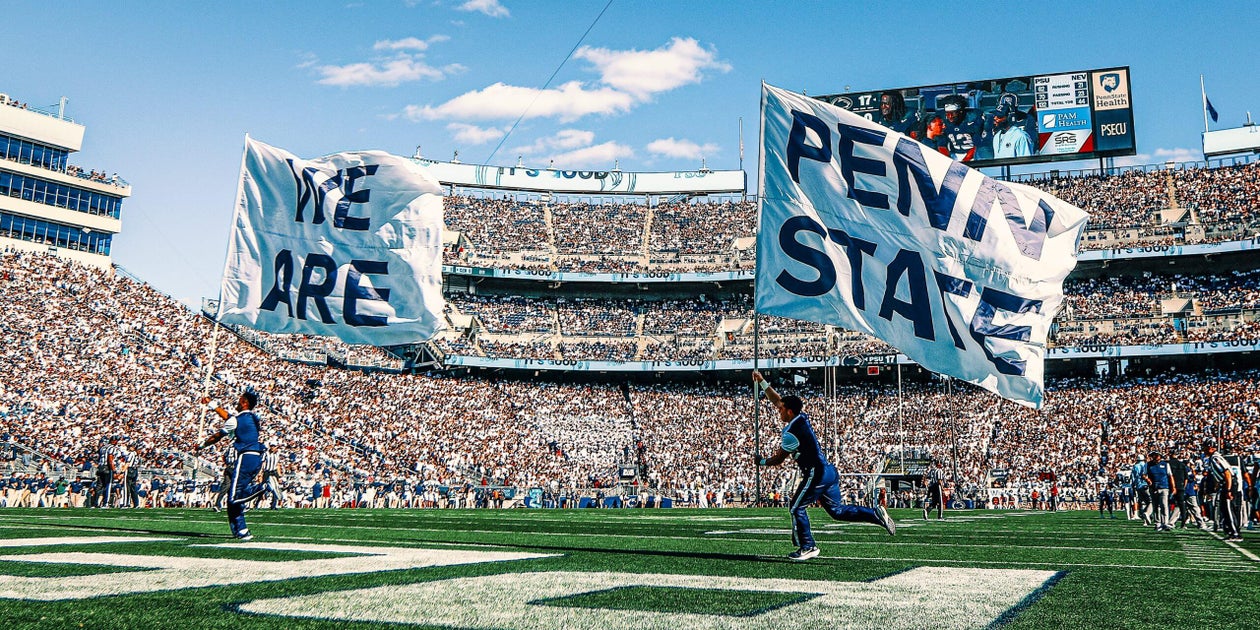
STATE COLLEGE, Pa. — In the early days of college sports’ name, image and likeness era, some of the most prominent Penn State supporters — business leaders, wealthy donors, famous former members of the football program — were working to bring the Nittany Lions up to speed with the competition.
Just not all together.
As Big Ten rivals Michigan and then Ohio State won national titles, Penn State was still getting its NIL house in order, consolidating funds, streamlining operations, aligning its power players and making Happy Valley an appealing and lucrative place for top talent to come — and stay.
Penn State’s issues were not uncommon. A lot of schools learned a lot about themselves after the NCAA changed its rules regarding athletes being paid for endorsement and sponsorship deals in the summer of 2021.
First off, boosters and fans needed to understand and accept that, yes, players are now being paid and that’s OK.
Second, while donor-fueled NIL collectives were popping up all over to facilitate the payment of those players, more was definitely not merrier. Supporters of a particular school needed to be coordinated and collaborative to best serve the teams and players they were trying to fund.
“When you go to any school in the country and you find multiple collectives, it’s because they didn’t trust each other and they believe they could do it better than the other one could,” said Rob Sine, a Penn State alum and CEO of Blueprint Sports, a company that helps operate dozens of NIL collectives.
Complicating matters for Penn State were lingering fault lines among influential people within the Nittany Lions community that have tended to flare up when the school was faced with questions of how best to move the football program forward in the post-Joe Paterno era.
“It was kind of like a meeting of the five families,” Sine said, using a “Godfather” reference to describe bringing two Penn State collectives together. “There was not a lot of trust out of the gate.”
But in June of 2023, Success with Honor and Lions Legacy Club merged to become Happy Valley United. Less than a year and half later, the new entity was functioning well enough to help head coach James Franklin assemble one of the best teams in college football.
Quarterback Drew Allar, running backs Nick Singleton and Kaytron Allen and defensive tackle Zane Durant were among more than a half-dozen Nittany Lions who weighed staying in college for another year against starting NFL careers.
While those decisions aren’t all about money, the financial component is important. Happy Valley United was able to ensure that players did not feel as if they had to sacrifice to play another season for the Nittany Lions.
“Penn State having a baseline of money that we can help make that happen is great. We needed to get to a point where we had the baseline so it isn’t kids making a decision of money or no money,” said Rich Stankewicz, a former Penn State football player in the mid-1990s and director of operations for Happy Valley United. “It’s no longer that decision.”
No. 3 Penn State faces its first major test in a season of high expectations Saturday against No. 6 Oregon, a rematch of last season’s Big Ten championship won by the Ducks and a potential inflection point in the College Football Playoff race. It’s a chance to show why the money — and the university-wide effort to organize it — was important.
Every school was feeling its way around to some degree when the NCAA rule changes arrived in the summer of 2021, and myriad state laws muddled the picture even further.
Collectives went from nonexistent to everywhere seemingly overnight.
They played different roles at different schools, but it is fair to say Oregon’s Division Street — founded by Nike co-founder Phil Knight and other former Nike executives in September 2021 — was way out in front of the pack. At Oregon, the new way of doing business was embraced, professionalized and weaponized by coach Dan Lanning and the Ducks, who have stacked rosters with highly rated high school recruits and transfers.
Many other schools were slower to adapt, including Penn State.
“When NIL was first announced, for many it was a dirty word,” Stankewicz said. “The idea we would compensate players was, ‘Oh my goodness. The horror of it. This is the end of college football as we know it.’”
Franklin realized NIL was the next college football arms race.
“The first teacher to step up in any of these settings to talk about NIL was Coach Franklin,” Sine said. “It was tremendous. He would get up there and say, ‘Look, we need you.’
“He would always talk about Columbus, Ohio, and talk about the numbers he was hearing coming out of (Ohio State). He was very interested in what was happening around the country and being able to show, if you want to get to a program that is going to win more than 10 games and get to the point where we’re in the CFP on an annual basis, we have to have your support. We have to have this infrastructure built out.”
Of the three Penn State-affiliated NIL collectives launched in 2022 — maybe even four, if you want to count a venture led by quarterback Sean Clifford right after he was done playing for the Nittany Lions — two stood out.
First to market was Success with Honor, which had the backing of some of Penn State’s biggest donors: Ira Lubert, a member of the National Wrestling Hall of Fame and a driving force behind the school’s powerhouse wrestling program; Anthony Misitano, the founder of PAM Health rehabilitation hospitals; and Rich Sokolov, who has been a high-ranking executive at some of the country’s largest real estate investment firms.
Former Penn State assistant football coach Jay Paterno, Joe’s son, helped get Success with Honor off the ground, along with attorney Anthony Lubrano, another longtime member of the school’s board of trustees. The goal was to work with Penn State athletes from all sports.
Meanwhile, former Penn State linebacker Mike Mauti was among those who believed football — which generates much of the revenue that funds all 31 varsity sports at the school — needed to be prioritized. Sine said a call he received from former Penn State star running back Ki-Jana Carter led to the creation of Lions Legacy Club, a football-focused collective, a few months later.
“And it created this idea that all the money should go to football first,” Paterno said. “And the reality is there are alums who played lacrosse, fencing or tennis, who may not necessarily care about football.”
Lions Legacy’s model targeted corporate sponsorships and partnered with West Shore Home, a remodeling and renovation company founded by Penn State graduate B.J. Werzyn. West Shore Home is also the company that struck a deal with Penn State earlier this year for naming rights to the Beaver Stadium field — another move that didn’t sit well with some Penn Staters.
“Just from a pure communication and efficiency standpoint, it didn’t make sense to have our base split,” said athletic director Pat Kraft, who was hired by Penn State in July 2022.
Again, multiple collectives competing against each other was an issue all over the country, including at Penn State’s main competition for Big Ten supremacy. At Penn State, though, some of the key figures involved have been bumping heads for years. In April 2023, Mauti and board of trustees member Brandon Short, another former Penn State linebacker who played for Joe Paterno, endorsed opponents of Jay Paterno and Lubrano in a trustees election.
Mauti, whose father and brother also played for Joe Paterno, said in April of 2023 that Jay Paterno and Lubrano had been standing in the way of investments into facilities and NIL and not working in the best interest of the football program.
Onward State, a Penn State student-run online news organization, quoted Mauti as saying, “[Paterno’s] input on this matter is toxic, and [his] relevancy has expired in this era of collegiate athletics.”
Paterno downplays any animosity, noting that as a trustee he needed to step away from the collective. He said he had no issue with combining the two entities.
“I said, ‘Look, I don’t care. I’m happy. You guys want to merge, merge,’” Paterno told The Athletic.
Stankewicz acknowledged there were “hiccups and bumps” along the road to bringing the two sides together.
“There are egos involved. These are high-powered people involved in all of the groups: industry heads, high-profile former athletes, high-profile former coaches,” Stankewicz said. “The No. 1 thing for everyone is they care about Penn State. So many passionate opinions because they care about Penn State.”
Stankewicz credits Kraft with helping bridge the divide and tapping into that commonality: They all wanted Penn State to be successful, and the best way to achieve that was to have one collective.
After the merger, it was a sprint to get the collective operating efficiently enough to help Penn State football compete at the highest level.
Ohio State’s athletic director Ross Bjork notably said about $20 million was spent on the Buckeyes’ 2024 national championship roster. Coaches and college sports administrators say the price tag for the most talented rosters this season easily exceeds that.
But it wasn’t just a matter of raising enough money to be able to spend with the best in the country; the entire operation needed to run smoothly to gain the trust of the athletes putting NFL millions on hold.
Sine pointed to Penn State tight end Tyler Warren, who had a stay-or-go decision to make after the 2023 season similar to what many of his teammates faced after 2024.
Warren and his family had a good idea of his draft prospects and their financial implications, Sine said. He was probably more likely to be taken on Day 2 than in the first round. Contracts for second-round picks range from just under $10 million down to about $6.5 million over four years.
Warren returned, had a monster season and was drafted 14th overall in April by the Colts.
“That wouldn’t have happened if there wasn’t the infrastructure in place to be able to understand: Payments are going to happen on time. Here’s how we’re going to stagger them throughout the year. It’s going to be a 12-month contract. Here’s what you can expect, when you can expect it. If you have questions about cars, if you have questions about taxes,” Sine said, going through a laundry list of what is presented to players.
Durant, a defensive tackle from the Orlando, Fla., area, said weighing a rookie contract against an NIL deal is only part of the equation.
“Because, initially, you’re a kid going into the real adult life when you leave college,” said Durant, who was projected as a third or fourth-rounder in the last draft. “So you’re going into the real-world problems of all those different things. When you (go back) to college, in the last year they could teach you how to manage that stuff with the money that we’re getting from NIL. So it could help us prepare for the next level.”
With schools now able to directly pay athletes through a revenue sharing system and rules being implemented that could lead to more NIL deals being done in house, the future of collectives is unknown.
But when Penn State needed one — and just one — it came together just in time.
“Penn State won is who won,” Sine said.
(Photo: Isaiah Vazquez / Getty Images)