
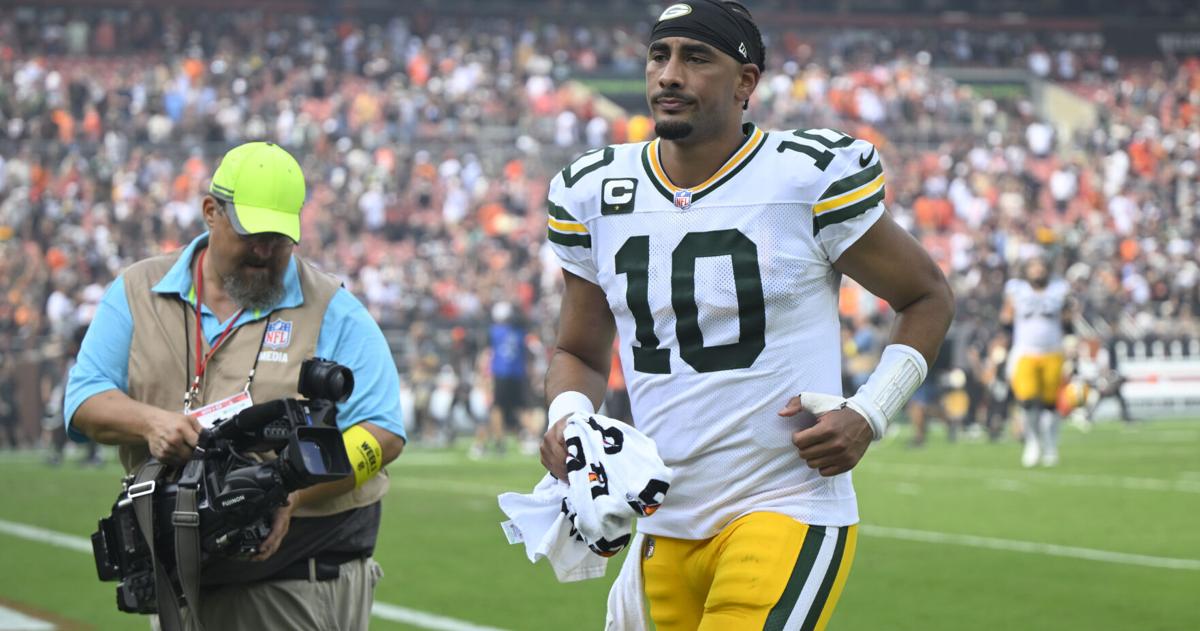
GREEN BAY — Jordan Love had gone 116 minutes and 42 seconds of the 2025 NFL season without throwing an interception — or, without throwing one that counted, anyway.
Then Cleveland Browns safety Grant Delpit dropped off Tucker Kraft and into Love’s throwing window to pick off the Green Bay Packers quarterback’s pass intended for Dontayvion Wicks late in the fourth quarter of what would wind up being a 13-10 loss to the previously winless Browns.
The Packers were leading, 10-3, at the time, and facing a third-and-3 play from their own 25-yard line, and the interception was the first domino to fall in what wound up being a full-blown collapse in those final 3 minutes and 18 seconds.
In the immediate aftermath of the loss, head coach Matt LaFleur tried to take the blame, saying his play-call was the issue — “That’s a bad play call. We shouldn’t have called that play. That’s on me,” LaFleur said at the time — while Love admitted that he should’ve seen Delpit abandon his coverage of Kraft and appear somewhere he wasn’t supposed to be.
“I didn’t see him, but it’s something I’ve seen before,” Love said. “I’ve got to find a way to see him.”
Just as a singular loss to the Browns doesn’t mean the Packers are no longer among the NFL’s elite, one crucial mistake doesn’t mean that Love isn’t good enough to get the Packers to where they want to go — Super Bowl LX in Santa Clara, California in February.
But if the Packers are indeed going to be the team they believe they are, the interception is precisely the type of ill-timed mistake that, if it happens in a crucial moment of a playoff game, can mean the end of a season.
To Love’s credit, he has no problem whatsoever with publicly acknowledging his mistakes — unlike the legends who preceded him, Brett Favre and Aaron Rodgers, who sometimes struggled to take clear ownership of their errors, rare though they might’ve been in their Pro Football Hall of Fame-caliber careers — and didn’t have much interest in using LaFleur’s explanation as a free pass for his gaffe.
When told after the game that LaFleur had taken responsibility for the play and it was suggested that the Packers could have run the ball — even though the Browns defense had sold out to stop running back Josh Jacobs and succeeded, holding him to a 1.9-yard average on 16 carries — Love was having none of it.
“Nah, that was the call that came into the huddle. We don’t have time to sit there and talk about different things on the field right there. It’s hindsight,” said Love, who enters this week’s prime-time road matchup with the Dallas Cowboys having completed 67.9% of his passes for 663 yards with five touchdowns and the one interception (110.1 rating, the fourth-highest in the NFL).
“You look back on it, obviously, the interception happened. But, who knows? I like the coverage that [the Browns] ran versus it. They did a really good job, with [Delpit] falling off right there. If they don’t fall off, I think we get a completion right there and move the sticks and we’ll be talking about, ‘It’s a great call.’
“It’s one of those things that’s hindsight. Got to figure out how to move forward from it and grow from it.”
That’s exactly the way LaFleur explained the play-call 24 hours later, when he wasn’t exactly second-guessing himself the way he’d done right after the game — although there was a convincing argument to be made that, with as poorly as the Browns had been playing offensively, having Daniel Whelan punt the ball away and forcing quarterback Joe Flacco to drive the length of the field for a game-tying touchdown was the smarter play.
“Yeah, hindsight’s 20/20,” LaFleur replied when asked about such a scenario. “We’re trying to be aggressive and thought that was our best opportunity [to close out the game]. Obviously, didn’t work out that way. Something that you can’t take back.
“All you can do is try and learn from it and try not to make the same mistake again.
Later, LaFleur added, “The way our defense was playing, I definitely don’t think you ‘have to’ do anything. They had one more timeout; if you ran the ball, they’re probably going to burn their last timeout. Maybe it’s a different story.”
Sunday’s loss was Love’s 39th start as the Packers quarterback, including playoffs. He has thrown 31 career interceptions, including five in his last two playoff appearances. (He had one interception in the Packers’ season-opening win over Detroit nullified by a Lions penalty.)
While his postseason interception percentage (5.7%) is inflated by the three he threw in last year’s season-ending playoff loss to the eventual Super Bowl LIX-champion Philadelphia Eagles, his 2.2% interception rate in the regular season is higher than Rodgers’ (1.4%), Kansas City’s Patrick Mahomes (1.8%) and Baltimore’s Lamar Jackson (1.8%) but compares favorably to Buffalo’s Josh Allen (2.3%), the Los Angeles Rams’ Matthew Stafford (2.3%) and Tampa Bay’s Baker Mayfield (2.6%).
And while he may remind some older fans of the Ol’ Gunslinger, he’s nowhere close to Favre’s rate (3.3%).
All that said, for everything that went wrong Sunday — having Brandon McManus’ potential game-winning 43-yard field goal blocked, the patchwork allowing Love to be sacked a career high-tying five times, the defense allowing the Browns to get in position for Andre Smzyt’s walk-off field goal — the Packers win the game ugly if Love avoids that interception. And it’s not unreasonable to expect more from your $55 million per year quarterback in his third year as the starter.
“Our defense was doing such an outstanding job in that game. You just don’t want to give them anything in terms of field position,” LaFleur said. “And then we had an interception returned to the [4]-yard line and just gave them an opportunity.”
Call it an early-season one-to-grow-on mistake that, LaFleur hopes, will pay off down the road.
“One thing I always tell our quarterbacks is, if we have a bad play [called], don’t make a bad play worse,” LaFleur said of the interception. “I will say in his defense, Delpit did a nice job. You can see he’s in man coverage and he fell off the route, so he did something that we did not anticipate him doing. So, he made a good play.
“Just by his body language when he was throwing the ball, it looked like he was trying to pull it down, but he was already committed.”
COPYRIGHT 2025 BY CHANNEL 3000. ALL RIGHTS RESERVED. THIS MATERIAL MAY NOT BE PUBLISHED, BROADCAST, REWRITTEN OR REDISTRIBUTED.