
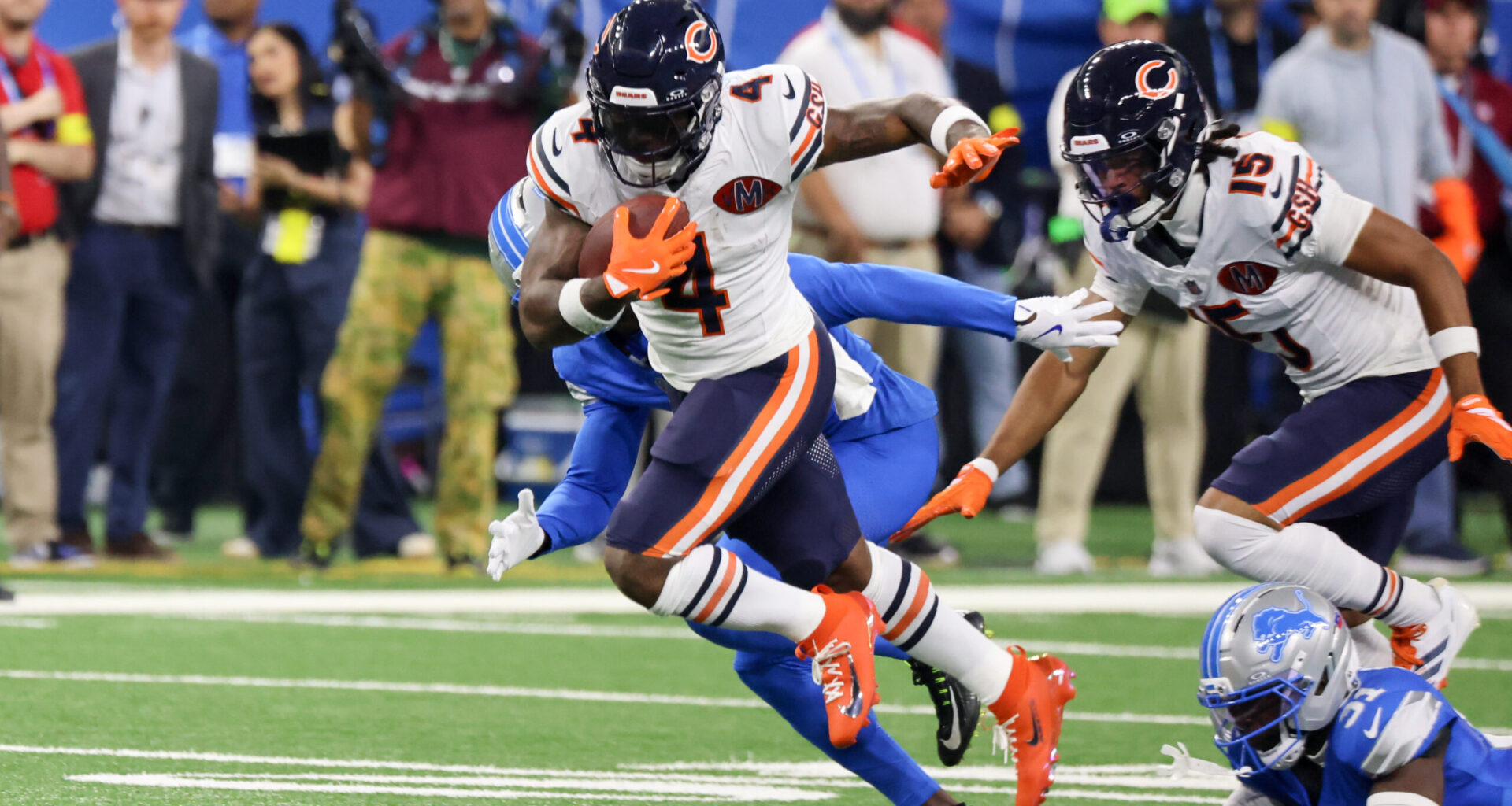
Learn how the Bears’ running game impacts their success and why it is essential for driving their offense forward.
The Chicago Bears’ offense lives and dies by the ground game. When Chicago pounds the rock, everything else opens up. Play action becomes lethal, drives stay alive, and the defense finally gets a breather. But when the run game stalls? The whole game sputters. It’s not just a luxury for this team; it’s a necessity.
The Bears’ running back room is comprised of D’Andre Swift, Kyle Monangai, and Roschon Johnson, with Swift being RB1. Once upon a time, Swift played under now Head Coach Ben Johnson in Detroit, where he averaged 5.5 rushing yards per attempt in 2022. After three years in Detroit and a stop in Philadelphia, Swift signed with the Bears in 2024.
With high expectations from past seasons, ultimately, Swift has not moved the needle for the Bears’ run game. With the 7th round rookie Monangai still gaining the coach’s trust, and Johnson not getting a single carry so far this season, the Bears’ run game has not lived up to expectations.
Digging in on the Bears’ Running Game
The Chicago Bears’ rushing attack is averaging 4.1 yards per attempt (18th in the NFL) and 113.3 rush yards per game (15th in the NFL). Swift is averaging 3.5 yards per carry and Monangai is averaging 3.4 yards per carry, which are both under the historic NFL average of 4.2 – 4.4 yards per carry. Chicago ranks fourth in the NFL in yards before contact per carry at 1.99 yards, meaning that the offensive line and run blockers are providing a near two-yard cushion every rush.
Despite that advantage, we are not seeing the true power of the offense come to fruition. Going back to Week 1 against the Minnesota Vikings, the Bears’ offense took the field for the first time this season. The first snap had Williams lined in shotgun, which resulted in a 3-yard pass. On the second play, Williams lined up under center, snapped the ball, and faked the handoff to Swift. Minnesota’s defense was not fooled…at all. The Vikings did not bite on the play-action fake, and why would they? The Bears did not run the ball on the previous play, nor did they prove to Minnesota that they are capable of running the ball effectively.
On the bright side, the offensive line and skill position run blockers are performing extremely well. ESPN Analytics ranks the Bears at a 76% run blocking win rate, which is tied for second in the NFL. Coach Johnson’s run scheme and the Bears’ blocking are working; it shows up on the tape with rush lanes being open for these backs. Coach Johnson’s creativity and play calling also aid the rushing attack. We have already seen this season that Johnson has been using QB Caleb Williams’ legs in the run game with some designed QB runs.
We have also seen WRs Olamide Zaccheus and Luther Burden III get involved with end arounds, and WR DJ Moore lined up in the backfield receiving some carries. While Moore, as a running back, has not posted statistically impressive numbers, it is an added wrinkle that opposing defenses have to consider when defending the Bears. Coach Johnson’s philosophy is to make the same things look different and different things look the same. No matter the personnel on the field or the formation the offense is lined up in, defenses can not guess whether a run, pass, or anything in between is coming on a given play.
Story continues below.
More Sports News
.wp-block-group__inner-container:has(> .embla),
.wp-block-group:where(.alignfull) > .wp-block-group__inner-container:has(> .embla) {
width: calc(100vw – (var(–side-spacing) * 2)) !important;
}
.embla {
position: relative;
overflow: hidden;
}
.embla__container {
display: flex;
flex-wrap: nowrap;
gap: 0 !important;
width: 75%;
}
.embla__slide {
margin-inline-end: var(–column-gap);
}
.embla__arrow,
.embla__arrow:active,
.embla__arrow:target,
.embla__arrow:hover,
.embla__arrow:focus-visible {
display: none;
position: absolute;
top: 50%;
transform: translateY(-50%);
width: 40px;
height: 40px;
margin: 0;
padding: 0;
line-height: 0;
background: rgba(255, 255, 255, 0.75);
color: var(–color-primary);
border-radius: 100vw;
svg {
width: 24px;
}
}
.embla__prev {
left: 0;
}
.embla__next {
right: 0;
}
]]>
For the play action to function optimally, the opposing defense must respect and play the run game effectively. Coach Johnson knows this as well as anyone, as he calls the play action as much as anyone in the NFL, and his offense thrives on it.
Before joining the Chicago Bears, Johnson served as the offensive coordinator for the Detroit Lions, where, in 2024, the Lions ranked first in the NFL in play-action percentage at a rate of 36.6%. That Lions team was sixth in the NFL in rush yards per game and top 10 in other rushing categories, such as rush yards per play. The dynamic backfield of Jahmyr Gibbs and David Montgomery forced opposing defenses to respect the Lions’ rushing attack, allowing the Lions to have one of the NFL’s best offenses, driven by play-action.
In 2025 thus far, Chicago is utilizing the play action at 24.5% which is the 12th highest rate so far in the NFL, according to NFL Pro. I am sure that Coach Johnson wants that number to be higher, but in order to do that and make the play action more effective, the success of the run game must improve. Getting the run game going sets up plays like this.
So, how does the rushing attack get better as the season goes on? The operation should improve overall with more repetitions and experience. Coach Johnson himself said during the offseason that the run game takes about a month into the season to truly get going. We need to remember that offensive lines need that time to grow and gel, especially for the Bears, who overhauled all three positions of the interior offensive line. Of course, the running backs also need time to get acclimated to the new offensive system that Johnson is implementing. There is also the option of looking externally in the trade market for a running back. This, of course, depends on the Chicago Bears’ team success and record, which will determine if they want to give up money and draft capital for a running back.
Help on the Horizon?
Some names to keep an eye on, should Chicago be interested, Breece Hall of the New York Jets is on the final year of his current contract. Would the 0-3 Jets want to trade away their running back instead of signing him to a long-term deal? Would the 0-3 New Orleans Saints look to offload Alvin Kamara’s contract and obtain draft capital in the process? Should the 0-3 Miami Dolphins season spiral out of control, could RB Devon Achane become available?
In the end, the Bears’ rushing attack isn’t just a missing piece of the puzzle-it’s the pivot on which their whole offense can swing. Whether they find that spark from a current roster gem, a creative play-caller’s tweaks, or even a future trade piece waiting in the wings, the path is clear: improve the run game, and the whole offense might just come alive.