
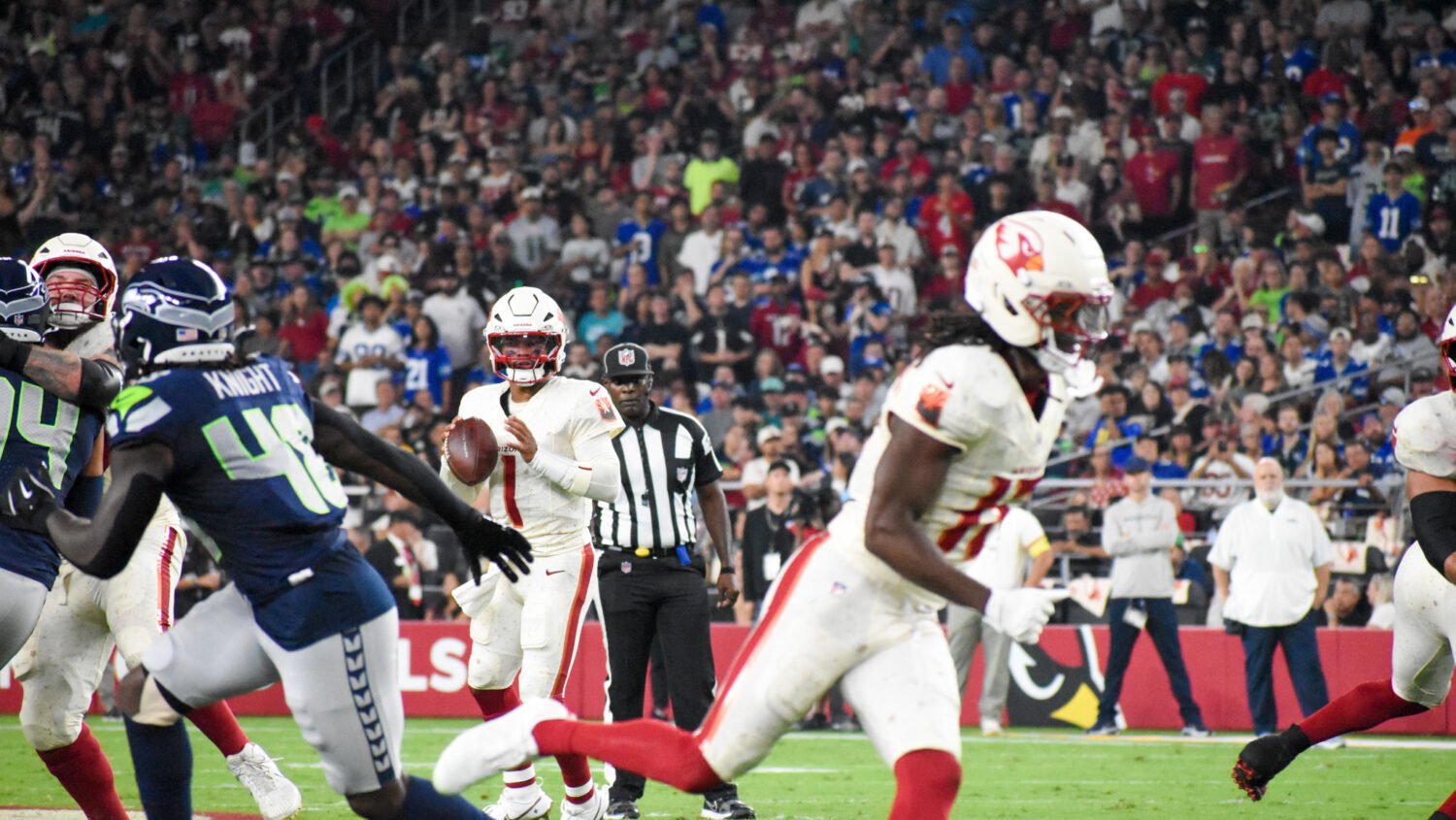
GLENDALE — For those of you grasping for any silver linings following another brutal divisional loss for the Arizona Cardinals, the passing game offers its best shot at that on offense, if you even want to go that far.
The 23-20 defeat to the Seattle Seahawks included a whole lot of the dink-and-dunkathon from the Week 3 defeat, but the comeback attempt with two touchdown drives in the fourth quarter saw the ball deployed down the field more consistently.
But, uh, it still feels like grasping.
Kyler Murray’s stat line gets represented quite plainly by all the underneath stuff, a 27-of-41 evening for a measly 200 yards. The 4.9 yards per pass attempt mark only the sixth time in the last 20 years that a Cardinals quarterback has tossed at least 40 passes and had that number land under five, per Stathead. Murray has three of the six occurrences (one each from 2019 and 2020) and is joined by Trace McSorley (2022), Blaine Gabbert (2017) and Ryan Lindley (2014).
Of Murray’s 41 throws, 29 registered less than 10 air yards. Nine were between 10-19, while three went 20-plus.
That might sound like flawed distribution, and while it still very much is, that’s an improvement (more on that in a minute) that will have to continue for a team with a run-first identity requiring a pivot. This was yet another poor performance on the ground, an alarming response to James Conner’s season-ending injury and an offensive line that keeps faltering in that part of the game.
The retooling began on Thursday. Head coach Jonathan Gannon said the Cardinals did not want to battle Seattle “in a phone booth,” the type of trench warfare the Cardinals usually prefer. He answered that when asked about the lack of 12 and 13 personnel from a group known for that, with ESPN’s Bill Barnwell noting the Cardinals ran 28 of their 34 plays in the first half out of 11 personnel, abandoning another one of their signatures in using at least two tight ends on a consistent basis.
It didn’t particularly define success or failure, but it shows how Arizona is already trying new things it seemingly wouldn’t have before.
The Cardinals had only three plays of 10-plus yards in the first half before six in the second half, including four in the final frame.
To return to where those 41 pass attempts were going, it is a step up compared to the season numbers after three weeks.
Murray entered Thursday with six passes that are considered “deep” by NFL Next Gen Stats, meaning they had 20 air yards or more. The good news is that five of those for Murray were in the pocket and not in a scrambling situation, so they came naturally. The bad news is through three weeks that ranked the Cardinals 26th out of 32 teams.
More bad news!
Even taking the qualifications down to “intermediate” — so now we’re talking 10-19 yards — Murray’s 17 attempts sat the Cardinals 25th. Once again like the deep shots, 14 of those 17 came in the pocket before improvising was required, so Murray’s not just relying on his legs to create those opportunities and some are coming inside the structure.
But Murray’s 7-of-17 completion rate helps produce a quarterback rating on those tosses that sits 25th, and he was 3-for-9 on Thursday.
Here is why this is much more of a problem than the lack of chucking it long.
Take a collection of the 10 best offenses in the NFL through three weeks in EPA, the NFL’s attempt at a tell-all statistic for efficiency, and line them up on the best quarterback ratings for intermediate tosses. Here’s what you’ll get.
Of those top-10 offenses, its quarterbacks on that leaderboard make up all of the top seven, then sit 10th, 17th and 20th. The team in 20th is the Washington Commanders and Jayden Daniels, but throw in Week 3 replacement Marcus Mariota and he’s fifth on the non-qualified leaderboards.
Let’s do this in 2024 too. Those top-10 offenses have its quarterback ratings in intermediate throws placing first, third, fourth, fifth, eighth, 10th, 11th, 13th, 14th and 15th. Now, the Cardinals might not need to be a top-10 offense in order to be a playoff team, but it speaks to what the best in the league do and what they will have to aspire for going forward.
More good news here in the relatively tepid optimism realm. That 13th ranking was Murray’s in the eighth-best offense by EPA last season. Of course, that was buffered considerably by the run game, as was Murray’s ability to use that part of the field.
So they’ve done it before, But can they now without their identity? After Thursday night’s loss, Murray ranks 30th out of 31 qualified signal callers in quarterback rating on intermediate throws. He’d be at least 10 spots higher without the drops from his receivers.
With that said, perhaps some of this was inflated by game flow, but Thursday was once again movement in the right direction.
In that similar mold of thinking, it’s a choose-your-own-adventure spectacle when it comes to how you want to define the night Marvin Harrison Jr. had and how that affects your hopes for the passing game’s chances of rebounding.
Murray threw two interceptions in the first half and both were directly on Harrison. He stopped running his route in the first quarter and bobbled a gimme slant in the second. The first turnover was one of two early plays that continued a mind-numbing trend of those two being unable to stay in sync.
It’s clearly just a Harrison problem, a young player that shows he can become completely broken by mistakes and poor play. There is nothing more damaging to a highly-touted prospect than a mental barrier that at times must feel insurmountable.
With that, he did show that he can bounce back. Arizona stuck by him in the fourth quarter, when Harrison made a few plays looking like the guy he was supposed to be.
But as someone who covered Deandre Ayton’s entire career with the Phoenix Suns, those flashes only matter so much. It’s time for consistency. Now.
Seattle isn’t as good of an offensive team as its numbers through four weeks suggest but this was still a fantastic effort by the Cardinals defense to keep this game within reach. It will also not continue to matter if the Cardinals do not figure out their offense, and by proxy, their passing game.
