
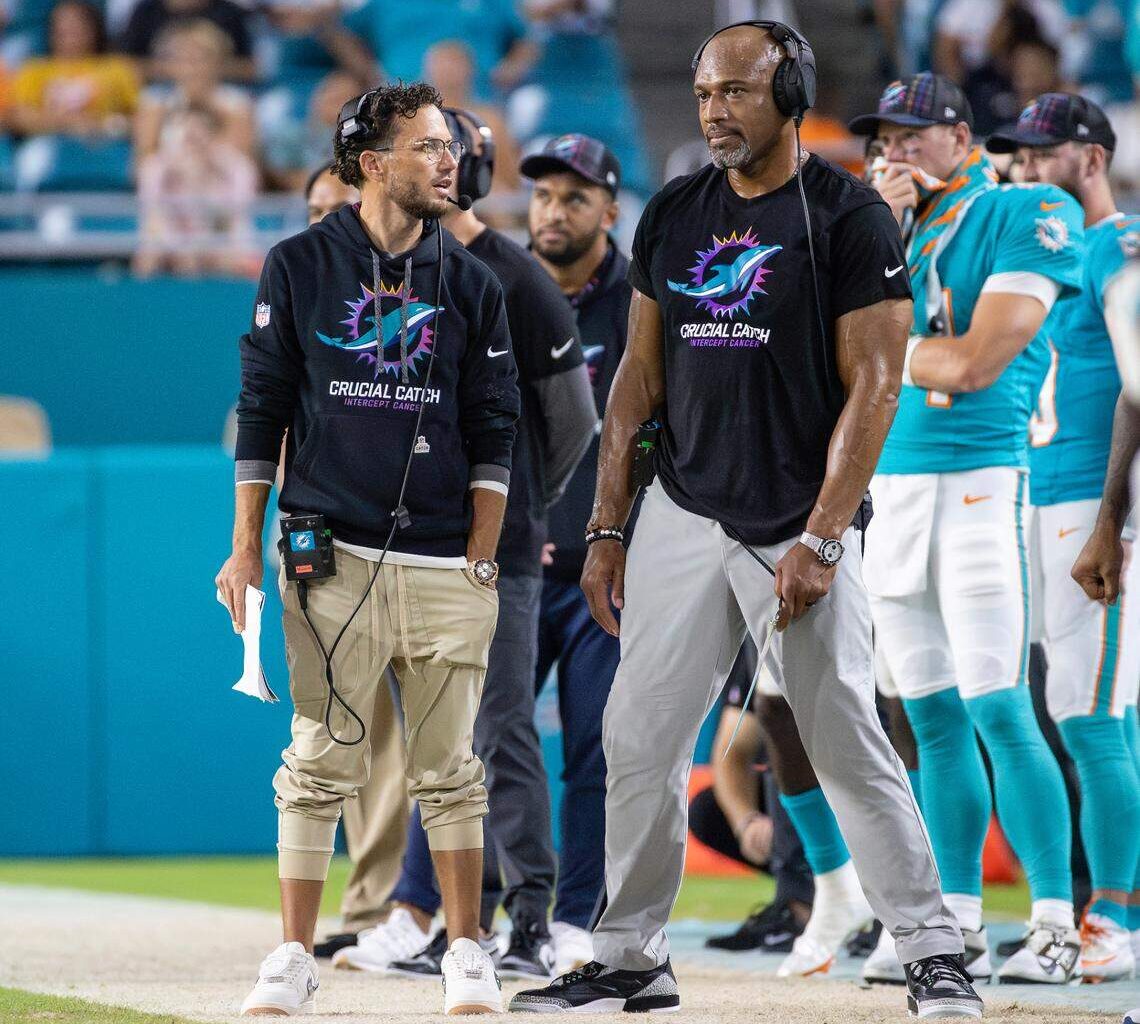
The passion on Anthony Weaver’s face was palpable.
As the Miami Dolphins defensive coordinator discussed the shortcomings of his unit, Weaver’s trademarked huge smile slowly faded. His voice didn’t raise, yet the tone became sharper. In a span of roughly three minutes, Weaver made it clear that he understood how much more difficult it was to play on that side of the ball than when he last suited up in 2008, however, the defense needed to increase its aggression.
Advertisement
“I’m old school,” Weaver said. “I may sit up here, I’m a nice guy. I smile, I do all those things, but all of our problems that we need to solve can be solved through violence. Yeah, they want to legislate it out of the game, but we play defensive football. Defensive football at some point you draw a line in the sand and you say, ‘I’m going to set the edge. I’m going to stick my helmet under this guy’s chin and I’m going to set the edge. I’m going to violently take the ball away.’ And that’s what we need to do.”
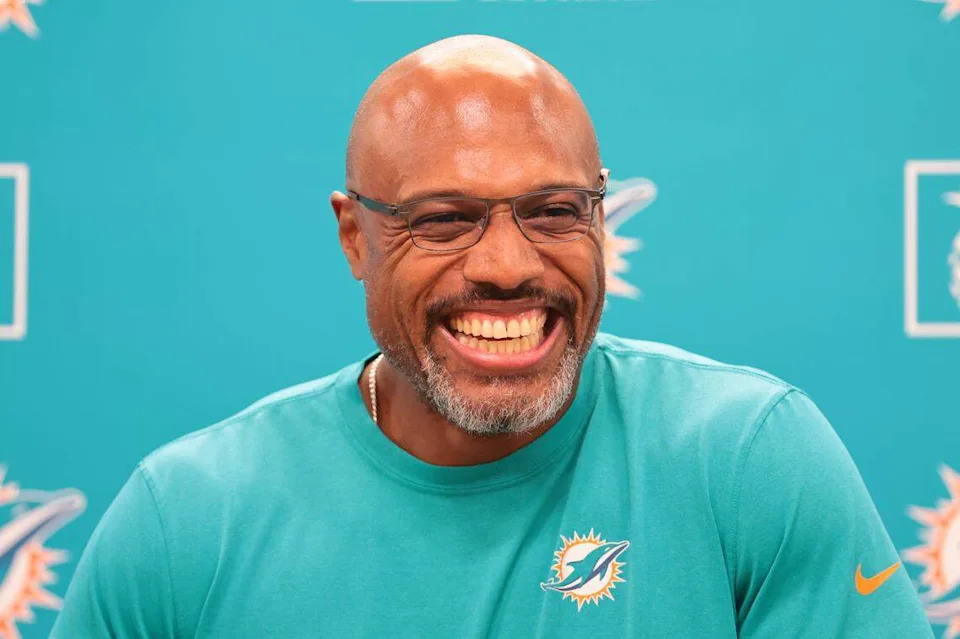
Miami Dolphins defensive coordinator Anthony Weaver speaks to reporters before practice at Baptist Health Training Complex in Miami Gardens, Florida, Thursday, September 4, 2025.
That much happened during the third quarter of the Week 3 matchup against the Buffalo Bills. Outside the Bills’ touchdown on the opening drive of the quarter, the Dolphins defense forced punts on back-to-back possessions, something that nearly allowed the team to get back in the game. And as the team marinated on the 31-21 loss, they believed to have found something to build on for the rest of the season.
“I just feel like everybody made up their mind that we’re not going to keep going out like this,” cornerback Jack Jones said of the defense’s play in the third quarter. “We’re not going to keep giving up touchdown after touchdown, score after score.”
Advertisement
That mind-set didn’t necessarily appear to be the case when the game began. Like most of the Dolphins’ previous matchups, the defense ceded points early. The immediate consequence, according to Weaver, was the “chaos” that erupted on the Dolphins sideline.
“I didn’t think we were playing physical enough,” Weaver said. “I thought they punched us in the face early. Our response to that wasn’t what I would think would put us in position to respond accordingly. We reacted. There was some chaos on the sideline, and when that happens, you’re just not going to play good, connected defense. You start worrying about the previous play instead of the play that’s in front of you.”

Sep 18, 2025; Orchard Park, New York, USA; Buffalo Bills quarterback Josh Allen (17) makes a pass for a touchdown against the Miami Dolphins in the second quarter at Highmark Stadium. Mandatory Credit: Gregory Fisher-Imagn Images | Gregory Fisher-Imagn Images
A different team, however, came out in the second half. Tyrel Dodson’s sack of Josh Allen led to an unnecessary roughness call. Jones made two critical tackles on back-to-back downs to force a third-and-long. Matthew Judon pressured the reigning MVP to force an incompletion. Rasul Douglas had sticky coverage to force another incompletion.
Advertisement
Although it didn’t lead to a victory, the violence that Weaver mentioned was clearly apparent. He challenged the defense to keep that level of intensity during an impassioned speech to the team early in the week.
Weaver “played the game, so of course he knows what [violence] looks like,” defensive tackle Benito Jones said. “So when we ain’t doing it, I think sometimes it pisses him off.”
Added Benito: “How he was talking, how his voice was moving the room, I was looking at him like ‘Weave talking.’ He’s the guy that played the game and is now coaching it. His message got across. We went out there Wednesday and practiced hard. I’m just waiting for Monday so we can go out and do what we got to do.”
Even coach Mike McDaniel couldn’t help but feed off of Weaver.
Advertisement
“We talked about how we can coach [while] adjusting our play energy and our passion,” McDaniel said. “Working together through that fires me up. That’s a good representation of one of the reasons Anthony Weaver is here.”
The obvious test of whether Weaver’s passionate plea will come during Monday’s prime time matchup against a divisional foe in the New York Jets. But as veteran edge rusher Matthew Judon said, the violence that Weaver wants his defense to play with won’t just manifest itself at kickoff – it should’ve been building from the very moment that the team walked off the field at Highmark Stadium.
“You don’t cook it; you come with it,” Judon said. “You come into the game into the game with violent intentions. You arrive to the ball with violent intentions every time the ball is snapped until the whistle blows, until it’s zeros on the clock no matter the score.”