
On the Seattle Seahawks’ opening possession against the Arizona Cardinals on Thursday night, running back Zach Charbonnet was stuffed at the line of scrimmage on fourth-and-1. The next day, coach Mike Macdonald conceded that Seattle instead could have — and perhaps should have — used its version of the tush push with tight end AJ Barner, who has twice converted in short-yardage situations this season.
“You can put that on me in terms of diagnosing how long the (distance to gain) was,” said Macdonald, who has previously stated that the Barner play isn’t the default call in those situations because of the difference between needing a few inches, a full yard or a yard-and-a-half to move the chains.
More concerning for the Seahawks than Macdonald’s misjudgment was the fact that Charbonnet’s run wasn’t close to being successful.
By the time Charbonnet received the shotgun handoff, rookie left guard Grey Zabel had been blown off the ball by Arizona defensive tackle Dalvin Tomlinson. The immediate penetration forced Charbonnet to bounce the run outside and right into the arms of linebacker Mack Wilson.
The @AZCardinals defense gets the stop on 4th down 😤
SEAvsAZ on Prime Video
Also streaming on @NFLPlus pic.twitter.com/a3UCvJPLh5
— NFL (@NFL) September 26, 2025
That play was emblematic of a larger theme through what has mostly been a promising 3-1 start to the season: Seattle isn’t very good at running the ball.
Every team, Super Bowl contenders included, has flaws. Despite a glaring one, the Seahawks have managed to win their past three games. They are very obviously a good team at the moment. The defense is elite, quarterback Sam Darnold has the passing game humming and his connection with Jaxon Smith-Njigba is creating problems for the opponent every week. The sky isn’t close to falling.
But what stands out about Seattle’s current flaw is that it happens to be the facet of the game intended to be the offense’s bread and butter. It is encouraging to see Darnold moving the ball efficiently through the air without the support of a high-end run game, but if the Seahawks are to be a great team — which is their stated goal — then they need to get more out of the ground game, specifically the perimeter runs.
As Macdonald said on his radio show on Sept. 15, “If we’re not going to be able to hang our hat on wide zone, then we’re going to be in trouble.”
The Seahawks are not in trouble, but they could be if they don’t figure something out during this mini bye week to better execute the most important part of the offensive scheme.
After Ken Walker III and his fellow running backs averaged fewer than 3 yards per carry in a blowout win over the New Orleans Saints in Week 3, Macdonald declared that the run game was “not even close” to being good enough. Seattle took a step forward in Week 4. Walker rushed for 81 yards on 19 attempts and produced a pair of first downs, coming on carries of 20 and 21 yards. Charbonnet had just 39 yards on 12 carries but had more first downs (three) and found the end zone.
However, they combined to produce eight runs that either went backward or were stuffed for no gain. Both of Seattle’s starting running backs rank well worse than the league average in percentage of runs that fall into one of those categories (all stats provided by TruMedia unless stated otherwise). Some of that is their doing, but the bigger pieces of the blame pie belong to everyone else.
“It’s a process (versus) result thing you’re looking at,” Macdonald said of Walker and Charbonnet’s rate of unsuccessful carries. “We ran for (155 yards) yesterday, so there’s a lot of good stuff that we’re doing. I think we took a step from the week before, but there are runs where we’re not getting off the ground. It’s really everybody: It’s how we design it, how we coach it, how we’re blocking it, how we’re running it.
“It’s a lot of things. That’s part of the things we’re going to be looking at moving forward, especially over the weekend, and see how we can improve.”
Seattle’s run game is well below average by several advanced metrics, including EPA per carry, yards before contact and percentage of runs for a loss or no gain. Its success rate is mediocre. Charbonnet and Walker have combined for five touchdowns in four games, but that hasn’t been a product of dominance on the ground.
As Macdonald said, there are multiple factors impacting the rushing numbers. One factor is the way defenses are choosing to defend them. Seattle faces light boxes at a very low rate and sees eight-man boxes at a very high rate. Offensive coordinator Klint Kubiak’s scheme often deploys a fullback or multiple tight ends, and defenses are responding with heavy personnel and loaded boxes. It can be hard, though not impossible, to run the ball efficiently under those circumstances.
The other, arguably more impactful factor: Seattle simply isn’t executing very well on rushing attempts. Some examples are very glaring, like when an offensive lineman, tight end or wide receiver is knocked backward or thrown to the ground by the guy he’s supposed to be blocking. This was an issue on multiple runs against the Cardinals, whose much-improved defensive front made Seattle fight for nearly every yard Thursday night.
On many of Seattle’s other unproductive runs, the operation just looks out of sync. Linebackers go unblocked. Defensive backs aren’t contacted by receivers at the point of attack. Offensive linemen come off the ball seemingly unsure of which defender to block. Ahead of Week 4, Macdonald said Seattle’s run game simply needed better running and better blocking. But he has also mentioned the need for the targeting and communication to be on point. Those issues appear to be just as prevalent as the execution of the blocks themselves.
Kubiak alluded to this as well when he assessed the run game before facing Arizona. “We can coach better there,” he said. When asked a follow-up question, Kubiak said: “We’ve got to be more detailed. It starts with me.”
There’s some coach-speak in those answers, but it’s not hard to see where the details are lacking in Seattle’s rushing attack. Whether those errors fall on Kubiak, his assistants, Darnold, center Jalen Sundell or all of the above, the bottom line is the Seahawks haven’t been very sharp, and it’s hurting the run game. This is notable given that “more clarity in the scheme” was supposed to lead to improvement this season
So, what’s the fix?
Seattle has four backup offensive linemen on its active roster: Olu Oluwatimi, Josh Jones (who missed Thursday’s game with an ankle injury), Bryce Cabeldue and Mason Richman (Christian Haynes is eligible to come off injured reserve, but it’s unclear if he’s near a return). Rookie tackle Amari Kight was called up from the practice squad and played two offensive snaps as a sixth offensive lineman Thursday. Veteran guard Shane Lemieux was recently signed to the practice squad, which also features center Federico Maranges.
While addressing his guard depth on Sept. 1, Macdonald said that in the event of an in-game injury at guard, Sundell would move to guard and Oluwatimi would take over at center. It’s unclear whether Seattle would consider shaking up the rotation without an injury, putting Oluwatimi in at center, moving Sundell to right guard and taking out Anthony Bradford. But the staff has gushed about how the competition at certain positions has brought out the best in its defensive players. The same philosophy might be applied to get the best out of its front line.
Schematically, the Seahawks won’t pivot from their identity. They roster multiple fullbacks and regularly put multiple tight ends on the field. Defenses will likely continue to combat that style of play with bigger bodies and heavy boxes.
The upside for the Seahawks is that Darnold will probably keep taking advantage, because Smith-Njigba is a matchup problem, and the team has two capable pass-catching tight ends in Barner and rookie Elijah Arroyo. That’ll be enough to win more games as long as the defense continues to be one of the league’s best.
But to truly unlock the full potential of this offense, Seattle must be able to lean on its run game. On the wall that players pass on the way from the locker room to the outdoor practice field is the slogan: “A style nobody wants to play.” Offensively, they know exactly what they want that style to be, and they mostly have the personnel to deliver it. They just need the on-field product to match those words.
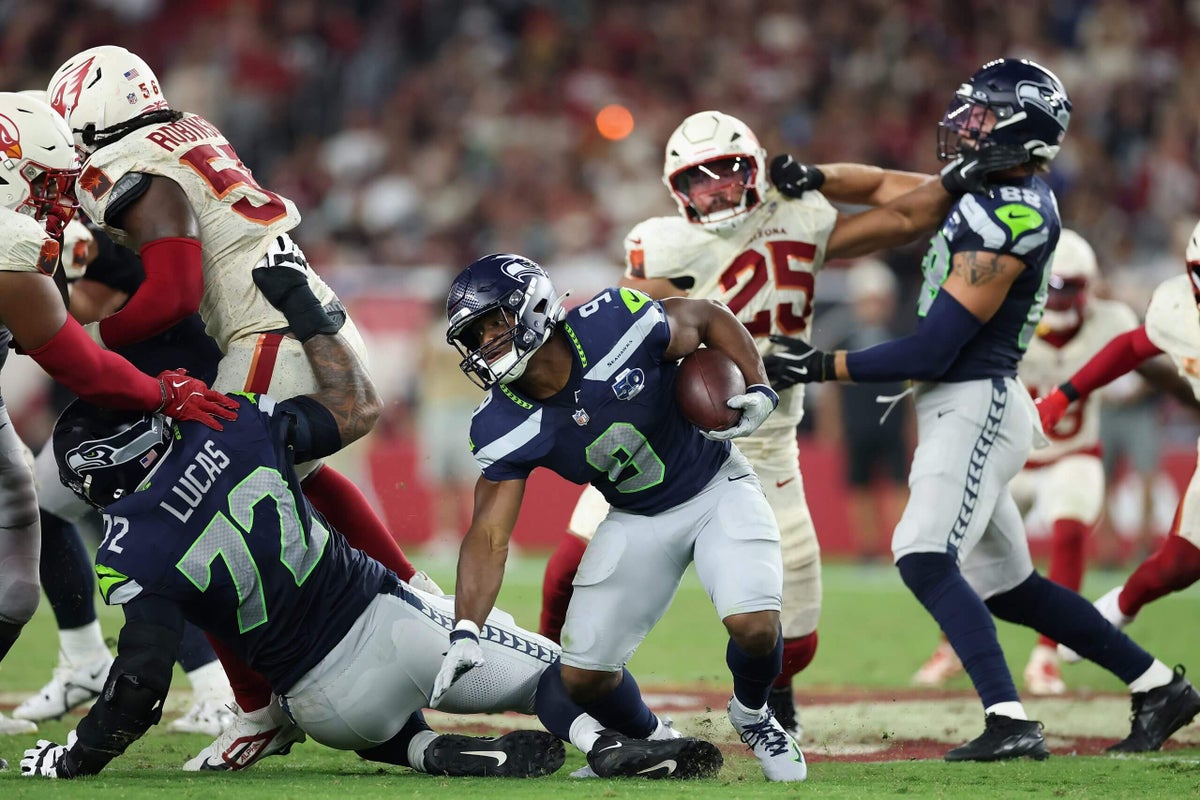
(Photo of Kenneth Walker III: Christian Petersen / Getty Images)