
The NCAA is on the verge of approving a single transfer window in college football that would allow players on teams competing in the postseason to remain eligible for playoff and bowl games before entering the portal.
The window of Jan. 2-16 was approved by the Division I bowl subdivision oversight committee on Monday and needs only a final signoff from the D-I administrative panel next month to take effect.
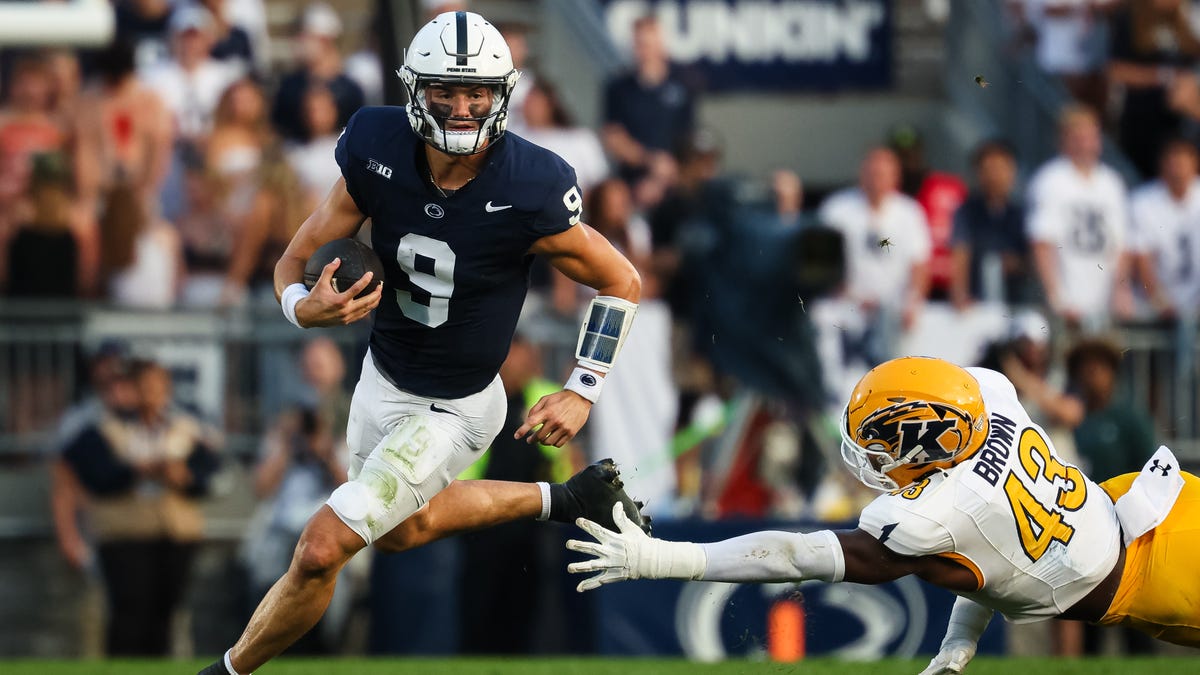
Bowl subdivision coaches voted unanimously to support the January portal proposal during their American Football Coaches Association convention earlier this year. The change would allow them to focus more on coaching during bowl season, and it would prevent most teams from losing active players as they prepare for important games. Last winter, Penn State backup quarterback Beau Pribula entered the portal and missed his team’s run in the College Football Playoff.
“The current NCAA post-season model creates a challenge for student-athletes,” Pribula, now at Missouri, wrote on social media at the time. “The overlapping CFB playoff & transfer portal timeline has forced me into an impossible decision.”
Players on CFP teams will have a five-day window to enter the portal following their team’s final game. All other players will have from Jan. 2 to Jan. 16 to enter, instead of the current Dec. 9-28 window.
Already gone is the spring portal period, which was April 16-25 this past offseason. That saw many players and coaches juggling transfers and spring practice. Nico Iamaleava, a quarterback who led Tennessee to the playoff last season, left the Volunteers for UCLA in the spring, leaving Tennessee scrambling.
The oversight committee had initially recommended a 10-day notification-of-transfer window from Jan. 2-11 but expanded it after feedback from athletes. Other than the CFP exception, the only other way for football players to transfer outside the new window is if a coach is fired; in those cases, players may enter the portal within 30 days. The committee is considering changes to that exception as well.
Australian kickers stand out in Big 12 Conference
Boulder, Colo. – The Big 12 has certainly gone Down Under to get a leg up in the punting game. Nine of the conference’s top 15 punters this season hail from Australia.
Crikey! That’s a lot of booming Aussie punters, mate.
“Punting is a natural thing for us,” explained Colorado’s Damon Greaves, who’s from Busselton, a small city in the southwestern corner of Western Australia. “You guys grow up throwing it. … We grow up punting it.”
Statistically, the league’s best Aussies include Finn Lappin (Kansas), Liam Dougherty (Houston), Max Fletcher (Cincinnati), Orion Phillips (Utah), Jack Burgess (Texas Tech), Sam Vander Haar (BYU), Greaves, Oliver Straw (West Virginia) and Ethan Craw (TCU).
Combined, the Australian contingent is averaging 44.1 yards per boot this season. They’ve also pinned opponents inside the 20-yard line on 55 occasions. Craw has the long punt of the bunch this season at 69 yards.
The influx of Aussies can be attributed, in part, to Australian rules football, which is a blend of running with the ball (think tailback) and kicking (punter). Just like American football, Aussie version uses an oddly shaped ball (in their case, an oval).
Most players can kick with either foot and roll out either way to rocket a punt – just in case it’s needed.
The transition between Aussie rules and American football, though, takes some time.
That’s where Prokick Australia enters the picture. The development academy teaches burgeoning punters the proper technique, skills and strategy. Not only that, but the program gets prospective players used to playing with a helmet and pads.
There are roughly 85 players from Prokick Australia in American college or pro football. Among those are Broncos rookie Jeremy Crawshaw (Florida), Bears punter Tory Taylor (Iowa) and Seahawks punter Michael Dickson (Texas).
The program has produced Ray Guy award winners and numerous All-Americans since it was started in 2007 by former Australian Football League player Nathan Chapman.
“We’re instinctively good at kicking. But there’s not much that needs to happen for it to go wrong, so we still need to practice it,” Chapman said in a phone interview from Australia. “It’s part of what we’ve grown up doing and this is where we start to just utilize some of those skills to bring it into the American game.”
The Big Ten had an influx of Aussie punters in 2022.
Now, it’s the Big 12’s turn.
“If we put a dominant punter in the Big Ten or the Big 12 or the SEC and a coach plays against one of our players and says, ‘I want that,’ we need to give them someone who’s going to compete against that level,” Chapman explained. “We’re really selective on who we give the opportunity to kick at that level and they do a lot of training to get through our processes to make sure that we feel like they can handle the demands of SEC football or the Big 12.”
Greaves grew up playing high-level Australian rules football before making the switch to punting. He started his career at Kansas and then transferred to Colorado.
The path to college was a winding one for the 28-year-old Vander Haar. He spent a number of years selling swimming pools for his dad’s company before attending a tryout with Prokick Australia. He learned the nuances of punting and it turned into an opportunity to kick for Pittsburgh and now BYU.
“I never even thought I’d go to university,” Vander Haar said. “I looked at some jobs, but I didn’t have a degree, and so that kind of stumped me a little bit. But then obviously I felt like I could punt the football a little bit, and so I joined Prokick.”
It’s forged friendships, too.
On Friday, when the Cougars (4-0, 1-0 Big 12) host West Virginia (2-3, 0-2) it will be a momentary reunion for two close friends. Straw was in Vander Haar’s wedding.
Last weekend, Vander Haar had the chance to catch up with Greaves in Boulder.
“It’s like a Prokick pipeline,” Vander Haar said. “There’s a bunch of us and it’s kind of cool.”
It even extends beyond the Big 12.
Vander Haar connected with another Prokick alum, Tomas O’Halloran of East Carolina, before their game on Sept. 20. Vander Haar didn’t know the punter but received a message from O’Halloran on social media.
“He was like, ‘What’s up? It would be cool to hang out,’” Vander Haar recounted. “You just have that bond – you all came from the same program.”
Swinney relishes chance to face Belichick
The coaching clash between Bill Belichick and Dabo Swinney may have lost its luster with North Carolina and Clemson off to disappointing starts, but don’t tell Swinney that.
Swinney said he’s embracing the opportunity to coach against Belichick on Saturday when his Tigers face the Tar Heels in Chapel Hill.
“Yeah, I mean, are you kidding me? It’s amazing,” Swinney said Tuesday. “I mean, I never in my lifetime thought I would get an opportunity to coach against coach Belichick. I mean, how cool is that?”
It marks only the second time in college football history that a coach with multiple national championships will face one with multiple Super Bowl titles. Bill Walsh, a three-time Super Bowl winner with the San Francisco 49ers, led Stanford against two-time champion Joe Paterno and Penn State in the Blockbuster Bowl on Jan. 1, 1993.
The spectacle of Belichick’s arrival at the college level has commanded a national spotlight.
UNC’s hiring of the six-time Super Bowl-winning head coach (he won two others as an assistant) looked to be an all-in bet to upgrade the program – which included paying Belichick at least $10 million in each of his first three seasons – and reset the balance of the Atlantic Coast Conference. Swinney’s Tigers have long dominated the league, winning eight of the last 10 titles.
Excitement grew over the Oct. 4 matchup as the season approached and it figured to be one of the marquee games on the college football schedule.
But North Carolina’s opener turned into a debacle, with TCU running a sold-out crowd out of Kenan Stadium by the end of the third quarter in a 48-14 blowout. UNC’s two wins came against Charlotte and Richmond before the Tar Heels lost to another Big 12 team – UCF – by a 34-9 score.
Clemson has been an even bigger disappointment.
The Tigers entered the season ranked No. 4 in the AP poll, the overwhelming favorite to repeat as ACC champions and expected to compete for a third national title under Swinney after returning the most experienced team in the country.
But first-team preseason All-American Cade Klubnik and company stumbled out of the blocks, losing at home to then-No. 9 LSU. Little has gone right since.
The Tigers needed a second-half comeback to beat Troy, and then dropped back-to-back games to Georgia Tech and Syracuse to fall to 0-2 in the league. The Tigers had entered the game against the Orange as a 17 1/2-point favorite at home, but fell behind 10-0 early and lost 34-21.
Clemson’s 1-3 start is its worst in the Swinney era, and the Tigers spent the bye this past weekend soul-searching, self-evaluating and resetting their season-long goals with their national championship hopes vanquished.
“It has been a coaching failure,” Swinney said. “We have failed as coaches. … I’m not pointing the finger, I’m pointing the thumb.”
With both teams struggling, the ACC scheduled the game for a noon EDT kickoff – not the prime-time matchup that many had anticipated. Rapper Ludacris was booked to perform before the game on the Chapel Hill campus, a concert that is now set to start at 9:40 a.m.
Swinney said it’s time for the Tigers, two-touchdown favorites, to “see what we’re made of.”
Belichick and Swinney had crossed paths before Belichick’s arrival at UNC, though they got to know each other more in the ACC coaches’ meetings during the offseason. At the time, Swinney joked that seeing Belichick at the meetings was “so 2025.”
Belichick said he began picking Swinney’s brain in an effort to garner insights from his long run of coaching at the college level.
“Dabo spoke a number of times about various issues, and I can just tell from his comments and his opinions on certain things where he was coming from, what his beliefs are, what’s important to him and what his convictions are,” Belichick said. “And those were all pretty consistent with what I thought they would be.
“But to actually hear him articulate them and talk about things that he deals with as the head coach at that school – that in all honesty, I haven’t had enough experience at this level to appreciate all those – was very insightful for me. We talked about some things outside of the meetings, off-camera and things like that. But he’s been very, I would say, helpful with a couple of things that I’ve asked him about just in general. And I appreciate his openness and willingness to try to give me some advice that I’ve asked for.”
Swinney said he was more than happy to help.
“The guy’s got eight (Super Bowl) rings,” Swinney said. “He’s arguably the greatest (coach) ever, certainly at the pro level. It’s a cool thing.”
Big 12 fines Colorado $50K for derogatory chants
Colorado coach Deion Sanders apologized to BYU on Tuesday just before the Big 12 Conference reprimanded the Buffaloes and issued a $50,000 fine for derogatory chants by fans over the weekend.
The expletives and religious slurs directed at Mormons took place as No. 23 BYU beat Colorado 24-21 at Folsom Field.
“That’s not indicative of who we are,” Sanders said before wrapping up his weekly news conference. “Our student body, our kids are phenomenal, so don’t indict us just based on a group of young kids that probably was intoxicated and high simultaneously.
“Maybe I shouldn’t have said that as well, but the truth will make you free. But BYU, we love you, we appreciate you and we support you. God bless you.”
Big 12 Commissioner Brett Yormark condemned the chants in a statement announcing the penalty.
“Hateful and discriminatory language has no home in the Big 12 Conference,” he said. “While we appreciate Colorado apologizing for the chants that occurred in the stands during Saturday’s game, the Big 12 maintains zero tolerance for such behavior.”
BYU is the flagship school for The Church of Jesus Christ of Latter-day Saints, widely known as the Mormon church. Last February, the University of Arizona apologized after that school said some fans engaged in an “unacceptable chant” as the Wildcats basketball team lost 96-95 to BYU.
Earlier this week, Colorado’s leaders condemned the behavior of those fans involved in the use of profane and religious slurs.
“Such behavior is deeply disappointing and does not reflect the values of respect, inclusion and integrity we expect of our campus community,” read the statement, which was issued from chancellor Justin Schwartz and athletic director Rick George.
The school said it has a strict policy regarding abusive behavior and those “found to have engaged in conduct that is not consistent with our values are held accountable.”
“Discriminatory language and hostile conduct have no place at our athletic events or anywhere on our campus,” the statement continued. “We thank the majority of our fans who continue to support our teams with enthusiasm and respect.”
The Cougars host West Virginia on Friday, while the the Buffaloes play at TCU on Saturday.
 Want to comment on this story? Become a subscriber today. Click here.