
Florida State and Virginia were locked in a double-overtime thriller as the ball headed to Seminoles receiver Duce Robinson in the end zone.
Robinson bobbled the catch, then continued that juggle through the back of the end zone and out of bounds. The call was a touchdown, the kind of narrow-margin play certain to get closer scrutiny in replay review.
Only now, TV viewers for Atlantic Coast Conference games like that one get a clear window into how officials decide to overturn or uphold those calls.
The ACC is the first college league to let viewers listen live to reviews during select broadcasts. There’s no waiting for referees to take off their headset after a mystery-filled stoppage and deliver a verdict. Instead, viewers can hear frame-by-frame discussions between stadium officials and the replay command center at the league headquarters in Charlotte, North Carolina.
It’s offered a welcome dose of transparency, along with rave reviews for taking viewers somewhere they’ve never been before.
“You hear the whole conversation,” said Bryan Jaroch, ESPN vice president of sports production. “That transparency takes out any of the second-guessing of how they came to their decision. I would love to see this across every conference. We’re trying to push for that. But I think it’s exactly what we need to do.”
The first run
The debut came with 6:34 left in the first quarter of the Aug. 30 game between SMU and East Texas A&M on the ACC Network, a review that overturned a fumble call on Mustangs quarterback Kevin Jennings by ruling his arm was coming forward for an incompletion.
There have been seven games with the replay listen-in, generally earmarked for Friday night broadcasts on ESPN or ESPN2, as well as Saturday nights on the ACC Network. The plan can vary beyond that based on the volume of games monitored by the replay center at any one time, such as adding the Clemson-Georgia Tech game on Sept. 13 on ESPN with only one other ACC team playing in that same noon Eastern slot.
The ACC and ESPN, which have a media rights deal through the 2035-36 season, are still tinkering with the visual presentation of video overlays and graphics. But the experiment already has succeeded in pulling back the curtain with reviews, most notably with critical late calls such as Robinson’s later-overturned catch in FSU’s loss at Virginia.
“I think generally speaking, when people communicate, things get better,” Duke coach Manny Diaz said. “Because when people don’t communicate, then people assume, right? Our brains are designed to tell stories, so we either have the facts of the story or we make up the facts of the story.
“So I think it’s a good move for the league. It seems like it’s been well-received, to at least hear the thought process behind upheld, reversal, whatever. So at least people know what’s being said.”
The next usage comes with a spotlight of Saturday night’s matchup between No. 3 Miami and No. 18 Florida State.
“So here it is at prime time on ABC,” Jaroch said. “So I think even more people will see it and say: ‘Wow, that is amazing. That’s exactly what we’re looking for.’”
Getting started
ESPN had experimented with providing access to replay-review conversations going back to XFL games in 2023. The broadcaster had worked with the ACC last year to have a rules analyst listen to conversations between the on-field referee, the stadium replay official in the booth and the Charlotte replay center.
Then ESPN suggested letting viewers listen in, too.
The ACC had been working with off-site replay assistance for roughly a decade back to its previous home in Greensboro. When it opened its current headquarters in Charlotte two years ago, the plan included a video feed in the new command center showing replay officials huddling around monitors to study replays.
“We always say we have nothing to hide in that room,” said Michael Strickland, league senior vice president for football. “We wanted to put our money where our mouth was. So we started with the camera and that worked well. TV liked to use it.
“This sharing of the audio is kind of just the next iteration of that underlying philosophy that we’ve had for quite a while. And it is reflective of the ACC being willing to be a first mover in many different areas.”
Jaroch credited the ACC for making “a leap of faith” by putting those pressure-packed reviews on display. As he said: “Access always wins when it comes to fans.”
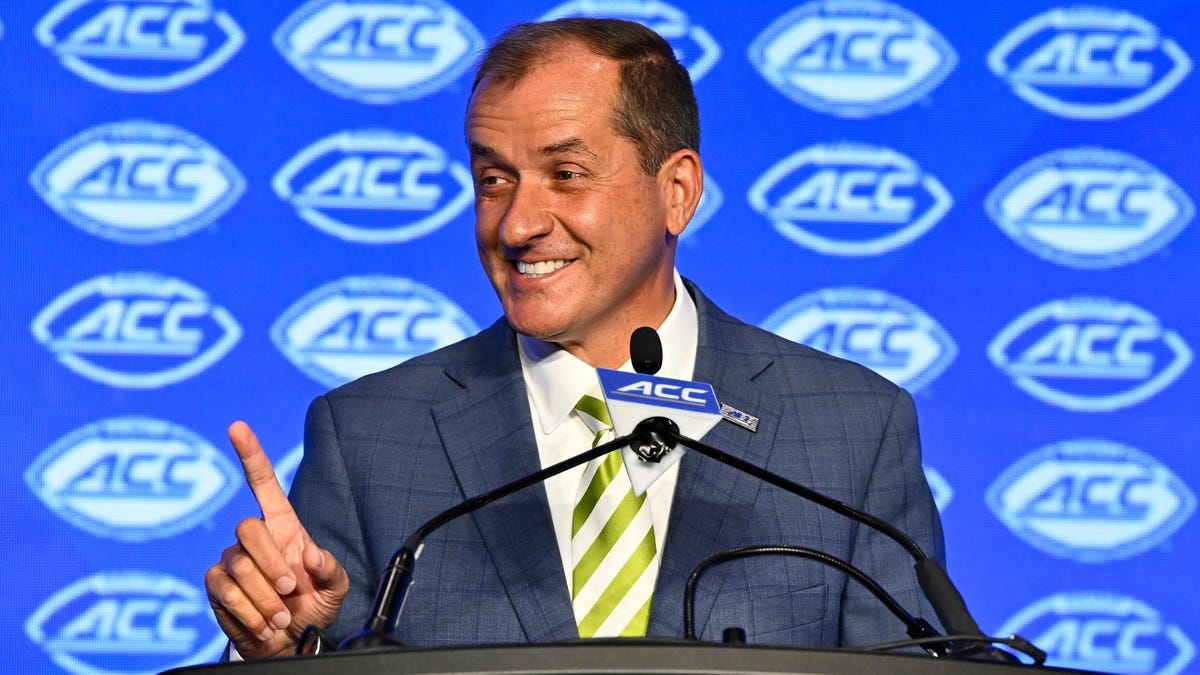
Strickland credited Commissioner Jim Phillips for signing off on the idea as good for the league and, more broadly, the sport.
“He could’ve easily said, ‘I don’t want to take that risk,'” Strickland said. “But he did not. He went the other route. It’s pretty awesome to work for somebody who believes in a group of people like he did and does.”
Making the call
The ACC has had high-profile chances to show viewers how reviews work.
Take a late TD catch in the Clemson-Georgia Tech game, for example. The Tigers’ Josh Sapp hauled in a pass near the back of the end zone and pinned the ball against his left thigh, then bobbled it further as he fell out of bounds.
The broadcast showed game referee Adam Savoie communicating via headset with the stadium replay official and the replay center crew in Charlotte. But now the audio fills in formerly missing gaps in that evaluation as officials combed through multiple angles in slow-motion playback.
“Do you see a loss of control with the foot in the white?” Savoie eventually asked.
“I don’t think he has control there,” a voice replied.
“I agree with you,” Savoie said before announcing the call was overturned.
Or there was the review of Robinson’s near-catch in the Virginia loss– “Still moving here, still moving,” a voice said of the ball in a frame-by-frame narration – as momentum carried Robinson out of the end zone before securing the catch.
“We believe in everybody that’s involved in the process,” Strickland said. “Because if we didn’t believe in them, they wouldn’t be here. So why not do it at the end of the day? And it’s nice to see that faith has been rewarded.”
Notre Dame relies on Carr’s high-scoring offense
South Bend, Ind. – No. 21 Notre Dame protected quarterback C.J. Carr in his first career start, a top 10 matchup on the road.
Since unleashing Carr in the second game, the Fighting Irish offense has become a scoring machine.
Notre Dame has topped the 40-point mark in three straight games and the 50-point mark in each of its last two, and they may need to do it again when high-scoring Boise State visits South Bend on Saturday.
“Where he’s at, is rare,” coach Marcus Freeman said before Carr makes his fifth career start. “Performing at the level he’s playing at is rare. But C.J. Carr is rare. He’s blessed with great talent and has the unique trait very few people have – he’s a competitive, selfless individual. Whatever it takes to win, he has that trait, and he’s mature in the way he prepares. It leads to improvement and really good results.”
Carr certainly has been turning heads. He leads all freshmen nationally in yards per attempt, yards per completion, passing efficiency and passing yards per game, and ranks in the Top 20 in each of those categories among all quarterbacks.
But he isn’t doing this alone.
The Irish (2-2) have one of the nation’s top rushing duos, Jeremiyah Love and Jadarian Price. They’ve combined for 614 yards and 11 TDs on the ground and are showing they can catch the ball by combining for four more scores through the air. Price also has a kickoff return for a TD.
“You want to stop the run? Good, OK, we can beat you. We can throw 400 yards like we did last week,” Notre Dame running backs coach Ja’Juan Seider said. “You want to take that away? Well, we can run for 200, 300 yards, whatever it takes to win.”
Notre Dame’s receiving corps is rounding into form, too.
Jordan Faison has lived up to the high expectations with a team-best 19 catches while the supporting cast seems to be improving by the week. Malachi Fields has been a solid second option, Eli Raridon looks like the next in a long line of good tight ends to play at Notre Dame and Will Pauling, the transfer from Wisconsin, caught his first TD pass last weekend.
Add another good offensive line, a favorable schedule and the prospect of Carr’s continued improvement to the mix and the suddenly strong Irish offense could carry this team – if given the chance.
“I don’t know he’s ever going to get all the keys to the Ferrari, but, I mean, we’ll let him take it out for a spin every once in a while,” offensive coordinator Mike Denbrock said, referring to Carr running the offense. “He’s done a nice job with it.”
They can’t stop now, either, given Notre Dame’s narrow margin for error.
Two early losses, at then-No. 10 Miami and at home against then-No. 16 Texas A&M by a total of four points, put Notre Dame’s playoff hopes in jeopardy and although it has rebounded with lopsided wins over Purdue and Arkansas, one more loss would almost certainly eliminate the 2024 national runner-up from the playoff picture.
The next step in the long road back is against another playoff team from last season, Boise State. The Broncos (3-1) rebounded from their 34-7 season-opening loss to South Florida with their usual style – scoring 49 points per game in routs of Eastern Washington, Appalachian State and Air Force.
With Notre Dame’s defense still struggling, the offense may need to exceed its three-game scoring average of 50.7 points over the past three weeks, creating the possibility of a shootout Saturday, a prospect Faison embraces.
“It’s very fun,” Faison said. “I mean, we go in there with the expectation of doing whatever it takes to win. We might score seven points, we might score 50 points, doesn’t matter. But hey, it’s obviously fun knowing that we’re going to go into there and try to perform.”
Federal panel dismisses NCAA appeal
Nashville, Tenn. – A federal appeals panel on Wednesday dismissed the NCAA’s eligibility case against Vanderbilt quarterback Diego Pavia, who is playing this season under a preliminary injunction.
All three judges agreed with the dismissal for lack of jurisdiction in a quick ruling returned after hearing only oral arguments Sept. 16 in Nashville. Judge Amul R. Thapar noted Pavia won the preliminary injunction before the NCAA hurt its appeal by granting a waiver to athletes in his position.
“The NCAA gave Pavia exactly what he wanted – a waiver that guaranteed he could play for Vanderbilt in 2025,” Thapar wrote. “Because that waiver provides Pavia complete relief at the preliminary-injunction stage, we dismiss the NCAA’s appeal as moot.”
Pavia started playing at New Mexico Military Institute in 2020. (The NCAA did not count that season toward eligibility because of the COVID-19 pandemic.) He led the junior college to the 2021 national championship, then played at New Mexico State in 2022 and 2023 before transferring to Vanderbilt for 2024, making this season his sixth overall in college football but only his fourth at the Division I level.
The NCAA pointed to what Thapar said on page 15, where he wrote “Congress should consider stepping in to preserve these benefits for the millions of young athletes yet to come. Until it does so, judges should tread carefully in this area and insist on a thorough record from which to rule.”
Tim Buckley, the NCAA’s senior vice president of external affairs, pointed to the SCORE Act with bipartisan support in Congress along with the backing of athletes from all three divisions.
“The SCORE Act is the only bill in Congress that would protect the NCAA’s longstanding academic eligibility rules – ensuring high school athletes get an opportunity to play in college,” Buckley said.
An attorney for the NCAA argued last month that the organization believes its rules determining athlete eligibility do not violate the Sherman Act or other antitrust laws. Rakesh Kilaru also said the NCAA intends to enforce its rules.
The NCAA granted a waiver after the injunction allowing eligibility through the 2025-26 academic year for junior college athletes who would have exhausted eligibility during the 2024-25 academic year.
A federal judge agreed last December that Pavia had a strong likelihood of success at trial against the NCAA rule limiting junior college players’ eligibility as a restraint of trade under the Sherman Act.
“If the NCAA had not issued a waiver, we would have had time to review the injunction and hand down a decision before the end of the 2025 season,” Thapar wrote for the panel. “Instead, in late 2024, the NCAA committed to allowing Pavia to play, so the mootness of the appeal made expedited review through the appellate process less important.”
The panel said its review was limited to the preliminary injunction only and does not affect Pavia’s lawsuit from continuing at the U.S. District Court level.
Pavia’s attorney Ryan Downton pointed to a key comment in Judge Whitney D. Hermandorfer’s concurrence: “As I currently understand things, that’s not because the NCAA can immunize any trade restraint from review by deeming it ‘eligibility’ related. Otherwise, the price-fixing in Alston could pass unscrutinized if recast as a rule rendering ineligible any player receiving excessive benefits.”
The NCAA is facing several eligibility lawsuits, and Downton has another lawsuit over the NCAA’s redshirt rule restricting athletes to playing four seasons with a redshirt season over five years with Vanderbilt linebacker Langston Patterson a lead plaintiff.
“In other words, both the JUCO and redshirt rules are subject to United States Antitrust laws – a threshold issue in both the Pavia and Patterson cases,” Downton said in a statement.
Pavia is a big reason why Vanderbilt is ranked No. 16 and 5-0 going into Saturday’s game at No. 10 Alabama.
Wembley Stadium will host Big 12 teams
Irving, Texas – Arizona State and Kansas will play in the first college football game at London’s Wembley Stadium next year.
The Big 12 Conference announced Wednesday that the Sun Devils and Jayhawks will meet in the Union Jack Classic on Sept. 19. It will be the league’s third game in Europe over two seasons.
Iowa State opened this season with a 24-21 victory over Kansas State in the Aer Lingus College Football Classic in Dublin on Aug. 23. TCU will face North Carolina in the same event to open next season.
“I’ve often said my goal is for the Big 12 to be the most globally relevant conference in college athletics,” Big 12 Commissioner Brett Yormark said. “Expanding our international presence will elevate our brand, create new opportunities for student-athletes and open the door to meaningful commercial growth for the league.”
Wembley Stadium, one of the world’s most iconic sports venues, hosted its first NFL International Series game in 2007.
Kansas will be the designated home team for the Big 12 game there next season.
 Want to comment on this story? Become a subscriber today. Click here.