
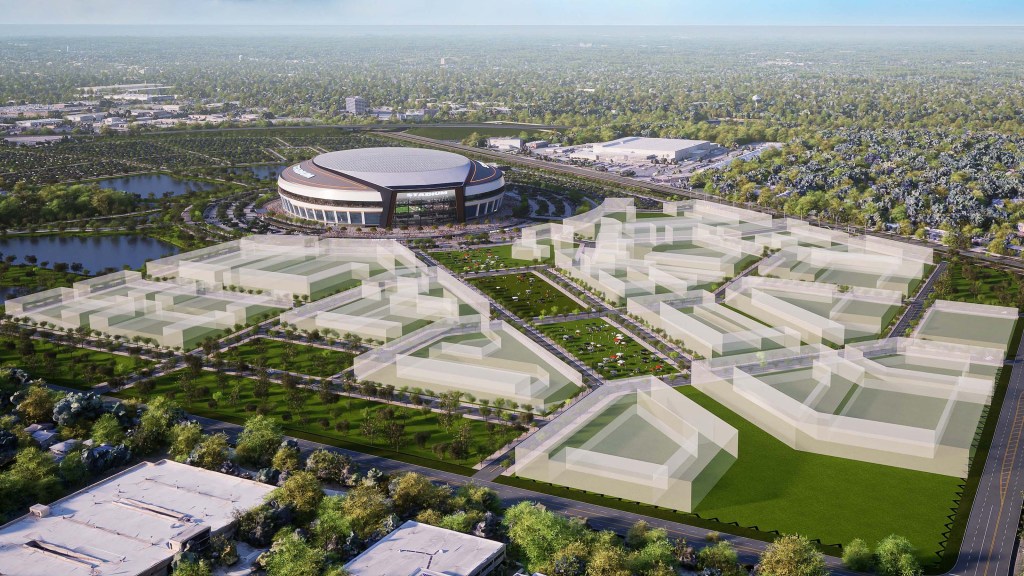
About 18 months ago, a proposal by the Chicago Bears, endorsed by Mayor Brandon Johnson, to build a new stadium on the lakefront landed with a thud in Springfield due to the team’s insistence on a $1 billion taxpayer subsidy for the facility’s construction.
The team since has switched gears to the former Arlington Heights racetrack property it owns and says it now will finance the entire stadium construction cost. There’s just the small matter of needed “public infrastructure” work to make the project feasible.
The estimated cost of that? A whopping $855 million.
That’s according to a consultant’s report commissioned by the village of Arlington Heights and paid for by the Bears. You’ll notice that the figure is not too far below the $1 billion request that torpedoed the Bears’ lakefront dreams.
This page has supported the principle that government generally bears some responsibility to pay for legitimate infrastructure in order to support development sizable enough to generate a big number of jobs and major economic growth. But at some point, depending on the scale, that infrastructure tab begins to morph into subsidy. At $855 million — and let’s be honest, the cost likely will be higher — we think the Bears already are at that point.
After all, a roughly $9 billion entity building a stadium can include some roads or a new train platform or two. Or find a way to do without them. If the entity so chooses.
The lofty price tag in the consultant’s report would cover new ramps to access the site from Route 53, a reconfigured Metra station and sewers and water mains that would serve not just the stadium but a substantial residential and commercial development on the remainder of the 326-acre site.
The report projected that the state would reap nearly $1.3 billion in additional tax revenue from the project, $400 million more than the infrastructure cost. But those tax contributions would come over 40 years, according to the Tribune.
Tax revenue isn’t the only measuring stick to use in gauging how valuable a new development is to the general welfare, but it’s an important one. And that long payoff time for an upfront public investment of $855 million is an important consideration in the discussions to come over state legislation the Bears say they need to break ground.
To remind readers, what the Bears want from the state is authorization to lock in a set amount of property taxes to be paid by their development over decades. That ask — yes, that too is a subsidy — already looks like a steep hill to climb, given the reluctance of Springfield’s Chicago delegation to approve financial inducements for the team to leave the city.
Gov. JB Pritzker already has laid down one marker. He’s said the Bears at a minimum should pay off the hundreds of million in outstanding bonds on the Soldier Field redo, which the team demanded from the city and state in the early part of this century.
So just to sum up what’s wrapped up in this Super Bowl of negotiations: clearing debt from Soldier Field’s books, the $2 billion-plus to build the Arlington Heights domed stadium, the $855 million in infrastructure, billions more to complete the rest of the project, and a property tax freeze that no other landowner in tax-burdened Cook County gets.
We’re probably missing something, too.
A fair deal for all the parties involved is going to be a monumental challenge. But one thing is clear to us: Infrastructure needs for a private development that approach $1 billion should not be strictly a public responsibility.
Submit a letter, of no more than 400 words, to the editor here or email letters@chicagotribune.com.