
John Hartwell, Utah State’s then-athletic director, heard from no shortage of interested candidates when Aggies coach Matt Wells left for Texas Tech in late 2018. His successor would inherit a team that had won 11 games and brought back future NFL star Jordan Love.
But influential donors at the school had their sights set on one man, former Utah State coach Gary Andersen, who rescued the program and led it to an 11-2 season in 2012 before leaving for Wisconsin and later Oregon State. Hartwell was not keen on the idea. Andersen had abruptly quit on the Beavers midway through a 1-5 season two years earlier, after which an Oregon reporter printed texts of the coach blasting his assistants.
But after receiving a call from his president, who’d heard from those donors, Hartwell accepted that he couldn’t hire anyone else.
“I think I’d have been gone,” said Hartwell, a college athletic director for 13 years who recently joined a consultancy firm, College Sports Solutions.
Andersen, unfortunately, confirmed Hartwell’s instincts. Even with Love, Utah State fell to 7-6 in the coach’s first season. During the 2020 campaign, the Aggies started 0-3, and he again resigned, forfeiting the remaining $2.7 million on his contract.
It was the latest in a long line of schools falling for nostalgia and hiring back coaches who’d once returned them to glory, only to find the sequel far less satisfying than the first.
“A lot of times the AD has to stand up there at the podium and smile and say this is the best choice for the job,” said Hartwell, “when you’re putting up a facade for something that was not your decision.”
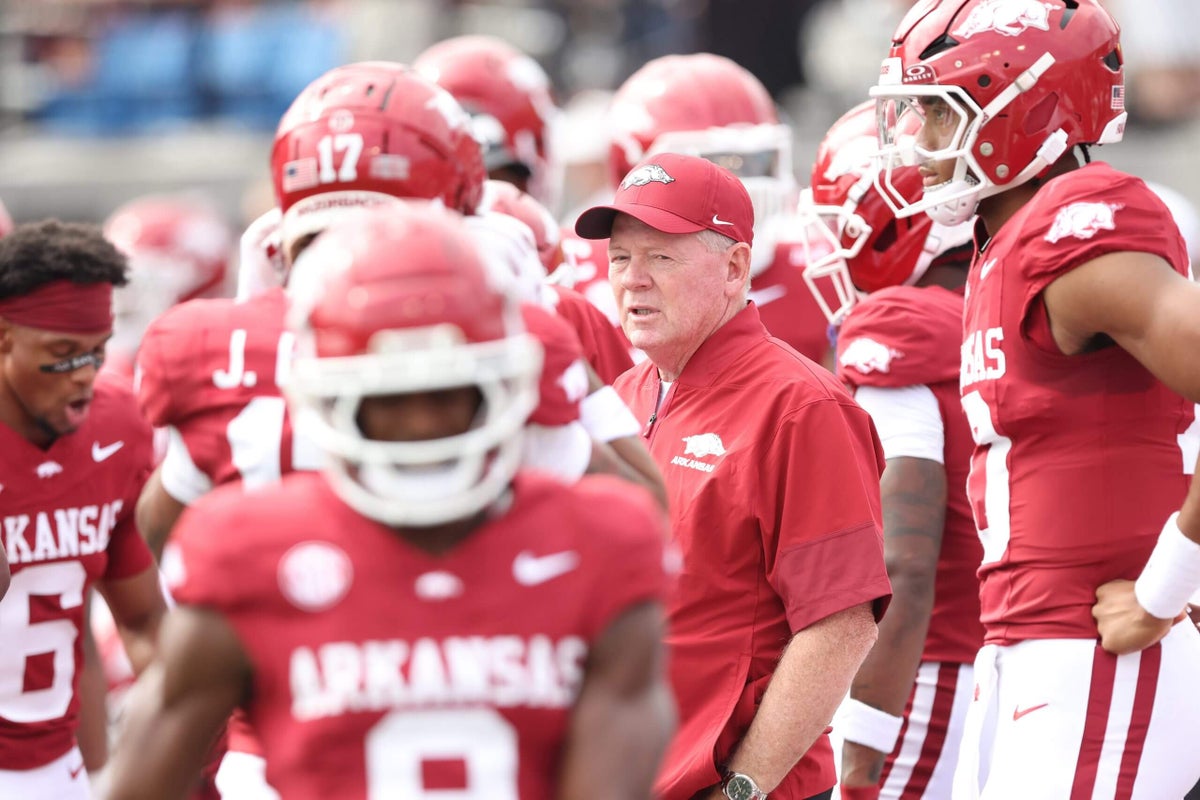
Hopefully, Arkansas AD Hunter Yurachek won’t have to put up a façade when he hires a new coach following this season. But it’s no secret who a significant chunk of his fan base wants it to be. In his announcement Sunday that he was firing sixth-year coach Sam Pittman and promoting offensive coordinator Bobby Petrino as interim coach, Yuracheck assured them, “(our) search will include Coach Petrino, who has expressed his desire to be a candidate for the full-time job.”
Yes, the same Petrino, now 64, who coached Arkansas from 2008 to 2011, leading the school to double-digit win seasons his last two years, but was fired for lying about the details of a motorcycle accident that revealed he was having an affair with a woman he’d hired in the football department.
Never mind that another school, Louisville, already tried this once before with Petrino and got burned, when his second stint there ended with a 2-10 debacle in 2018. Arkansas has only finished in the Top 25 once since Petrino’s 2012 ouster, and went 32-34 under Pittman, so many are more than willing to forgive and forget at this point.
Just see the YouTube comments from Arkansas fans on our Tuesday episode of “The Audible” discussing the possibility.
Just last year, both West Virginia (with Rich Rodriguez) and UCF (with Scott Frost) decided to bring back previously successful coaches. It’s too early to know how those experiments work out.
But for the most part, college football coaching sequels rarely end well.
Sequel coaches’ win-loss records
COACHSCHOOLFIRST TENURESECOND TENURE
Gary Andersen
2009-12: 26-24, one WAC title
2019-20: 7-9
Chris Ault
1976-95*: 164-62-1, seven conference titles
2004-12: 70-46, two WAC titles
Don Brown
2004-08*: 43-19, 2006 national title,
2022-24: 6-28
Mack Brown
1988-97: 69-46-1
2019-24: 44-33
Randy Edsall
1999-2010*: 74-70, two Big East titles
2017-2021: 6-32
Dennis Erickson
1982-85*: 32-15
2006: 4-8
Dennis Franchione
1990-91*: 13-9
2011-15: 26-34
Brady Hoke
2009-10: 13-12
2020-23: 27-20
Johnny Majors
1973-76: 33-13-1, 1976 national title
1993-96: 12-32
Bobby Petrino
2003-06: 41-9, two conference titles
2014-18: 36-26
Bill Snyder
1989-2005: 136-68, one Big 12 title
2009-2018: 79-49, one Big 12 title
Mike Riley
1997-98: 8-14
2003-14: 85-66
John Robinson
1976-82: 67-14-2, 1978 national title
1993-97: 37-21-2, two Pac-10 titles
Greg Schiano
2001-11: 68-67
2020-25: 29-36
Jeff Tedford
2017-19: 26-14, one MWC title
2022-23: 19-8, one MWC title
Mark Whipple
1998-2003*: 49-26, 1998 national title
2014-18: 16-44
*—School was in a lower division for some or all of the tenure
Between 1995 and 2024, 16 FBS coaches returned to the same school a second time, excluding interim tenures. Only three had a better winning percentage than they did the first time. Some, like UConn’s Randy Edsall (6-32 from 2017 to 2021), were total disasters.
Of the 11 who won a conference title during their first tenure, only four won one the second time. Most of the other seven did not come close.
Some came back to schools that had moved up a level (from FCS to FBS) since their first tenure. Two of those involved UMass, where former FCS national championship coaches Mark Whipple and Don Brown combined to go 22-72 during their second stints.
Of the 16, 10 were either fired, resigned or abruptly retired. One, Rutgers’ Greg Schiano, is still coaching.
There have been a few refreshing exceptions, first and foremost Kansas State’s Bill Snyder, who initially retired in 2005 after 17 highly successful seasons, only to return three years later and stay for another 10. He won his second Big 12 championship in 2012.
Mike Riley was only at Oregon State for two seasons the first time before moving to the NFL in 1999. He returned four years later and coached the Beavers for 12 seasons, four of them with top 25 finishes.
And Nevada’s Chris Ault, the coach there all but one year from 1976 to 1995, most of it in what was then I-AA, came back in 2004 and led the Wolf Pack to two WAC titles, the latter in 2010 with Colin Kaepernick.
Most of the other 13 did not fare nearly as well. Let’s focus on five who, like Petrino, left their school for the first time on a high.
Johnny Majors, Pitt
Pitt went 1-10 the year before it hired Majors in 1973. Four seasons later, he’d led the Panthers to a 12-0 season and 1976 national championship behind Heisman winner Tony Dorsett. After going 33-13-1, he left for his alma mater, Tennessee, where he spent 16 seasons before a messy, forced resignation in 1992.
Pitt, an independent during Majors’ first run, had joined the Big East that same year but gone 3-9. It happily welcomed back the Hall of Famer to perform another resurrection.
“That’s what I do, rebuild,” Majors said during his first season. “I guess that’s my niche in football. It’s worked out so far.”
Not this time. Pitt went 3-8, 3-8, 2-9 and 4-7 over his four seasons, at which point he retired from coaching.
John Robinson, USC
From 1976 to 1979, Robinson’s teams won the Rose Bowl three times in four seasons, claimed a share of the 1978 national championship and finished No. 2 twice. He coached there for seven seasons, and when he left for the LA Rams in 1983, he held the second-highest winning percentage (.807) in USC history.
A year after his nine-year run with the Rams ended, USC hired Robinson back in 1993 to bring back the days of Student Body Right.
“Somebody’s gonna carry the ball 30 times a game,” Robinson said when hired. “I’m gonna put up a stand next to those other Heisman trophies and get someone to fill it.”
It was actually a receiver, Keyshawn Johnson, who starred for his 1995 team that went 9-2-1 and beat Northwestern in the Rose Bowl. But after winning just six games the next two seasons, AD Mike Garrett left a message on the coach’s answering machine informing him he was fired.
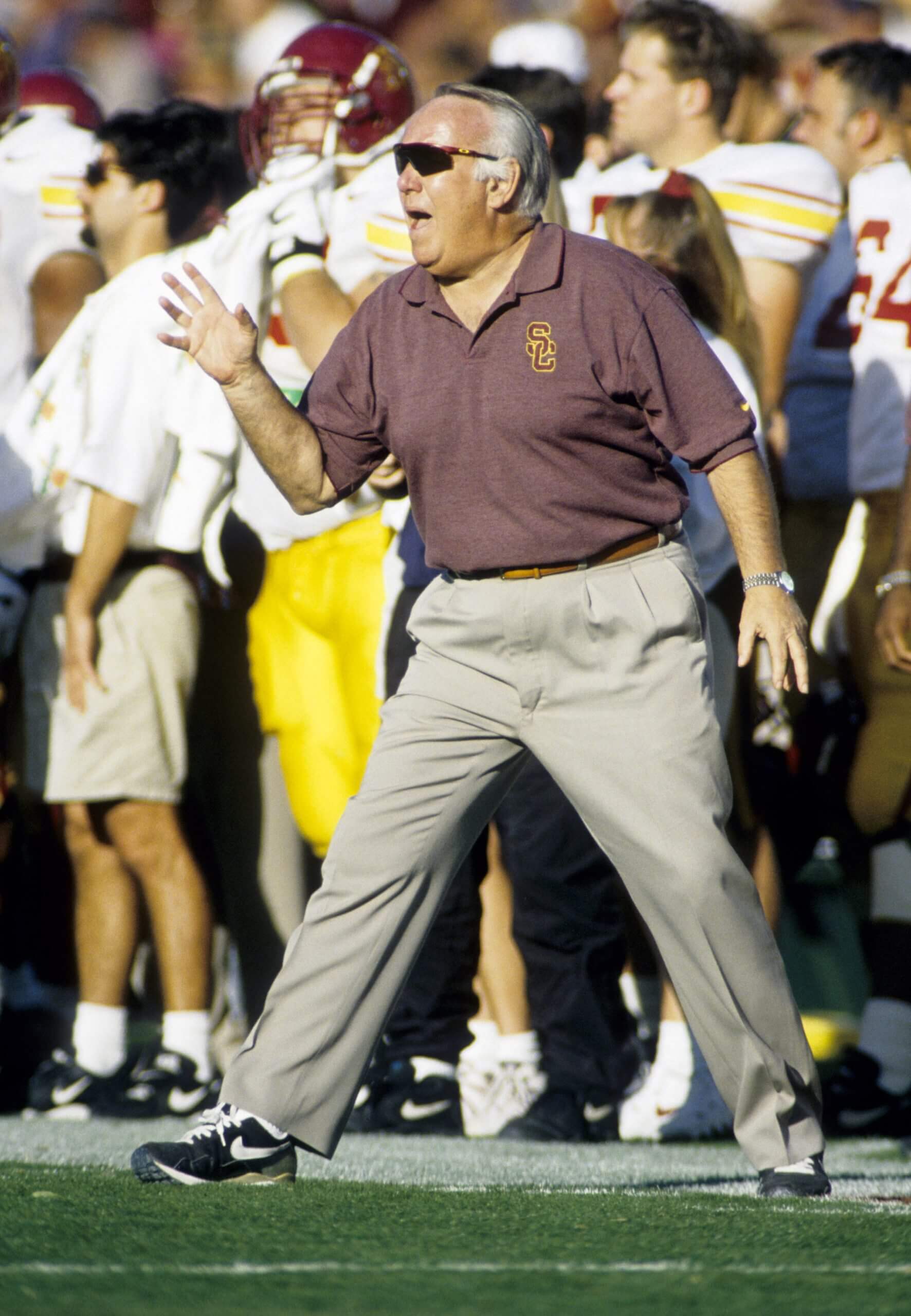
John Robinson never had a losing season at USC, but was fired after going 6-5 in 1997. (Long Photography / USA Today Sports)
Mack Brown, North Carolina
Over the span of a decade, from 1988 to 1997, Brown built up the Tar Heels from a 1-10 team in his first two seasons to back-to-back top-10 seasons in his last two. UNC’s final No. 6 ranking in 1997 was its highest in nearly 50 years. He then left for Texas, where he won the 2005 national championship and 77 percent of his games over 16 seasons.
Brown, then 68, had been out of coaching for five years, working as an ESPN analyst, when UNC summoned him back in November 2018 to replace Larry Fedora. To help recreate that mid-’90s vibe, he hired several of his former UNC players or assistants for his first staff.
Brown got off to a promising start, landing and developing future NFL QBs Sam Howell and Drake Maye and finishing in the top-20 in his second season, but he couldn’t build on the momentum. It was widely assumed he would retire after the 2024 season. When he didn’t, AD Bubba Cunningham fired him.
Randy Edsall, UConn
From 1999 to 2010, Edsall led UConn through its transition from FCS (then I-AA) to the Big East, culminating in a conference title and trip to the Fiesta Bowl, where the 8-4 Huskies lost 48-20 to Oklahoma. The next morning, he hopped on a plane to Maryland to take a new job. UConn folks were furious.
Six years later, after Maryland fired him, he returned to UConn. He went 6-29 from 2017 to 2019 and got a reprieve in 2020 when the school canceled its season. After losing to Holy Cross in the second game of 2021, he abruptly announced he’d be retiring at the end of the season. The school said, nope, he’s stepping down today.
Bobby Petrino, Louisville
Petrino first made a name for himself when he took over a long-irrelevant Louisville program in 2003 and led it to two top-10 seasons, the latter a 12-1 Big East championship campaign in 2006 that culminated with an Orange Bowl win over Wake Forest. But he alienated much of the fan base along the way by relentlessly flirting with other jobs, eventually taking one as head coach of the Atlanta Falcons. He abruptly left before the end of his first season to return to college at Arkansas.
We know how that ended.
Western Kentucky gave him a lifeline, but he left after one 8-4 season in 2013 when longtime Louisville AD Tom Jurich — who previously gave Petrino a 10-year contract, only to watch him bolt six months later — decided to go back into business with him.
“If it was the same Bobby that was here 10 years ago, I wasn’t interested,” said Jurich. “He is definitely a changed person.”
Petrino, to his credit, recruited and developed Lamar Jackson, who won the Heisman in his third season back. That season, the Cardinals reached 9-1 and No. 5 in the country before losing their last three games. Less than two years later, in 2018, Louisville imploded, going 2-10.
Petrino was fired with two weeks left in the season. The news broke during an airing of his Sunday morning coaches show.
But the man is nothing if not resilient. A year later, he resurfaced as head coach of FCS school Missouri State, where he went 18-15 from 2020 to 2022. Then came a year as Jimbo Fisher’s OC at Texas A&M. Then Pittman called. Then Pittman got fired, and here we are.
Next week at Tennessee, Petrino will lead Arkansas out of the tunnel for the first time since the 2012 Cotton Bowl against Kansas State. His chances at landing the full-time job will likely hinge on how 2-3 Arkansas closes out the season.
At which point, Yurachek has a decision to make. Will he listen to the vocal masses and hand Petrino the reins full-time? Or will he be mindful of the largely disastrous recent history of schools running it back with the same coach?
Like Louisville.
(Top photo: Nelson Chenault / Imagn Images)