
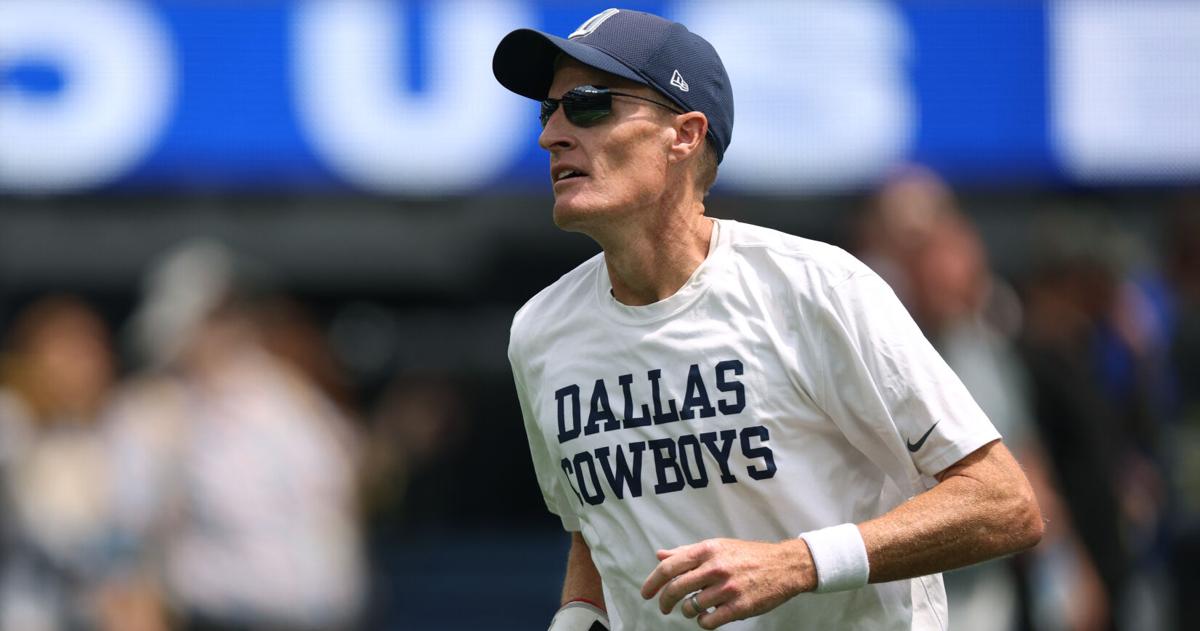
Titans special teams coordinator John Fassel deserves plenty of praise this season for making significant upgrades in that portion of Tennessee’s game.
Heading into Week 6, Fassel has the Titans ranked seventh in kick returns (26.6-yard average), eighth in punt returns (13.7-yard average), 26th in kick coverage (27.3-yard average, which is still better than last season’s 32.1) and ninth in punt coverage (8.4-yard average).

John Fassel is seen during his time as specials teams coach of the Dallas Cowboys and before a preseason game against the Los Angeles Rams at SoFi Stadium on Aug. 11, 2024, in Inglewood, Calif.
Getty Images/Harry How
The disastrous run of Colt Anderson, last year’s special teams coordinator, is but an ugly memory now.
But Fassel hasn’t been able to get a handle on the Titans’ special teams penalties and — interestingly enough — he’s not overly concerned about that.
The Titans lead the league both in special teams penalties with 13 and in special teams penalty yardage with 99 yards. They’ve also been flagged for six special teams pre-snap penalties, at least twice as many as the figures of every other NFL team.
Are the penalty numbers — and especially the pre-snap penalties — a source of frustration, Fassel was asked Tuesday?
“Nope, nope,” Fassel responded. “I think there’s an element of our special teams competitiveness and play style that is the most important thing. Sometimes there’s a little bit of cost to that, and I don’t want the competitiveness or play style to drop because we’re trying to be concerned about [not] committing penalties.”
Fassel did seem to acknowledge that there’s a difference between pre-snap penalties — such as the two illegal formation flags thrown against the Titans last Sunday — and penalties called during plays.
“I don’t want to say ‘whatever’ [about the illegal formations] because it’s not ‘whatever,’” Fassel said. “We left about that much early on a kickoff or [were] about that much too deep lined up as a tackle on punt.”
The most memorable Titans special teams penalty this season occurred in Week 2, when Cedric Gray’s blindside block penalty negated Chimere Dike’s 57-yard punt return for a touchdown.
But the Titans were stung with another impactful special teams penalty during last Sunday’s win over Arizona, a game that saw the Titans flagged five times for special teams violations (one was declined).
In the second quarter, Dike returned a Cardinals punt 17 yards, setting the Titans up with possession at their own 33-yard line. But rookie cornerback Marcus Harris was called for an illegal block above the waist, which meant the Titans took over at their own 10-yard line instead.
The team’s ensuing drive failed to reach the Tennessee 40-yard line before the Titans punted.
Fassel said the call was “definitely questionable,” though he understood why the flag was thrown.
“[Harris] didn’t push [the Cardinals player], but he was on his back,” Fassel said. “A good veteran gunner takes a dive and sometimes sells it … It was a close call. I could see how they would [throw a flag]. I can also see how they maybe wouldn’t have.”
Fassel was very complimentary of Harris, who has played a significant special teams role this season, ranking third on the team with three tackles.
“If you look at his jersey and pants after the [Arizona] game, it looked like he was playing a game in mud,” Fassel said. “I mean, he was dirtied and bloodied and sore. Just super proud of his competitiveness, and by no means do I look at a block in the back and say, ‘C’mon, Marcus.’
“Everything he did in that game was high-level compete, and I’ll live with that all day, the cost of a couple things that might happen.”
That seems to sum up Fassel’s overall philosophy about the Titans’ high penalty total.
“We got to work hard to eliminate them, but I don’t want our play style or our play competitiveness to drop to try to eliminate the penalties,” he said. “I’m really proud of the guys, just the way they play.”