
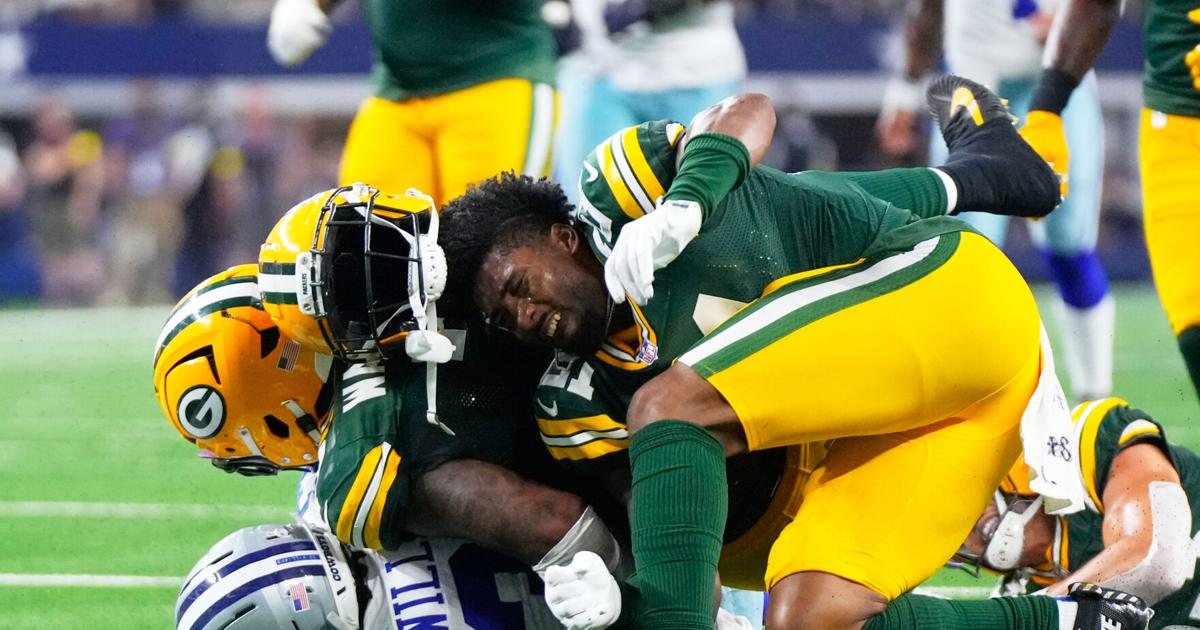
GREEN BAY — From their perch in the visitors coaches’ box at AT&T Stadium, high above the field, Jeff Hafley and Ryan Downard were far too preoccupied with trying to find a solution to what was ailing the Green Bay Packers’ previously dominant defense to be asking themselves what everyone else on the outside surely was wondering:
Who are these guys, and what have they done with the defense they were during the first three weeks of the season?
After pulverizing their first two opponents — fellow NFC contenders Detroit and Washington — in victories that were even more lopsided than the final scores showed, and after more than holding up their end of the bargain in a bad road loss to the previously winless Cleveland Browns, the dudes in green and gold trying in vain to slow down the Dallas Cowboys before a national prime-time television audience looked like imposters.
A defense that had entered Week 4’s games ranked No. 1 in scoring defense (14.7 points per game) and third in total defense (232.3 yards per game) in the 32-team NFL wound up surrendering 436 yards and 40 points (if you include the Cowboys’ defensive 2-point conversion off a blocked extra point) in a tie-that-felt-like-a-loss 40-40 deadlock.
As a result, the Packers (2-1-1) head into Sunday’s matchup with the Cincinnati Bengals (2-3) at Lambeau Field with a defense that fell to 11th in scoring defense (21.0 points per game) but, miraculously, is still fourth in total defense (283.3 yards per game). They also have forced just two turnovers, and the only team with fewer takeaways than Green Bay is the 0-5 New York Jets, who’ve yet to force a single turnover this season.
And while the Bengals, who are so desperate to stay afloat while starting quarterback Joe Burrow (toe) is sidelined for three months that they benched backup Jake Browning and traded for 40-year-old Joe Flacco on Tuesday to start his game, feel like just the elixir the doctor ordered for the Packers defense’s wounded pride, can we assume anything after what happened to the D in Big D?
“You should be pissed off,” Packers star pass rusher Micah Parsons said at midweek when asked what it was like to spend his bye week coming to grips with the embarrassment of the defense’s performance against his former team. “We just gave up 40 points [after] we were talking about, we can’t give up 20 and how we shouldn’t lose games. Well, that’s how you lose games. So we should be pissed off, we should be ready to come out here and play Sunday — regardless of who’s playing — and whoop some butt.
“If we really are who we say we want to be, we should take how we finished last [game] and we should punish these guys. It should be a statement win; it should be a statement on defense.”
Just like the search for reasons why the Packers haven’t generated takeaways after spending the entire offseason and training camp emphasizing the importance of doing so, finding answers to how an allegedly great defense could look so vulnerable brought very few answers during the week.
“The first two games we were good — really good. Then some things came back and bit us in our ass. And we felt the repercussions of that,” first-team All-Pro safety Xavier McKinney said. “I think it was just kind of a wake-up call for all of us, knowing we’ve still got a lot of room for improvement, and we’ve got a long ways to go when we talk about getting to the Big Game. Luckily, it’s a long season and we get more opportunities to be able to fix these things.”
What exactly needed repair was open to interpretation. Certainly, shoddy tackling had been an issue, although they were only charged with eight missed tackles and linebacker Edgerrin Cooper was charged with three of them.
On top of that, no one outside of Parsons put pressure on Cowboys quarterback Dak Prescott, and the aforementioned no-takeaways has been a recurring issue.
“Like I told the guys today, ‘It’s, be phenomenal or be forgotten,’” Parsons said. “No one thinks about a ‘good’ defense. No one talks about ‘good’ defenses. We’ve seen a lot of good defenses. Eleven, 12 weeks of the year, they’re pretty good. But those other weeks, what did they look like?
“You think about those great defenses – the [Baltimore] Ravens [in 2000], Denver (with the Orange Crush defense in the late 1970s), Chicago (with the Super Bowl Shuffle crew in 1985) still get brought up because of what they did consistently. We’ve got to be great. We’ve got to be great every week.”
Added defensive passing-game coordinator Derrick Ansley: “We’ve got the right guys in the seats. Everybody’s prideful of what they put on tape. Because our film is our resume. So you just address it, find out the ‘why.’ You don’t overreact, and you go out there and correct it and move forward.”
Which brings us back to the cramped coaches booth inside AT&T Stadium, where in the moment, as the Cowboys were scoring touchdowns on five of six possessions, no one was contemplating the big picture.
Instead, Hafley, the Packers second-year defensive coordinator, and Downard, the team’s defensive backs coach and Hafley’s right-hand man upstairs, weren’t contemplating the implications of such an unexpectedly dreadful showing.
They were just trying to figure out how to stanch the bleeding while making sure they stayed calm themselves.
“The advantage you have in the box is that you’re in a controlled environment. You’re not down there in the chaos of the sideline,” Downard said. “So it’s our job to maintain a level head, because they’re dealing with all the chaos down on the field. So you’ve got to keep the ship going in the right direction and not be so reactive and up-and-down.”
That mentality led Hafley to focus his messaging to the defensive players during the week on the making sure they don’t start pressing and chasing plays that aren’t their because they’re trying to make amends for what they put on tape in Dallas.
“You have to learn lessons from everything that you do, and sometimes it takes a hard lesson like this one right here,” Hafley said. “So, they went through it, and now they need to understand there are going to be tough moments, and together, they need to be able to hit the reset button, take a deep breath, and go back and be who they are.
“You start pressing, and [then] you do uncharacteristic things and you stop doing your job and then you miss a play or you miss a tackle or you don’t line up where you’re supposed to because you’re trying too hard to do something else when all you had to do was line up and do your job. When sudden adversity hits, you don’t need to panic. And that’s what everybody needs to learn.
“I think our guys are highly motivated right now to get back on the field. They know what they’re capable of and they’re excited to play again.”
COPYRIGHT 2025 BY CHANNEL 3000. ALL RIGHTS RESERVED. THIS MATERIAL MAY NOT BE PUBLISHED, BROADCAST, REWRITTEN OR REDISTRIBUTED.