
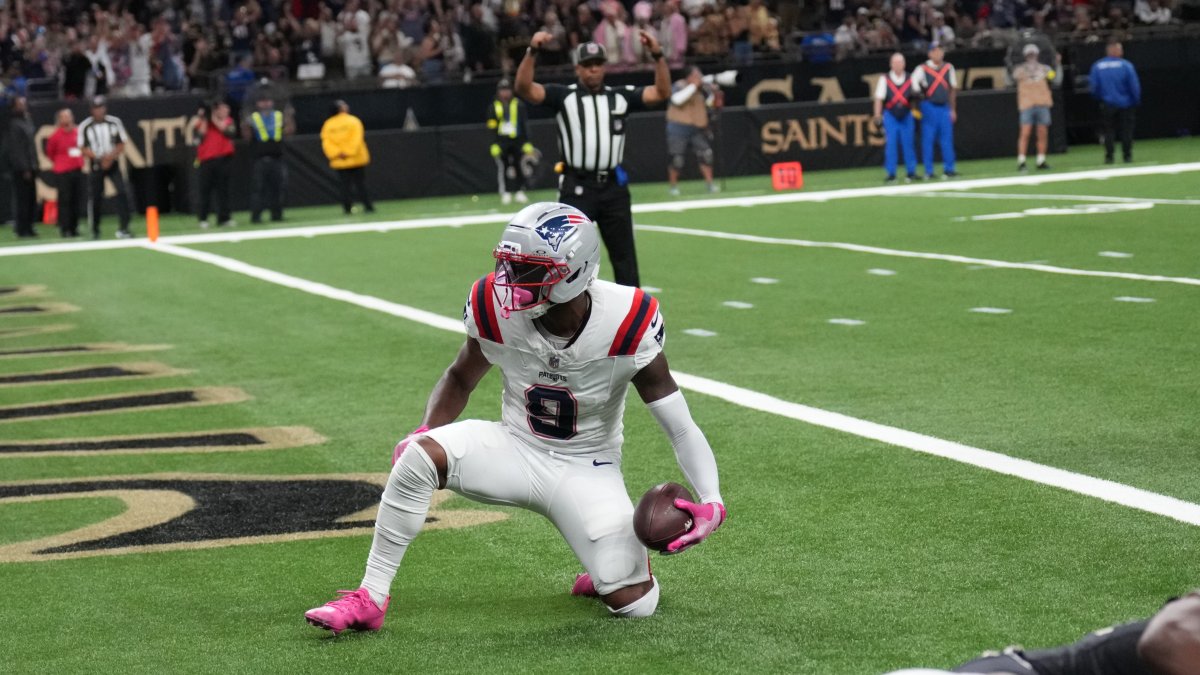
You may or may not know this, but negativity tends to drive and dominate conversations in the realm of professional sports. Blame whatever you want for that phenomenon — ratings, clicks, the general downfall of mankind, I do not personally know — but the natural response to just about anything these days is to spew negativity into the universe and move on to the next thing.
Yet if you don’t mind, it’s a worthwhile time to mix it up a bit. Because Kayshon Boutte is, quite simply, a tremendous sports story right now.
Coming off a week when teammate Stefon Diggs — a renowned, established superstar — was the Patriots’ best pass-catcher, Boutte rose to the occasion on Sunday in New Orleans, catching all five passes thrown his way.
Two of those went for touchdowns.
One sealed the victory.
Another moved the chains on that game-suffocating drive.
And the other converted a third-and-9, one play before a 53-yard touchdown pass to DeMario Douglas.
Boutte was, without question, excellent. But that’s hardly the story. Players have big games across the league every week. From that wide angle, Boutte’s day was not remarkable.
It is, rather, the journey of Boutte that makes Sunday’s showing special.
A five-star recruit out of high school, Boutte didn’t exactly have the collegiate career that many might have expected in his home state at LSU. As a result, he wasn’t drafted until the sixth round in 2023, the 22nd receiver taken.
In his first NFL game, he came down with a catch with his toe out of bounds. Twice. Bill Belichick responded by keeping Boutte out of uniform for the next eight games. On a team that badly needed receiving help, that coaching decision stood out, and he finished that rookie season with just two catches for 19 yards.
His career — or at least his Patriots career — appeared to be over just weeks after his rookie season concluded, as he was arrested and charged with making more than 8,900 online bets when he was underaged, including bets on NCAA football games, with some of those involving his own team.
Boutte remained with the team, and those charges were eventually dropped, clearing the way for Boutte to establish himself on the roster under new head coach Jerod Mayo. That didn’t really happen, though. Outside of two late-season performances against the Bills, Boutte failed to dispel any outside suggestions that the Patriots had the worst wide receiving corps in the NFL.
With an entirely new coaching staff — one that would have zero loyalty or ties to him — this year, Boutte was at a career crossroads. Not many — if any — outsiders would have foreseen him being the most consistent, reliable receiver all throughout spring practice and training camp, yet that’s what Boutte did under head coach Mike Vrabel and offensive coordinator Josh McDaniels.
Boutte was a roster lock all summer long, which was a positive step. But ultimately, what he did on Sundays would be the measurement of success or failure.
He went over 100 yards in Week 1, scored a touchdown in Week 2, and though his output the following three weeks was muted, he burst out with the best all-around game of his career in New Orleans of all places.
“It was amazing, coming back home, first time playing in the Superdome,” said Boutte, who grew up two hours from New Orleans but never even attended a Saints game. “A little emotional at first, it feels like a full circle moment, the first time I’ve been back playing here.”
Even in the immediate afterglow of the high on Sunday, Boutte was willing to get introspective on the lows.
“I think I would say three, four years ago, I wasn’t in the best position,” he said. “I think a lot of off-the-field stuff just — I kind of look at myself like I’ve been through a lot. And I feel like I’m finally getting back together.”
Boutte added: “I feel like it’s good to beat the adversity and just keep working.”
Adversity is everywhere, and every athlete in every sport overcomes their own hurdles on their journey. Yet on this day, in this moment, and in this spot, Boutte’s story and journey are worth appreciating. There’s a lot that can be learned from such a path.
And now, how about some leftover thoughts on the Patriots’ 25-19 win over the Saints in New Orleans.
— OK, time for the negativity: Referee Adrian Hill and his entire officiating crew were atrocious. Historically bad. It is not hyperbole to suggest that an investigation is warranted for the phantom offensive pass interference penalty called on Stefon Diggs, which negated a 61-yard touchdown pass from Drake Maye to DeMario Douglas.
It took so long for that flag to come out that the NFL actually tweeted out a highlight of the play, only to have to take it down due to the imagination of the officiating crew.
That one was clearly le plus grand accomplissement for the crew, but there was plenty more. A terrible OPI call on Diggs to negate his 51-yard catch on a third-and-17. A missed obvious pass interference on Quincy Riley against Mack Hollins a play later. Douglas getting blasted into next week while trying to reach back for a catch. A catch-fumble by Chris Olave that was incorrectly ruled an incompletion. A Juwan Johnson fumble that was wrongly ruled on the field, requiring a Vrabel challenge. Incorrectly ruling Drake Maye short on a QB sneak for a two-point conversion.
That’s a partial list. You get the idea.
You may consider it odd to start these thoughts with officiating criticisms, but this crew was that bad.
— Drake Maye. That’s it. That’s the thought. Drake Maye.
What more can you say? He gets better every week, he has ice in his veins on third and fourth down, he’s added good decision-making to the elite athleticism he had as a rookie, and he is driving this team to victories.
He’s becoming a problem for defenses. If you put a spy on him, he’ll hang in there and deliver a devastating downfield shot.
(His work to stay in the pocket on Douglas’ touchdown that called back was even better, but I can’t show you that, because the NFL had to delete the video, because of a fake pass interference penalty that negated the exciting football play.)
Outside of the “normal” stuff, Maye had a sideways flick to TreVeyon Henderson, he had a lefty throw out of bounds while fending off Demario Davis with his right hand, and he stuck his nose into the line of scrimmage for two critical QB sneaks.
Still just a young 23 years old, Maye is fearless. That’s a trait that can’t be taught, and Maye has it. That’s why he inspired such belief last year, and now with the team and coaching staff building around him, a lot more people are understanding.
— The Patriots’ running game is a legitimate problem. Outside of Drake Maye’s improvisations, they can’t do … anything. TreVeyon Henderson had 27 yards on nine carries. Rhamondre Stevenson had a brutal stat line: 18 yards on 13 carries.
It’s been a point of discussion in Foxboro, and everyone there knows it needs to be better. How they accomplish that remains a question.
— It’s pretty crazy that despite losing a 61-yard touchdown, DeMario Douglas still checked in with 71 yards and a touchdown. Douglas has been the opposite of Boutte this year, in that he was once an established, contributing pass-catcher but had seemingly fallen out of favor in the offense. He entered this game with 30 yards on the season, and he almost doubled that with his 53-yard touchdown in the first quarter.
Diggs really broke out last week. Boutte shined on Sunday, and in conjunction with Douglas showing signs of life along with Mack Hollins and Hunter Henry catching some chain-movers, there is evidence of this offense evolving into something more closely resembling a complete unit.
— Fashion police checking in: The white-on-white combination looked … good.
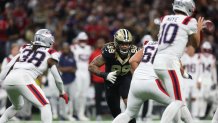
Saints defensive end Chase Young rushes while Drake Maye takes a snap. Photo: Stephen Lew-Imagn Images
Fashion police: Clocking out for the night.
— You’ve always got to love a quality mozzarella stick undershirt image:
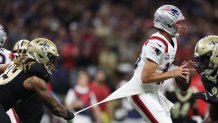
Chase Young grabs Drake Maye’s shirt during the Patriots-Saints game. Photo: Stephen Lew-Imagn Images
Stringy.
— Mike Vrabel may need to tweak his philosophy on penalties not playing a significant role in winning or losing. It’s not that he’s wrong, per se, but if the Patriots faced a better opponent on Sunday, we’d be pointing to penalties as a major reason why. (And no, not just the aforementioned bungled calls and non-calls.)
A delay of game after a run that lost three yards near the goal line moved a third-and-goal back to the 9-yard line. That led to a field goal. An illegal shift when Stevenson and Diggs moved simultaneously negated a third-down conversion from Maye and Hollins, and it was followed up with a Morgan Moses false start to make it a third-and-17. (That third-and-17 was converted, regardless of the OPI penalty that was called.)
In all, 11 accepted penalties for 65 yards is a good way to make life hard in a win against a bad team or turn a win into a loss against a decent team.
(And also, separately: A false start on the long snapper? Can’t have it. Can’t. Have. It.)
— When you watched Kayshon Boutte haul in the contested catch to convert a third-and-11, did you at any point think he should have been ruled down in bounds? I sure didn’t. Just wasn’t on my radar.
While it’s possible — and, well, likely — that I’m a moron, I’m choosing to give credit to Vrabel and John Streicher for throwing that challenge flag and winning. Doing that sealed the win, as it ran the clock down to the two-minute warning to allow for the kneeldowns.
Granted, there wasn’t a ton for the Patriots to lose at that point, other than a timeout in a game that they led with a fresh set of downs and 2:33 left to play. But it stood out as some high-IQ game management, something that frankly has been lacking in New England for some time.
— The referee told the pool reporter that the long delay in calling the Diggs OPI that negated Douglas’ touchdown was in part because “the official was processing the play.” In that same vein, I’m still processing the defensive performance from the Patriots.
On the one hand, Christian Ellis’ punch-out and Craig Woodson’s recovery was a game-changing play. Marcus Jones was active and competitive. Christian Gonzalez seems to have done his job. (We’ll have to check the tape there.) Khyiris Tonga and K’Lavon Chaisson drew holds. Harold Landry survived what looked like a bad knee injury to apply pressure in the backfield. The Saints’ ground game did nothing.
On the other hand, Kyle Dugger got burned on the first play of the game, off an ill-advised corner blitz. Jahlani Tavai and Carlton Davis each committed penalties that gave free first downs to New Orleans. Spencer Rattler (career 61.5 percent completion rate) completed 20 of his 26 passes.
A mixed bag, but ultimately, only one touchdown allowed on the road, in a building that was noisier than you might guess for a team that entered with a 1-4 record. It was good enough, but there will be plenty of teaching moments from that one.
— And that’s where we end this thing. What are the Patriots? We might not know for months. That is to say, Sunday looked like a case of the Patriots making it clear that they are not down in the dumps with the dregs of the league. They are able to fend off the likes of the Saints, Dolphins and Panthers, and they of course have the upset over the Bills in their back pocket.
They’re better than those teams, and so they should win most of their games moving forward. The schedule is that bad.
What will that ultimately mean? Most pressingly, it should mean a trip to the playoffs, which will be quality experience for the entire roster.
Long term? Unknown. But having seen seasons where the Patriots are among the very worst team in the league, all we can say for certain at this point in time is that this current situation is much, much better.