
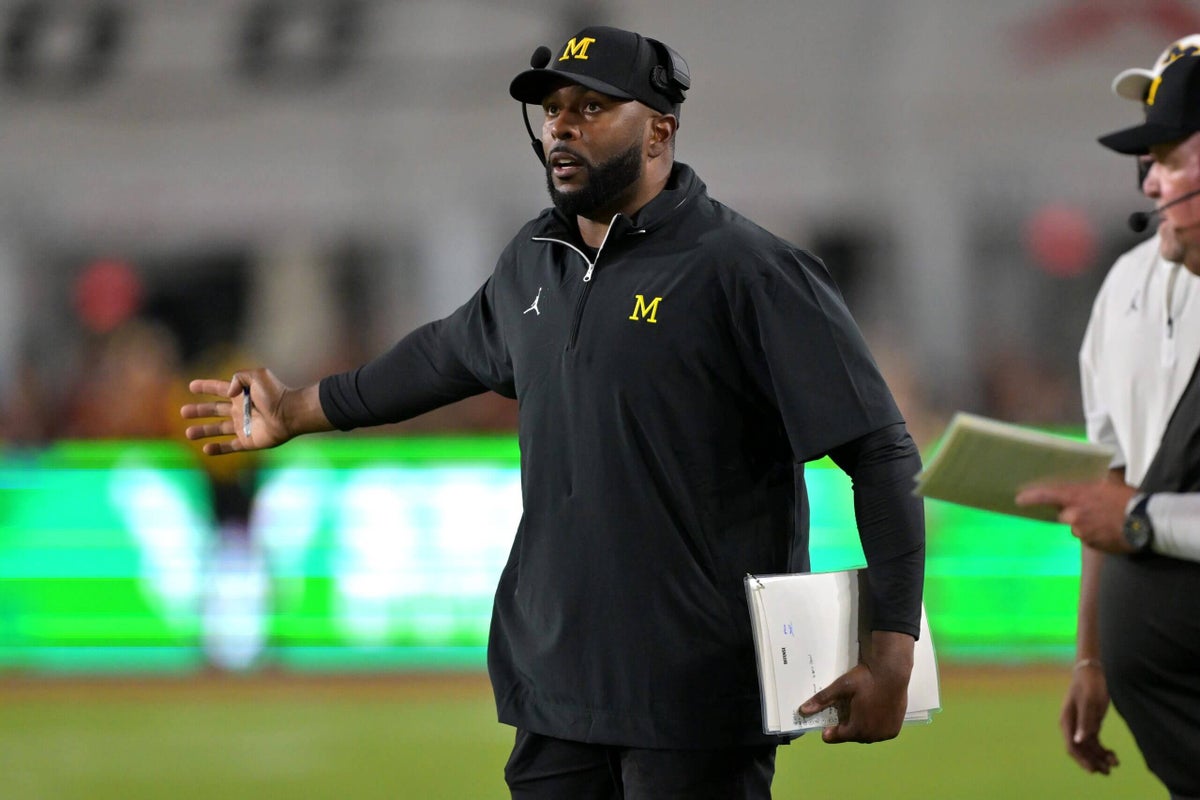
Sherrone Moore has coached 17 games since being named Michigan’s head coach, not counting his two-game suspension earlier this season. After Saturday’s 31-13 loss at USC, Moore’s record in those games is 10-7.
For comparison, here are the records of previous Michigan coaches after 17 games:
Jim Harbaugh: 14-3
Brady Hoke: 13-4
Rich Rodriguez: 7-10
It’s too early to say which path Moore’s career will follow. But after an all-systems failure Saturday night in Los Angeles, this much is fair to say: Michigan is flirting with mediocrity, and if the Wolverines aren’t careful, it could become a long-term relationship.
You could make a strong case that Michigan’s performance against USC was the most discouraging result of Moore’s tenure. Last year’s loss to Texas was bad, especially because it happened at home, but the Longhorns were a top-four team and Michigan was nursing its national championship hangover. Road losses to Washington and Illinois were ugly, but those could be pinned on a talent void at quarterback.
The Wolverines no longer have that excuse. Even if he’s just a freshman, Bryce Underwood is one of the most talented quarterbacks in college football. He’s supposed to be getting better with every start. If Michigan’s offense has grown since that Week 2 loss to Oklahoma, it didn’t show against a USC defense that gave up 31 points to Michigan State and 34 to Illinois.
After the game, Moore praised Underwood’s poise and said he “continues to get better and better and better.” Well, OK. There’s no reason to bury a freshman quarterback who threw for 207 yards on the road, not when Michigan has so many other issues. But if you ignore words like “potential” and “arm talent” and look only at the numbers, Underwood has been a below-average starting quarterback in the Big Ten. His completion percentage (59.7 percent) is last among Big Ten starters, and his five touchdown passes are the second-fewest for a Big Ten starter, ahead of only Iowa’s Mark Gronowski.
Quarterbacks tend to get too much credit and too much blame, and that’s the case for Underwood, too. The bigger issue is that Michigan has no discernible identity. For a team that hangs its hat on dominant play in the trenches, the Wolverines have been remarkably average. Actually, average would be a kind way to describe what happened Saturday night.
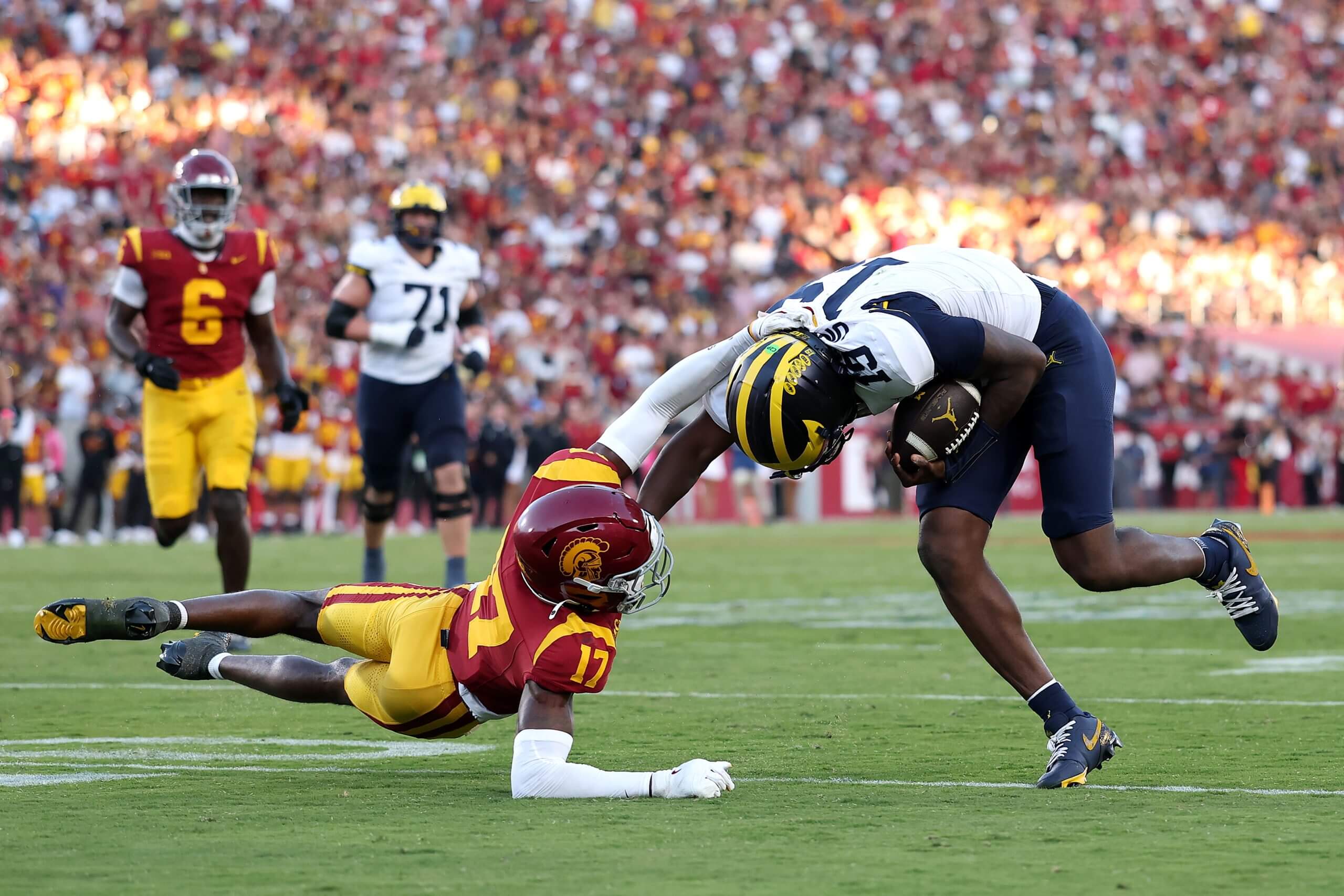
Bryce Underwood ranks 81st in the FBS in pass efficiency rating. (Luke Hales / Getty Images)
If I were making a list of the best offensive linemen in the Big Ten, it would be a while before I got to a player from Michigan. The Wolverines don’t have an all-conference offensive lineman or a top NFL draft prospect up front, and it shows.
The defense was even more worrisome. King Miller, USC’s third-string running back, ran for 158 yards, the most by an opposing back against Michigan since Kenneth Walker ran for 197 in 2021. Miller had runs of 47 and 49 yards, the latter coming on third-and-26, as USC averaged 6.2 yards per rush.
The Wolverines lamented their missed tackles, just as they did after Wisconsin’s offense — the same offense that got shut out at home Saturday by Iowa — marched for a touchdown on its opening possession last week. It’s true, the Wolverines have taken too many bad angles and missed too many tackles. But focusing on that issue alone obscures other problems.
The Wolverines miss Mason Graham, Kenneth Grant and Josaiah Stewart more than they thought they would. They got very little pressure on USC quarterback Jayden Maiava and gave USC’s running backs too many big holes. Some of those big plays could have been contained with better open-field tackling, but that wasn’t a problem when Michigan’s defensive front was stuffing everybody at the line of scrimmage.
“There were a lot of bounces where somebody didn’t keep their leverage or didn’t get off a block to make a tackle,” safety Rod Moore said. “Myself, I missed a few coming out of the post. That’s usually not how I play. Just got to get better.”
The unbalanced Big Ten schedules gave Michigan a chance to dress up like a College Football Playoff contender for Halloween. The Big Ten’s bad teams aren’t as bad as we thought — hello, UCLA and Northwestern — but avoiding Oregon, Indiana, Illinois and Iowa was a break for the Wolverines. Still, even a favorable schedule couldn’t mask the weaknesses that showed up against USC and, to a lesser extent, all season long.
Michigan is 4-2 at midseason, just like last year. Beyond the two losses, it’s disappointing that Michigan wasn’t more competitive against Oklahoma and USC, two good teams that are hardly unbeatable. Once again, the Wolverines are putting their eggs in the Ohio State basket, banking on a fifth consecutive victory against the Buckeyes to make their season meaningful.
When assessing Moore’s performance as head coach, it’s only fair to talk about the games he won before he had the job. Beating Penn State and Ohio State during Harbaugh’s suspension in 2023 established Moore as head coaching material. Moore’s 2-0 record against the Buckeyes is the biggest reason to believe he can get Michigan back to the upper echelon of the Big Ten.
You wouldn’t always know it from talking to Michigan fans, but the other 11 games also matter. In those games, Moore’s team has been outplayed far too often. Saturday’s loss was the latest example and possibly the most discouraging one yet.
Falling flat in big games is how mediocrity happens. Michigan can’t let it become a habit.