
Tempe unexpectedly will be looking for a new tenant in a building it owns on nearly 15 acres on the northeastern corner of Warner Road and Hardy Drive.
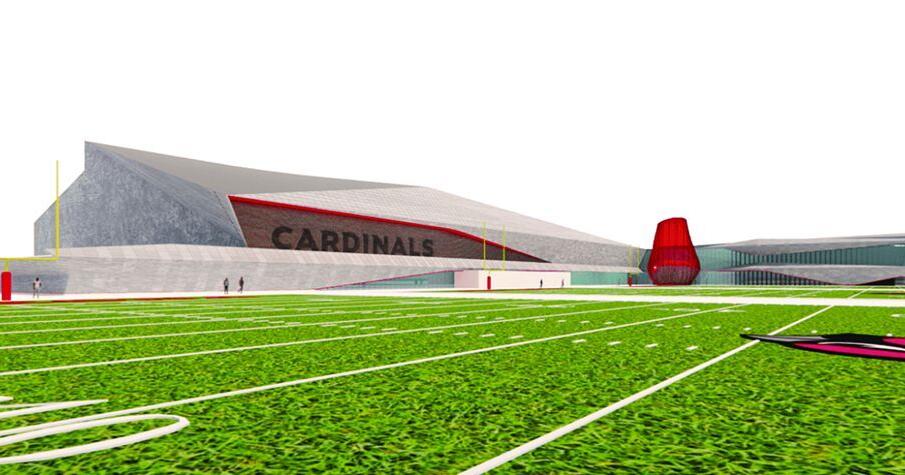
The Arizona Cardinals last week essentially flipped the field: In 2028, they will leave the training facility and headquarters that for 34 years they’ve called home for a 218-acre parcel they quietly purchased last summer in north Phoenix.
In March, the Cardinals — without giving Tempe a heads-up — had announced that they were going to pour $100 million into the south Tempe site to refurbish or rebuild it.
That was seen largely as hasty damage control, coming within days of the annual NFL Players Association ratings of all teams and their facilities that lambasted the Cardinals.
The players gave the team a D-plus for treatment of families, D-minus for food and dining area, F-minus for locker room and D-minus for training room. About 77% of NFL players – nearly 1,700 – responded to the survey.
Last week, the Cardinals changed course, saying they “decided to adjust after further examination.”
Tempe suddenly was on defense after the team revealed that it bought the parcel at Paradise Ridge, north of Loop 101/Pima Freeway and west of Scottsdale Road, at auction for $136 million.
It is the site that was under consideration for an Arizona Coyotes professional hockey arena – coincidentally after its plan for an arena and ancillary development in Tempe was shot down by voters in 2023. The team’s new plans fell through and moved to Salt Lake City.
Tempe Mayor Corey Woods, while not blindsided by the announcement, said team owner and president Michael Bidwill called him the night before the Cardinals made it public.
“He reached out to me directly, and was very, very gracious,” Woods said. “We just sort of talked about the needs of the team and of the organization. At this point, the challenge is the space that they are on, roughly 14 acres. The space that they’re looking to build on is going to be 30 acres.
“In Tempe, we’re a landlocked city and there’s not a lot of space to grow outward. There were just constraints that they unfortunately weren’t able to work with.”

Cardinals owner and President Michael Bidwill called Tempe Mayor Corey Woods the night before the Cardinals announced they were leaving the Tempe practice site.
(Arizona Cardinals)
Wide-open playbook of uses
The wheels already are churning regarding what’s to come next on the site. Possibilities along the vibrant Warner Corridor are diverse and plentiful.
The Warner-Hardy property has a two-story office building that houses the team’s front office (business operations moved a couple of years ago to a nearby building when space was becoming tight). It has a ground-level locker room, meeting rooms, injury-athletic/training room, weight room and auditorium.
And it has three football fields, one of them an enclosed, climate-controlled bubble.
What if Tempe packaged it along with Tempe Sports Complex, which abuts the Cardinals’ facility to the north, and sold it to a developer? If the buildings were razed, it would be a desirable, sizable, valuable and rare property in landlocked Tempe.
The Warner Road corridor has become home to large industrial warehouses, including one directly south of the Cardinals’ complex that is nearing completion.
There also is a growing tech presence on the Warner Corridor, including ASU Research Park about 3 1/2 miles to the east. Spaces for support businesses are in demand.
Nick Bastian, a south Tempe Realtor and community activist, said he’d received a suggestion that the site be converted into an entertainment and concert venue.
“It might become another corporate structure, or a small college or school, but what if we could do kind of a concert venue down there?” Bastian said.
“There’s been talk over the years, too, of even utilizing Tempe Sports Complex more as more of a community hub and being able host baseball tournaments or soccer tournaments, and, maybe there’s a way to really involve youth sports over there.
“Or maybe some kind of public-private partnership in the arts.”
What the area probably no longer needs is more shops and restaurants, especially with South Tempe Square now under construction about 1½ miles east on the northwestern corner of Warner and Rural roads.
“Some of these chip manufacturers and some of these commercial developers have kind of circled that area and said, ‘Hey, there’s some real potential here. You you’ve got great demographics, you’ve got great freeway access,’” Bastian said.
“I’ve got to think collectively we’ll come up with something really nice for that prime piece of real estate. There aren’t that many of them left in Tempe. I hope we do have some discussion and some community input.”
But what’s next is all just guesswork at this point, according to Woods, who said the city has no immediate plans and even he hasn’t a clue what comes next.
“Clearly, it’s a prime piece of real estate, and it’s land that the city owns,” Woods said. “We’re going to start having some conversations internally very soon about what might be the next thing to happen at that site.
“But obviously, since this is all so fresh, there haven’t been any conversations at this point between myself and Council, or even between myself and city staff.”
A price for free agency?
It is not immediately known if the team will owe the city money for bailing.
Under terms of the original 25-year lease in 1989, obtained by the Tribune, Tempe agreed to build the Cardinals – legally known as B&B Holdings – a corporate and training complex on city land at 8701 S. Hardy Drive and put $6.5 million into the construction cost.
The facility opened in 1991, when the cost came in at $7.1 million. The Cardinals paid the $602,000 difference and had that deducted from their $181,000 annual rent for the first 10 years on a pro-rated basis.
The team’s rent was to escalate to $266,000 for years 11 through 25, as long as they continued to play their home games in Tempe.
But when the then-University of Phoenix Stadium opened in Glendale in 2006 and the Cardinals began playing there, their annual rent for the Tempe training facility jumped to $825,000 a year.
Tempe had hoped that those terms would cause the team and the Fiesta Bowl to continue playing at ASU’s Sun Devil Stadium, the Cardinals’ initial game-day home when they moved to the Valley from St. Louis in 1988.
The Tribune also obtained a 2002 memorandum of understanding in which the original 25-year lease was extended to 2036 to coincide with the Cardinals’ agreement with the Tourism and Sports Authority, which was building the Glendale stadium.
The city – saying it understood the value to its downtown merchants of having the Cardinals, Fiesta Bowl, Super Bowls as well as other major events in the city – wanted the stadium built in Tempe.
For a brief time, a site at the northeastern corner of Interstate 10 and Warner Road in the Emerald Center was considered by the Tourism and Sports Authority.
But it ultimately was abandoned because it was too small and neighbors complained that there would be overflow parking.
Ultimately, TSA went to Glendale.
When the Warner-Hardy facility opened, it was considered state-of-the-art in the NFL, so highly regarded that the Chicago Bears borrowed liberally from it in 1997 for their new training facility in Lake Forest, Ill.
But 34 years is several lifetimes in the NFL and the Cardinals players evidently feel the Tempe complex has gone from the top of the league to the bottom.
One of the three football fields at the Cardinal’s practice site in Tempe is an enclosed, climate-controlled bubble.
(Arizona Cardinals)
Beefing up
The Tempe complex has 156,000 square feet. The north Phoenix facility will be nearly double that, 250,000 square feet.
It will house Cardinals football and business operations, but perhaps more importantly for Bidwill and the Cardinals, they will become developers of a mixed-use project on the surrounding 187 acres.
That’s big enough for a new stadium, however the Cardinals have said nothing of building one. They’ve played at what is now State Farm Stadium in Glendale since it opened in 2006, when they left Sun Devil Stadium in downtown Tempe.
“Our goal has always been to provide our players and coaches with the best possible environment to prepare and perform at the highest level,” Bidwill said.
“As we evaluated our options, it became clear that we needed more space than what was available at our current location or elsewhere in Tempe.
“We are deeply grateful to the City of Tempe for its incredible support over the past three decades and for its continued partnership. And we are just as excited to welcome this new chapter in our team’s history.”
The new facility will have three grass outdoor practice fields and a fieldhouse with a full-size indoor field.
The complex will feature a greatly expanded and modernized locker room, state-of-the-art spaces for the weight room, strength and conditioning, sports medicine and athletic training, meeting rooms, and a player lounge.
Rossetti, a leading sports architecture firm that has collaborated with several professional sports teams on new facilities, will work with the Cardinals on the design.
“The Arizona Cardinals’ new headquarters and state-of-the-art practice facility is an exciting, welcome addition to our city’s Headquarters Alley,” Phoenix mayor Kate Gallego said in a statement. “I’m grateful for this game-changing investment and the energy this project will bring to our community.”
Meanwhile, it is a bittersweet exit from Tempe for the Cardinals. Downtown merchants took a game-day hit when the Glendale stadium opened.
Not only did they lose the Cardinals, but also the Fiesta Bowl and its ancillary activities that had been an annual downtown Tempe draw.
Now, the last vestige of pro football is leaving. The Cardinals are spiking the ball in the end zone as they leave with what appears to be a big financial victory.
“I know that the Cardinals will continue to be a partner with the city of Tempe, so, while it’s a loss for the city, the Cardinals are still our hometown team,” Woods said.
“I’m obviously very supportive of them. I’m a big fan myself. And, you know, I’m going to continue to root for them on Sunday. I wish them all the best.”