
As we discussed yesterday, the offensive issues on the Jets are holistic. The quarterback has drawn the bulk of the attention. There are a lot of reasons the unit is struggling.
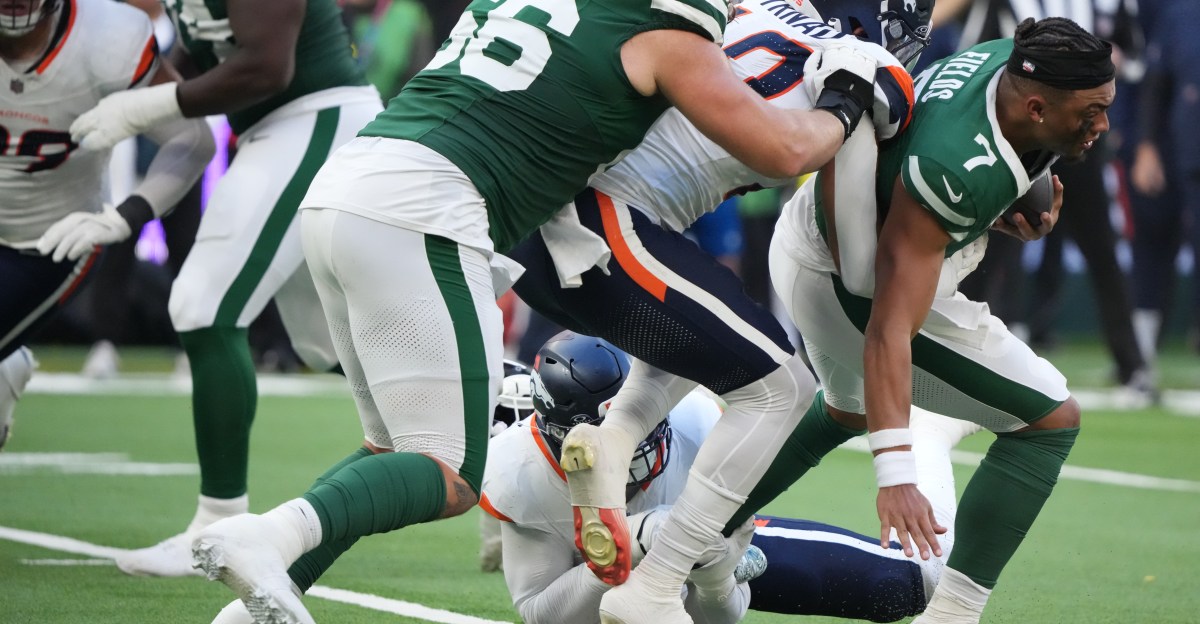
Of course, the quarterback is the most important cog on offense. When he isn’t playing well, it has an outsized impact. The nine sacks Justin Fields took in Week 6 included some rather ugly ones in key spots where he has nobody to blame but himself.
Late in the third quarter the Jets faced a third and five from their own 41. The Broncos are loading the line of scrimmage and appear ready to send an all out blitz.

You could make the argument the Broncos got a tad too cute with their alignment. Ja’Quan McMillan is edging towards a blitz from the slot.

The thing is you know he’s probably not blitzing because that would leave a receiver uncovered. If McMillan rushes the passer, the Jets will have an uncovered wide receiver. Josh Reynolds and Garrett Wilson are on that side of the field, and only Patrick Surtain would be on that side of the field.

This is kind of a giveaway that the Broncos aren’t going to send an all out blitz. There isn’t a non-Steve Wilks defensive coordinator in the NFL who would blitz so many guys that the defense couldn’t cover every receiver. This is a signal the Broncos might back out of the blitz.
Garrett Wilson comes into motion, and Surtain drops.

Denver indeed backs out of the blitz at the snap. Surtain is actually dropping to a safety roll as the Broncos roll into a Tampa 2. You have deep players (with Surtain dropping to safety), four players in zone underneath, and a middle linebacker with a deeper drop to clog the hole between the two safeties.

Garrett Wilson comes from his motion to run a deep route down the middle of the field. This is really to stretch the field and draw defenders away. If the Broncos bust the coverage, maybe you throw it, but he’s more of a decoy on this play than anything.

The real action here is Josh Reynolds running upfield on a 10 yard route, and Mason Taylor running to the flat.

The key defender for the quarterback is McMillan, the would be slot blitzer. With Surtain dropped to safety, McMillan is the outside defender. If he drops to Reynolds, Taylor should be open in the flat. If he drives down to take away Taylor, Reynolds should be open.

Rewinding a second or two, we see a bit of veteran savvy from Reynolds, initiating contact on McMillan within the first five yards which essentially serves as a pick for Taylor.

McMillan eventually drifts up the field near Reynolds. Taylor is open, and Fields sees him.

For whatever reason, Fields just doesn’t throw the ball. He holds onto the ball and takes a sack/
Let’s move on to a third down and six in the final minute of the third quarter.
I watched this play over and over longer than any person should ever voluntarily watch a play this ugly. I couldn’t figure out what went wrong.
Fields locked on to Arian Smith the entire way, even though Smith was running a shallow route across the field short of the sticks.


You can see for yourself that Smith does not exactly end in a spot that makes him the most ideal target on this third down play.

So what the heck happened here?
As always, I can only give you my best guess. The normal disclaimers apply. I wasn’t in the huddle. I don’t have a copy of the Jets playbook. I’m not privy to how the Jets coach Fields to execute this play.
With those caveats out the way, my best guess after winding and rewinding this play is that Fields was anticipating a blitz from the left side of the defense/right side of the offense.
The Broncos have one safety deep which is a possible indicator of man coverage.

From the way Fields operates on the play, I was left with the impression he thought Denver would come out with something like this. Red arrows are blitzers. Yellow lines are man to man assignments. In blue are Smith and the guy who would be covering him, linebacker Alex Singleton.

This would be a clear advantage for Smith going one on one with a linebacker. Would the Broncos run something like this? They were sending blitzes from different angles all game and leaving some unconventional coverage matchups. On paper, it could leave a mismatch. But if the blitz got home, the coverage wouldn’t need to hold for long. An unconventional coverage could also make Fields hesitate, which happened often. Throw a look at Fields that he isn’t expecting, and he frequently will get thrown off.
On this play, if Fields is right it is logical to lock onto Smith. Based on the play design, he is the outlet for a quick throw against the blitz anyway, and this has the potential to be a good play for the Jets. Well, again if Fields is right.
You can see that on the play, Breece Hall initially stays in to block seems to have a protection assignment focused on a blitz from that angle.

The Broncos end up with a bit of an unconventional pass rush, but it’s not the one Fields seemed to anticipate. Justin Strnad (red arrow), one of two anticipated blitzers from that side actually comes on the rush. Nik Bonitto (purple arrow) drops into coverage, making it only a four man pass rush. The second anticipated blitzer Riley Moss (yellow star) actually takes Josh Reynolds in coverage.

That is a big deal for this play. In a world where Moss blitzes (yellow arrow), Brandon Jones (yellow circle) would be the guy who would have to take Reynolds.

In this day and age, frequently coverages are a mix of zone and man. A play can start in something resembling zone and then morph into man coverage. The man each defender picks up is based on the combination of routes the offense runs.
On the left side of the offense/right side of the defense, the man assignments are straight forward.

On the flip side, it’s likely that rather than blitzing, Moss has the first receiver on that side of the field who goes vertical, Reynolds in this case.

And because of the way the defense is aligned, they can essentially zone up against a short crosser, and Jones at the end can eventually inherit man coverage. So Smith is never going to be open on this play or have a chance to get to the sticks.

Where this play gets really frustrating is that there is an open guy, Reynolds, if Fields is reading more of the field. Reynolds breaks inside. Moss is playing with outside leverage and is no position to stop this route. Meanwhile, Smith’s route underneath has sucked the underneath defenders in his direction, opening up a window.

That’s what this route combination is built to do. If the second level defenders, drive on the underneath route, the deeper route will be there. If they drop deep to clog the passing lane to Reynolds, throw underneath to Smith. Quarterbacks generally read this route combination high to low, looking for the bigger gain first. Fields should scan the field and hit Reynolds. Instead he has tunnel vision for Smith who can’t really do much to help. Fields holds the ball and eventually is dropped.
As I said yesterday, it’s too simplistic to put all of the Jets offensive woes on Justin Fields. The problems are system-wide, and some are at least partially due to the way the Jets are handling Fields. Still, there are plays that Fields is leaving out there that you need your quarterback to hit.