
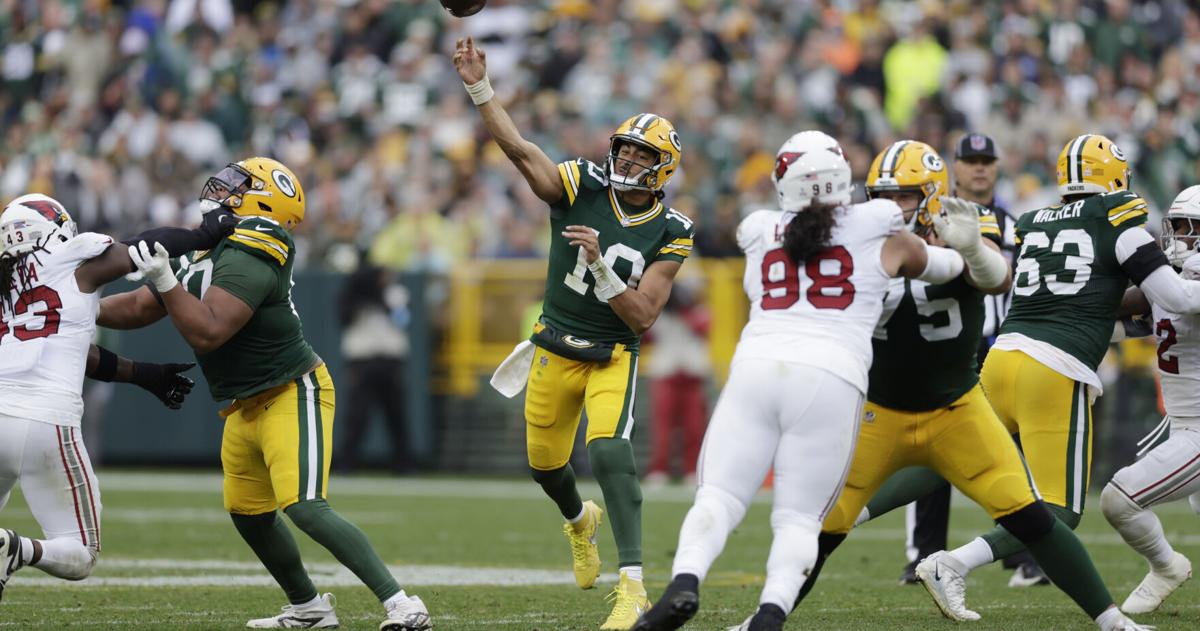
GREEN BAY — The Green Bay Packers’ third road trip of the 2025 NFL season got off to a tardy start on Saturday.
How will that impact Sunday’s matchup between the Packers (3-1-1) and Arizona Cardinals (2-4) at State Farm Stadium in Glendale, Arizona? Well, we’re in a holding pattern on that one.
Several years ago, the team began traveling in two planes — one charter flight for the coaches and players, another for the staff and other dignitaries. On Saturday afternoon, one of those flights took off on time from Austin Straubel International Airport.
Unfortunately, it wasn’t the one with the players and coaches on it.
That flight, because of a mechanical issue, was delayed … and delayed … and delayed.
So while the first plane departed on time around 1:15 p.m. Central Time and landed in Phoenix around 3 p.m. Mountain Time, the players and coaches were delayed nearly five hours while waiting for Delta airlines to bring a different plane in from Detroit and finally went wheels-up shortly after 7 p.m.
That flight was scheduled to land at Phoenix-Sky Harbor International Airport at 8:23 p.m. Mountain Time, according to FlightAware.com.
Whether the travel snafu causes the Packers any game-day performance issues, we’ll have to wait and see. In the meantime, here are three other aspects to Sunday’s matchup to keep an eye on:
1. BROTHERS IN ARMS
The Packers’ flight being delayed out of Green Bay did ruin the best laid plans of wide receiver-turned-cornerback Bo Melton and his brother, Max, a second-year cornerback for the Cardinals.
The brothers Melton had conjured up a pull-out-all-the-stops weekend for their parents, Vicky and Gary, booking an Airbnb for them in suburban Phoenix, making dinner plans, securing game tickets, the whole nine yards.
“When I touch down in AZ, I’m going to see my brother, see my family,” Bo had said on Friday afternoon as the Packers’ workweek wrapped up. “Max handled [the Airbnb], I handled the tickets, we played off each other. We took care of them, set up a nice dinner for them, that Max is going to show up to and I’m going to show up to. Just a whole experience for them.”
While the Packers’ late arrival surely put a crimp in the Melton family’s dinner plans, Mom and Dad will still get to see their sons on the field together, although not the way they were a year ago.
When the Cardinals came to Lambeau Field last season, Bo was still playing wide receiver, and Max lined up in coverage against him several times in the Packers’ victory.
But with Bo having shifted to cornerback this year, they won’t be able to match up. Bo has made some cameo appearances on offense and has one end-around carry for 3 yards, and he’s also returned three kickoffs for a team-best 32-yard average in addition to his special teams coverage and blocking work.
“It’s been different, for sure. Usually being on the offensive side, being in the game and getting plays, it’s less snaps,” said Bo, who has not yet played on defense and has played only four offensive snaps — compared to 251 offensive snaps last year.
“But you’ve got to figure something out, and they’ve figured out ways for me to impact the game. Not only as a gunner, but getting the ball in my hands — just getting the opportunity there to show my talent and expanding my role.”
Packers coach Matt LaFleur acknowledged that it must be hard for his Melton to have his role curtailed after the position switch, but it also underscores how important LaFleur and the coaching staff believe he is to their team chemistry.
“Because Bo does everything the right way,” LaFleur replied when asked why it was important to find ways to get Melton involved. “Certainly, he was a guy that played a lot of snaps in the past for us [at receiver], and if the situation weren’t what it is right now, he’d probably be playing for us as well. But making that switch over, I think he’s growing as a corner, and I think it’s just a matter of time before he gets in there.”
2. HOW TO BEAT THE RUSH
As much focus as there has been — and rightfully so — on the Packers defense’s inability to force turnovers (just two, the second fewest in the NFL) and fourth-quarter failings, opposing offenses have also clearly adjusted their approach in the passing game, eschewing longer-developing pass concepts in favor of a quick-hitting, get-the-ball-out-of-the-quarterback’s-hand approach to neutralize the Packers’ pass rush.
That’s been the book on the Packers defense the last three-plus games, as opposing offensive coordinators are working to limit star edge rusher Micah Parsons’ impact.
And while defensive coordinator Jeff Hafley would love to get more sacks and more takeaways, he is convinced that the get-it-out-quick approach is ultimately playing into the Packers’ hands defensively.
“If you look at our yards per pass play, it’s like as low as I’ve ever seen because of that,” Hafley said, pointing to the Packers’ NFL-best 5.13 yards per pass allowed. “So, how do we get takeaways if teams are going to just throw the ball quick? I don’t think teams are going to be able to go up and down the field like that and play the game like that and beat us.”
If the short passing game does become effective, Hafley said he’ll call more press-man coverages instead of relying on the zone concepts he generally prefers. But he still believes that very few defenses can nickel-and-dime his crew all the way to the end zone.
“You’re not going to score points doing that. I mean, you know how you score points in this league? It’s throwing explosive pass plays. That’s how you score,” said Hafley, whose defense entered Sunday’s games 11th in scoring defense (20.4 points per game). “You’re not going to do that going up and down the field the whole game.”
3. PROTECTION RACKET
In the aftermath of having two kicks blocked in two weeks — a potential game-winning field goal attempt at the end of a Sept. 21 loss at Cleveland, and an extra point that was returned for a defensive 2-point conversion in the Packers’ Sept. 28 tie with the Dallas Cowboys — Packers special-teams coordinator Rich Bisaccia decided to do something drastic:
He put all of his best offensive linemen on the field-goal protection unit, an additional burden on players who spend 60 or more offensive snaps each week trying to keep 300-pound behemoths off of quarterback Jordan Love and running back Josh Jacobs.
In addition to kicker Lucas Havrisik (who filled in for an injured Brandon McManus), holder Daniel Whelan and long-snapper Matt Orzech, the Packers’ protectors of the kicking operation in last week’s win over the Cincinnati Bengals consisted of starting left tackle Rasheed Walker, starting right guard Jordan Morgan, starting left guard Aaron Banks, starting center Elgton Jenkins, starting right tackle Zach Tom, No. 2 right guard Sean Rhyan, No. 2 right tackle Darian Kinnard, and defensive tackle Karl Brooks.
“I mean, it’s a point-producing play, so it’s whatever it takes,” LaFleur said of the change in approach. “Especially in those critical moments. I mean, you’ve got to get your best out there.”
Brooks and Tom handled the wing spots, where there had been mistakes made on the two previous blocks. Havrisik went 5-for-5 on the day, making two field goals and three extra points.
Look for those same eight players to handle the protection against the Cardinals, too.
“Of all the conversations we’ve had, no one’s ever asked about who’s on field goal protection until we’ve gotten one blocked,” Bisaccia pointed out at midweek, adding that he has used some starters in previous stops but not as many as he is using now.
“Part of the job of an offensive lineman is they play field goal pro. Now, fortunately, here in the past, we’ve had some bigger defensive linemen like Dean Lowry and TJ [Slaton] and they were on field goal protection for us as well. But the number one job in the field goal protection unit is for the offensive line — when they get done pass blocking.”
COPYRIGHT 2025 BY CHANNEL 3000. ALL RIGHTS RESERVED. THIS MATERIAL MAY NOT BE PUBLISHED, BROADCAST, REWRITTEN OR REDISTRIBUTED.