
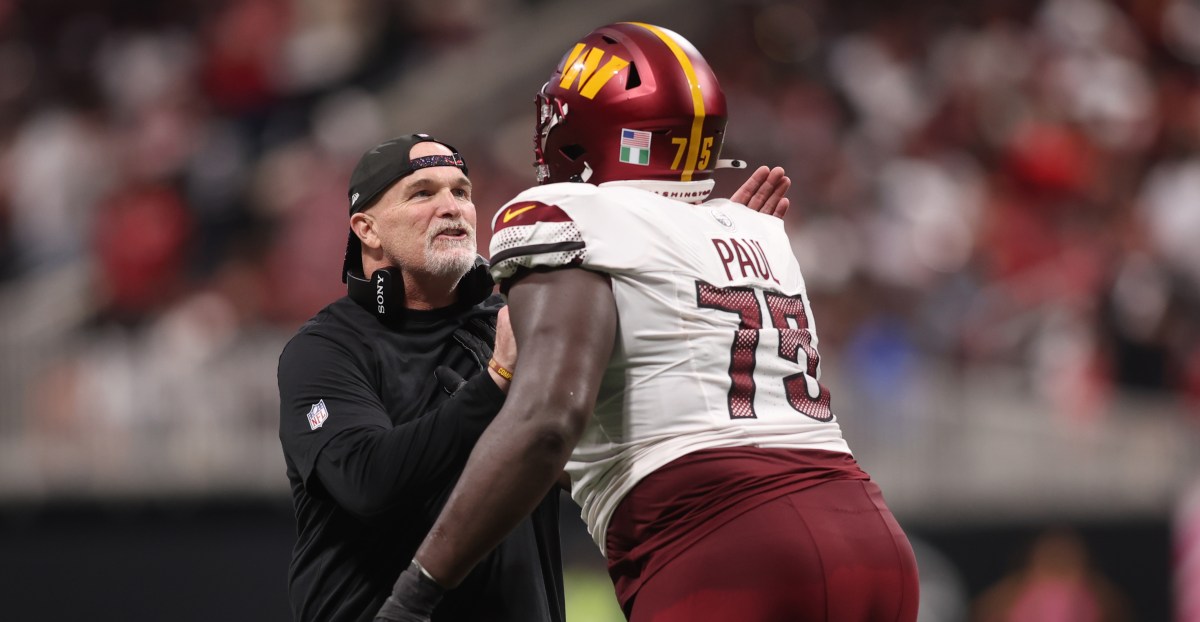
It’s easy to forget how long Chris Paul has been in the building.
He’s not one of the new faces of Dan Quinn’s retooled Washington Commanders, nor is he one of the early-round cornerstones added since the new staff took over in 2024. He’s not the shiny draft pick or the veteran free agent who made headlines in the offseason, either.
But through seven weeks of the 2025 season, Paul—a 6-foot-4, 325-pound seventh-rounder from Tulsa selected all the way back in 2022 — has quietly become one of the most reliable players on the roster.
For a guy who, entering this fall, had never played more than 67 offensive snaps in a single season, for most of his career, Paul was buried on the depth chart —first under a revolving door of coaches and then behind draft pedigree. He was a carryover from the Ron Rivera experiment, a player most assumed would fade out when the new regime began reshaping the roster. In a league where former staff holdovers are often among the first to go, Paul’s persistence has been his lifeline.
What’s kept him in the mix, however, isn’t luck. It’s competition, execution, and a player taking advantage of the opportunity in front of him.
A Culture Shift— and an Opening
When Quinn arrived last year, one of his first public declarations was that competition is the oxygen of growth.
Every position, every rep, every snap in camp would be earned, not given.
The offensive line was a clear focus, and the Commanders spent the 2024 draft investing there using third-round capital on Brandon Coleman (TCU). He was supposed to be the future — a powerful, yet fluid athlete with upside and alignment versatility.
But when training camp opened this summer following an up and down rookie campaign for Coleman, something started to happen. Paul, now entering his fourth year, didn’t just hold his own. He outplayed Coleman.
He didn’t miss assignments. He didn’t lose one-on-ones. His technique was clean, his anchor strong, and his communication seamless.
By the time Week 3 rolled around after not appearing in the opener, Paul was in the lineup —and he’s been there ever since, starting five straight games and solidifying the left guard spot.
For offensive coordinator Kliff Kingsbury, his offensive vision in Washington is built on rhythm and angles.
He wants athletic linemen who can protect in space but still win with power in the box. His front-five philosophy leans toward wide-bodied players in the upper half — guards and tackles who can handle interior twists, fend off long-armed rushers, and maintain leverage against power fronts.
At 325 pounds, Paul is dense in his lower half and powerful through his hips. He’s not a naturally twitchy mover, but his first step and hand placement make up for it. His body control in his sets allows him to stay square on defenders, an essential trait when protecting a right-handed quarterback’s semi-blind side like Jayden Daniels’.
Kingsbury’s scheme asks guards to operate in space more frequently than in years past, with frequent movement in the run game — pulls, skips, and climbs to the second level on split zone and counter looks. While, as a group, Washington hasn’t executed to the level they would like through seven weeks. Paul’s background at Tulsa, where he was asked to operate in a spread system with wide splits and multiple protections, gave him a foundation to handle the demands that Kingsbury insists on having.
Despite the lack of success the last two weeks on the ground, the Commanders still sit second in the NFL in rushing yards per game (148.9), behind only the Buffalo Bills. And while the lack of pop in the run recently can be attributed to a variety of things, it has far more to do with inconsistent edge blocking and backfield timing compared to isolating Paul’s performance inside.
On tape, his ability to generate movement in the run game stands out. He plays with flat pads and excellent hand leverage, working double teams with center Tyler Biadasz, and sealing off 1-techniques before climbing to linebackers. His hips stay aligned with his target, and he rarely lunges or overextends.
Quiet Dominance in Pass Protection
Where Paul has really made his mark though, is in pass protection. Through 166 pass-blocking snaps this fall, he’s allowed only five total pressures and zero quarterback hits. He hasn’t surrendered a single sack in three consecutive games — a streak of steadiness that’s been invaluable for a team trying to stabilize an offense that’s had its share of volatility.
His tape shows a player in complete control of his set points. Against twist-heavy fronts, Paul mirrors beautifully— he keeps his eyes up, scans for late movement, and passes off stunts cleanly. His independent hand usage has grown tremendously since college. He no longer two-hand punches early, instead waiting for rushers to declare before delivering a controlled strike.
It’s subtle work that doesn’t show up on a highlight reel, but earns the respect of coaches and quarterbacks alike.
Against Chicago in Week 6, he handled a mix of speed and power from Gervon Dexter and Andrew Billings, adjusting his sets with patience and showing excellent awareness when Daniels broke the pocket. There’s a growing trust between quarterback and guard, a quiet rhythm that’s emerging in the left-side operation with Paul and left tackle Laremy Tunsil — who’s also been fantastic.
For most seventh-rounders — especially those from smaller programs — longevity in the NFL is about finding your niche. Paul’s early years were a waiting game. He was stuck behind veterans, learning multiple positions, and trying to stick on rosters through the churn of change.
When Rivera’s staff was replaced, many assumed Paul would be cut loose… heck, almost everyone else has.
Instead, he embraced the offseason program. He reshaped his lower-body strength profile, improved his flexibility, and refined his pad level under offensive line coach Bobby Johnson. His training camp performance wasn’t just surprising — it was validating.
At 3–4, the Commanders’ season hasn’t gone to script. A year removed from an NFC title game appearance, expectations were high — and frustration has continued to bubble amongst fans and media alike.
There’s been talk of regression, of offensive inconsistency, and missed defensive assignments. But inside the building, there’s still belief. The foundation Quinn and Kingsbury are laying depends on players like Paul —grinders who embody the message of internal competition and production no matter what the win-loss column shows.
As Washington prepares for a primetime showdown with the Chiefs on Monday Night Football, Paul’s play will again be pivotal. Kansas City’s interior rush, led by Chris Jones, will test his technique and poise. It’s the kind of stage where hidden gems become household names — or prove their staying power under the brightest lights.
Football, especially in the trenches, is rarely glamorous.
Guards don’t draw camera lenses or fantasy points. But they determine how comfortable a quarterback feels and how much freedom a play-caller has. Paul’s emergence has given Kingsbury and Daniels stability in a spot that’s often overlooked, but crucial to the offense’s rhythm.
He’s not just a fill-in. He’s not a placeholder. He’s a legitimate starting-caliber interior lineman who has grown from a fringe roster hopeful into one of the Commanders’ most dependable blockers.
That’s no small feat for a player from a previous regime, a small-school product who’s survived turnover after turnover. In many ways, Paul’s story mirrors what Quinn wants this team to be — gritty, disciplined ballplayers.
Through seven weeks, Chris Paul has proven that production, not pedigree, drives opportunity. He’s become a model of internal development — a seventh-rounder who’s anchored a playoff-caliber offensive line and thrived within a new system built on competition and toughness.
Washington’s record currently may not reflect the promise they showed a year ago, but if you look close enough, the building blocks remain intact. Paul is one of them — steady, battle-tested, and emblematic of what’s working right now in D.C. via the air.
Come Monday night, under the national lights, he’ll line up again — helmet buckled, hands set, and ready to fight his tail off inside a phone booth. That’s who he’s always been.
And now, finally, everyone’s starting to notice.