
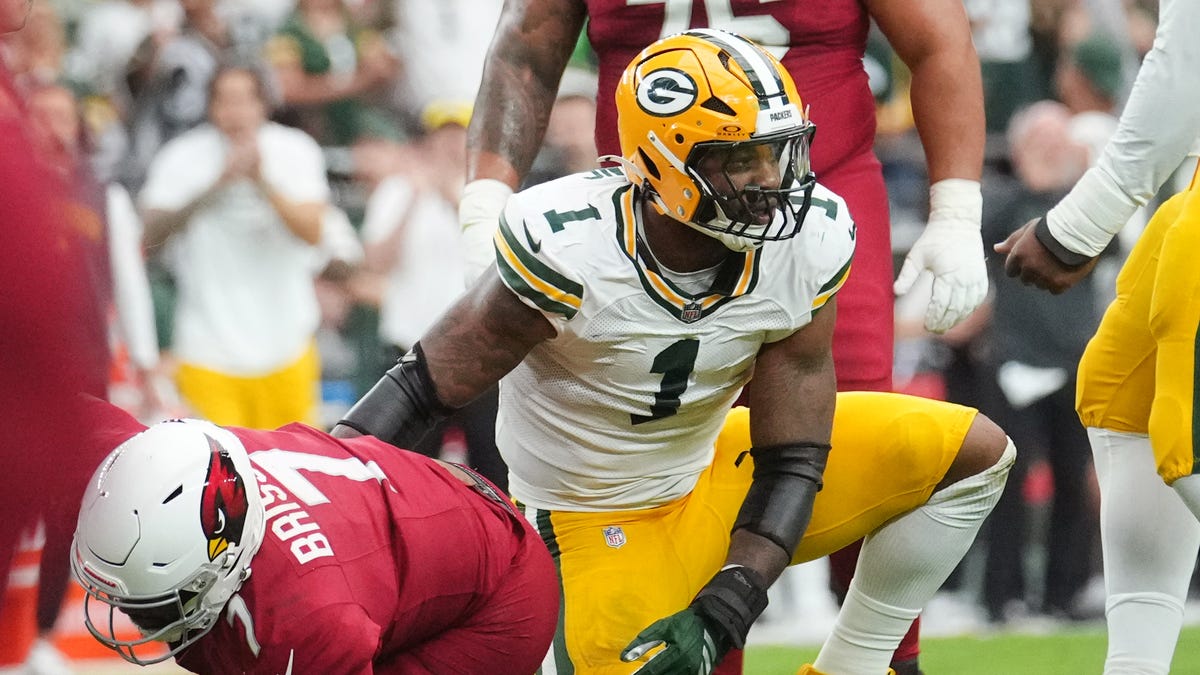
For 60 minutes against the Green Bay Packers in Week 7, the Arizona Cardinals had no answer for Micah Parsons.
The numbers tell the story of the superstar’s dominance. He finished with a career-high three sacks on 11 pressures. Making matters worse was the nature of Parsons’ impact. His average time to pressure was just 2.29 seconds, per Next Gen Stats. No player has generated as many pressures in as little time since Aaron Donald in Week 10 of 2019.
Some of that is Parsons being Parsons. But for the Cardinals, it’s a performance that raises questions about their offensive line and their offensive coaching staff.
After the game, Parsons only amplified those questions when he said he was surprised by how often the Cardinals left him one-on-one.
“I don’t think it’s my best pass rush game,” Parsons said. “I just think it’s the first time they allowed me to rush this year. If you look at the looks I’ve been getting. Double tight ends, chips, full slides.”
The next day, Cardinals head coach Jonathan Gannon pushed back, saying, “We didn’t (leave him one-on-one) a ton.” Gannon reasoned that most of Parsons’ one-on-one looks came in the red zone, where he wants to maximize the number of receivers running routes.
“You’ve gotta get people out in a route in the red zone,” he said. “Especially when there’s a go line on fourth down. So I was comfortable, knowing that he was gonna make his plays. Would you wish we limited him a little bit more? Yes.”
Why the Cardinals were unable to limit Parsons is a complicated story. But with the 2025 season now primarily about the future — and which players and coaches belong in that future — it’s a story worth untangling.
Cardinals’ plan on Parsons
More often than not, the Cardinals did provide help on Parsons. Per Next Gen Stats, they either chipped or double-teamed him on 20 of 32 pass-rush snaps.
Much of that, though, came on the final two drives, when the Cardinals chipped Parsons six times. Before the fourth quarter, offensive coordinator Drew Petzing rarely left a running back or tight end to help on Parsons, who made the Cardinals pay.
On the first play here, running back D’Ernest Johnson ran his route directly past Parsons. Scheming the play to give him a chip would have been simple.
Instead, the Cardinals put left tackle Paris Johnson on an island. He did well to avoid Parsons’ initial swipe and land his hands on Parsons’ chest. It’s a position from which Johnson would almost always win. But Parsons is the rare player with the speed and power to reset and rip past Johnson on his second effort. With a chip, he might never have had time to get to that second move.
On the second play, the Cardinals opted not to use Trey McBride to chip Parsons on second and 15. Getting McBride into his route quickly would have made sense if the Cardinals were sliding their protection left, leaving McBride as a hot route on a potential unblocked blitz from Edgerrin Cooper (56).
But they slid their protection right, meaning the unblocked linebacker was Quay Walker (7). So, barring a six-man rush, McBride was neither the hot route nor did he help in protection.
Right tackle Jonah Williams had one of his best reps of the game to run Parsons through the pocket while the pressure came from the middle, but the scheme did little to help him.
Chipping, though, does have its downside.
For the most part, chipping Parsons negated his pass-rush threat. This was the only play on which he generated pressure after being chipped by an extra blocker. But using that extra blocker, even briefly, has an adverse effect on the passing game.
Here, McBride’s out route carried linebacker Isaiah McDuffie (58) into the flat, vacating space in front of Michael Wilson. But because McBride was slow getting into his route due to chipping Parsons, that space didn’t vacate until after quarterback Jacoby Brissett had looked Wilson’s way. As a result, Brissett couldn’t throw to Wilson, even though the receiver gained plenty of separation.
These are the trade-offs when scheming an offense against a player like Parsons.
For the most part, the Cardinals focused on Parsons by sliding their protection toward him.
These two plays were the clearest examples of the Cardinals’ focus on Parsons.
Both times, Parsons aligned as a roaming linebacker in front of left guard Evan Brown, rather than in his typical spot as an edge rusher. To prevent a one-on-one matchup between Parsons and Brown, the Cardinals slid their protection to the right, bringing Johnson over to help on Parsons. That left an edge rusher one-on-one with a running back.
It would almost never be their protection scheme under normal circumstances — especially against the first look, when the Packers only rush four — but Parsons’ presence changes everything. Both times, Brissett was forced into a quick throw and did well to give his receivers a chance.
The question, then, is how Parsons still generated pressure at such an alarming rate. Some of that, naturally, falls on the players.
When asked whether the Cardinals needed to do a better job in their plan or in their execution against Parsons, Gannon replied, “A little bit of both, probably.”
Cardinals offensive linemen struggled
Early on, the Packers tested Johnson, a surprising move given that he has been the Cardinals best pass protector all season.
He struggled, though, in his first few assignments with Parsons.
On this play, which came on the Cardinals’ first drive, Johnson opened wide, knowing the speed threat that Parsons possesses off the edge. But when Parsons darted back inside, Johnson wasn’t able to keep up.
Fortunately, Brown was there to help on a double team, but Parsons made such quick work of Johnson that Brown was still working off his initial block by the time Parsons arrived. As a result, Brissett was forced to make one of his best throws of the day as he was hit from both sides.
“A lot of speed in and out, and his moves are really quick,” Brown said of Parsons. “So it’s just about getting contact through the hands and not letting him get the hands clean. … He doesn’t really have to play inside the system. I think that’s what makes him so good.”
But by the middle of the game, Johnson found his footing, a testament to his growth in his third season.
Here, he found himself one-on-one with Parsons. With the Packers only showing four pass rushers, the Cardinals could have slid their protection left and helped Johnson, but they trusted the left tackle to win on his own.
He did just that, landing the first punch on Parsons and then using his strength to anchor against Parsons’ power rush. And when Parsons tried to transition to a speed rush as his secondary move, Johnson had the quickness to combat that as well.
Unfortunately for the Cardinals, Jonah Williams was beaten on the other side of the line, flushing Brissett from the pocket despite Johnson’s work on Parsons.
That was a weakness the Packers began to attack in the second half. Down the stretch, they almost exclusively lined Parsons up against Williams.
On all three of these plays, the Cardinals slid their protection to the right, enabling right guard Will Hernandez to help on Parsons once he passed his initial assignment off to center Hjalte Froholdt.
It didn’t matter. All three times, Williams was beaten before Hernandez could get in position to help.
On the first play, Williams didn’t have the foot speed to keep up with Parsons. On the second, he didn’t get low enough, and Parsons was able to easily throw him aside.
Those struggles came to a head on the third play. Perhaps wary of being beaten inside again, Williams wasn’t quick enough to open wide, which allowed Parsons to beat him off the edge — taking Hernandez out of the play entirely. The TV broadcast captured Hernandez appearing to yell at Williams after the play.
Williams has been more solid than he often gets credit for since joining the Cardinals, but he was charged with five pressures allowed by Pro Football Focus in this game. That was his highest mark since Week 1 of 2022.
That doesn’t fully lift the blame off the coaching staff, though.
Here, in the red zone with the game tied in the fourth quarter, the Cardinals left Williams isolated with Parsons on consecutive plays.
Both times, the Packers only showed four rushers, meaning the Cardinals had an extra man in protection. But they didn’t use that advantage to help Williams on either snap, despite the struggles he had shown throughout the second half.
“If I got a one-on-one, I like myself eight out of 10 times,” Parsons said.
On this sequence, he won two out of two times, forcing a throwaway and a sack. That led the Cardinals to settle for a field goal, as they did after Parsons’ previous red zone sack.
“Sack doesn’t really kill you in the red zone,” Gannon said. “Not worried about those two.”
Overall, there’s no single reason the Cardinals couldn’t contain Parsons. For one, he is perhaps the best defensive player in the league. He entered the week averaging six pressures per game. The Cardinals have not had any player finish a single game with more than six pressures all year.
But the Cardinals could have lived with six pressures. They could not live with 11.
That falls on both the coaching staff, which did not always do enough to provide help, and the players, who did not always do enough to execute their assignments.
“Obviously, we had a plan for him,” Gannon said. “Can you double him every play? No, you can’t. And he made his plays. Credit to him. Do we need to do a better job vs. elite edge rushers when we play them? Probably, yeah.”