
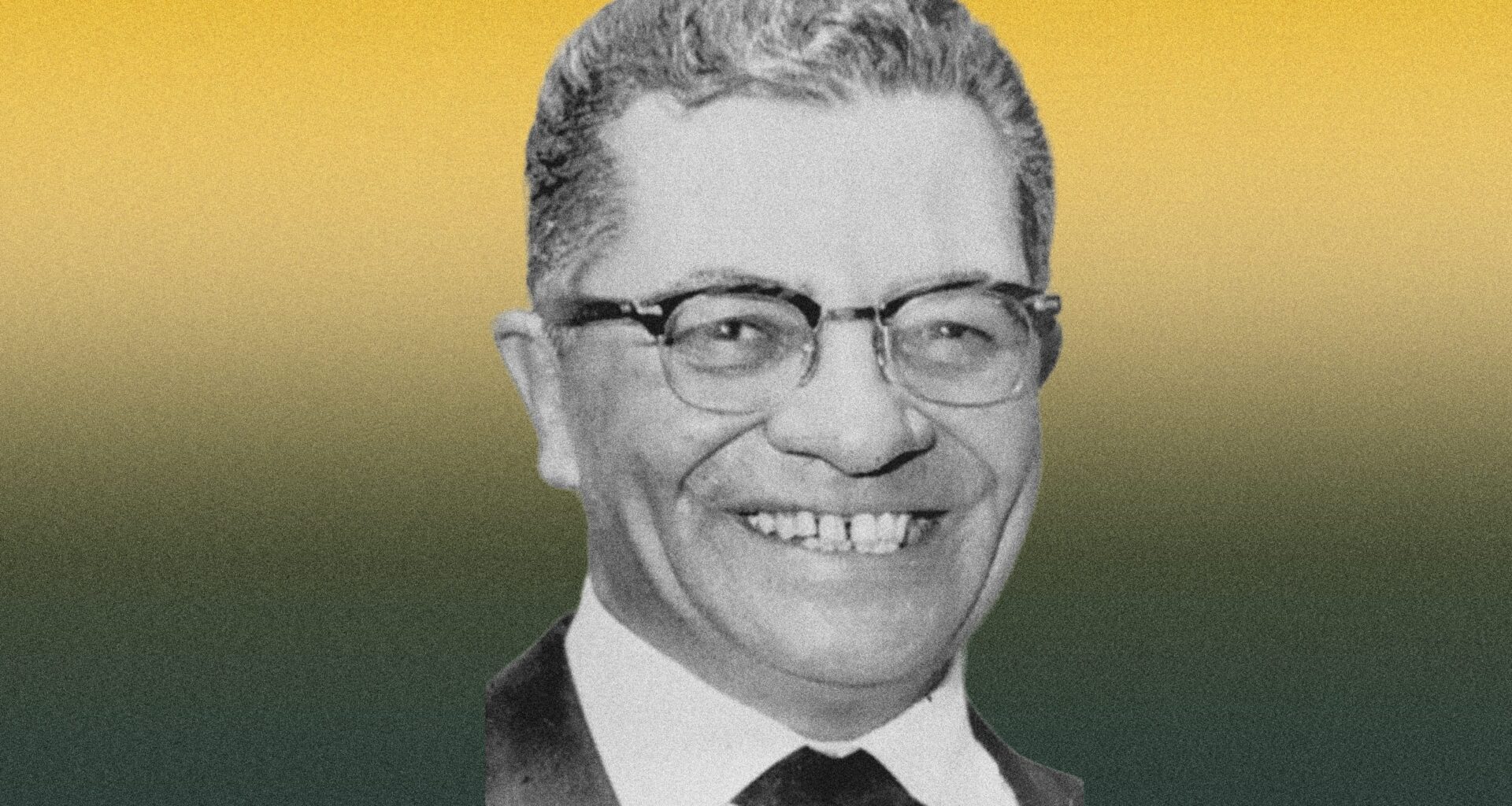
A sunny Sept. 19, 1965, in Western Pennsylvania saw coach Vince Lombardi’s Green Bay Packers take on the Pittsburgh Steelers in each team’s National Football League season-opening contest.
Little did everyone at Pitt Stadium understand that day how the teams would begin a history-making season for diversity and inclusion in pro football, one that reflected Lombardi’s Jesuit-imbued Catholic faith and call to social responsibility.
That season, the Packers and Steelers (who will meet again this Sunday) would simultaneously become the first teams in NFL history to have a majority of Black players on one of their starting units. Each team’s defense had six Black players among the starting 11.
Lombardi simply wanted the best players on the field in his quest to return to the NFL championship glory his teams found in 1961 and 1962.
“He didn’t care what color you were. Can you block? Can you tackle? That’s all it was,” said Dave Robinson, the first Black player to start regularly in the NFL at outside linebacker and who played for Lombardi on the Packers, in a 2016 interview with this author.
But the move to embrace all people was a reflection of Lombardi’s greater calling, one he first experienced inside the theater-sized classroom below the soaring clock tower of Keating Hall on the campus of Fordham University in the Bronx.
As a senior, Lombardi was taking his capstone philosophy class inside that theater in the fall of 1936, shortly after daily Mass and before football practice with the other members of the “Seven Blocks of Granite” offensive and defensive line that brought Fordham one win away from playing in the 1937 Rose Bowl.
The class was an academic component drawn from the Ratio Studiorum, the guideline for Jesuit education that had influenced university curricula for centuries around the world. “The Jesuits created the world’s first liberal arts curriculum, which is used to this day,” said Robert Reilly, the retired assistant dean of the Feerick Center at Fordham Law, in an interview with America.
That class helped Lombardi integrate every lesson he learned about the dignity of each human person and the sublimation of human will to God’s will in both moral conduct and loving action with his experiences as the Brooklyn-born grandson of Italian immigrants who faced discrimination.
“If you’re going to see God in all things,” Mr. Reilly explained, “you’ve got to look at a whole bunch of things to see him, so you can start seeing the connections.”
Lombardi sought those connections throughout his life, as prejudice against Italians kept him out of head coaching jobs despite the 12-year assistant coaching résumé he had built up at Army, Fordham and the New York Giants, where his teams had only one losing season.
But he noticed very few Black players making those rosters. The 1958 New York Giants had only four. When the Packers made him head coach in 1959, his new city did not have many more. Data collected by 1960 census takers in Green Bay showed that among the city’s 62,888 residents, there were exactly seven Black males. If the census counted players on his roster, more than half of those Black citizens would have been Packers players.
Lombardi not only changed the Packers’ fortunes, he paired the quest for excellence with a respect for human dignity and further changed part of the culture of Green Bay.
“There were a lot of racial and social inequities, and Vince made sure none of that permeated his team,” Mr. Robinson said. “We had no problems on our team whatsoever. Vince would be the first one to spot it and correct it.”
In his first year, Lombardi brought the defensive back Emlen Tunnell, the first Black member of the Pro Football Hall of Fame, from the Giants. Lombardi made him a player-coach before Tunnell’s retirement in 1961.
When Tunnell and his fellow Black players, like the defensive end Willie Davis and the safety Willie Wood, experienced substandard housing treatment or racism in the city’s diners and pubs, Lombardi led boycotts against each business. Lombardi had some personal experience with the discrimination his Black players faced. Author David Maraniss, in When Pride Still Mattered, has documented times Lombardi would go to a restaurant in the segregated South and be denied service, because wait staff believed he was Black.
When the Packers played preseason games in the South, Lombardi used his Army connections to establish team headquarters in integrated military quarters.
“It stemmed from his faith. His strongest suit is that he would not tolerate racism, ever,” Bill Curry, a Southern white player who had never shared a football huddle with a Black player before playing for Green Bay, told America.
“Sweat smells the same on everybody. We need everybody. I don’t care what color your skin is. I care if you’re a decent person, and I care if you can play football,” said Mr. Curry.
Lombardi encouraged Davis to get his master’s degree in business from the University of Chicago during the off-season. Davis became one of America’s top Black entrepreneurs and sat on countless boards of directors, including that of Marquette University in Milwaukee, perhaps as a nod to his Jesuit-educated coach.
That same coach who believed in finding God in all people became the first to regularly draft Black players in the NFL draft’s first round, starting in 1961, with perennial All-Pro defensive back Herb Adderley from Michigan State. Lombardi followed in 1963 with Robinson, an engineering student from Penn State, and helped him grow into arguably the best pass-covering linebacker in NFL history.
“Vince broke the mold in drafting Black guys in the first round,” Mr. Robinson said about the daily communicant who prayed the rosary on the way to his coaching office at Lambeau Field. “Like Vince always said, ‘I don’t draft by color. I draft by football-playing ability.’”
Their ability stood out on a defense that was the bedrock of the Packers dynasty that also won consecutive N.F.L. titles in 1965, 1966 and 1967, with the last two titles including wins in the first two Super Bowls in January 1967 and 1968.
Lombardi also gave vocal support to another one of his Black starters on that 1965 team, the defensive end Lionel Aldridge, when he announced his intention to marry Vicky Wankier, who was white. The pair had met resistance in the era before the Supreme Court ruling in Loving v. Virginia struck down laws against interracial marriage.
By 1968, Lombardi’s last year in Green Bay as general manager, his locker room had 16 Black players. Five of Lombardi’s Black Packers—Adderley, Davis, Robinson, Tunnell and Wood—were inducted into the Pro Football Hall of Fame.
Integration within what was arguably the greatest dynasty in NFL history also changed attitudes in a league that rarely had rosters on which more than 10 percent of the players weren’t white. By the time Lombardi died in 1970, Super Bowl championship teams had majority-Black rosters.
Lombardi’s embrace of all people went beyond race. He had witnessed his brother Harold, who was gay, endure prejudice throughout his life.
Lombardi had three gay players on his 1969 team in Washington—the first-team, All-Pro tight end Jerry Smith and the running backs Dave Kopay and Ray McDonald. Lombardi discouraged any discrimination against these players within his team.
“I know he coached openly gay players, and I think he was the first NFL coach to do that,” said Mr. Curry. “He saw the whole person. If they could play ball, they would make his teams.”
No doubt Lombardi’s own experiences with his family and in his childhood neighborhood in Brooklyn did much to influence his open-mindedness and willingness to tolerate difference in an age that did not always welcome it. But so too did the lessons he learned in Keating Hall and elsewhere at Fordham—lessons that helped him integrate faith, philosophy, truth and social responsibility in a way that helped him to reach excellence as a man as well as a coach.
Related