
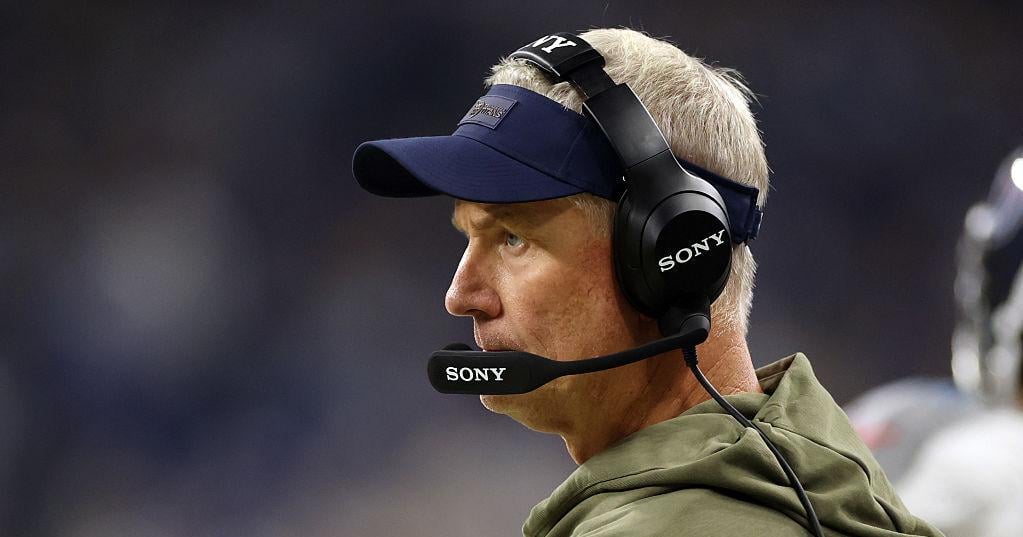
One of the few silver linings of being a football team headed nowhere — with an interim head coach who’s unlikely to be retained — should be an opportunity to take a chance or two.
When in doubt, take a risk.
What exactly is the downside?
A failure won’t make the difference between reaching the playoffs or not, nor will it — in all probability — make a difference on the long-term future of the coach.
But Titans interim coach Mike McCoy failed to embrace that philosophy once again in Tennessee’s 38-14 loss to Indianapolis, choosing to play it safe on a couple of makeable fourth-down situations when the game was — at least theoretically — still competitive.
The decisions followed the same conservative fourth-down pattern of former head coach Brian Callahan, who was fired six games into his second season with a 4-19 record.
“You look at situations,” McCoy told reporters of his choices. “You use certain things. What was the success of the play before that? How are you playing on third down? There are so many things that go into it.”
Why not be more different than Callahan?
“I’m my own self,” McCoy said. “I’m Mike.”
McCoy’s first opportunity came with just under two minutes left in the first half, when the Titans — trailing 17-7 — faced a fourth-and-4 situation at the Indianapolis 48-yard line.
Knowing he was facing the most explosive offense in the NFL, and that he would likely have to produce plenty of points in order to win, McCoy chose to punt instead of going for a first down.
The Titans did get the ball back with 26 seconds left in the half, but missed a 58-yard field goal.
An analytics account on `X’ that tracks fourth-down punting decisions, “Surrender Index 90” ranked that one in the 91st percentile of cowardly punts of the 2025 season, and the 88th percentile of all punts since 1999.
But it got worse in the third quarter.
Still trailing by just 10 points on their opening possession of the second half, the Titans drove to the Indianapolis 42-yard line, where Tennessee faced fourth-and-3.
Again, McCoy went the arch conservative route, sending in the punting unit instead of taking a chance on fourth down. Johnny Hekker delivered a touchback, meaning the Titans gained all of 22 net yards on the change of possession.
This time, Surrender Index 90 ranked the decision to punt in the 99.6th percentile of cowardly punts of the 2025 season, and the 97th percentile of all punts since 1999.
On the next play, Colts running back Jonathan Taylor went 80 yards for a touchdown that put Indy up 24-7, effectively ending the contest.
It wasn’t exactly a shock to see Taylor go the distance, as he’s now scored three touchdowns in each of his last three games against the Titans. Tennessee has one of the NFL’s worst run defenses, and was playing without Pro Bowl defensive tackle Jeffery Simmons.
“[Going for the first down] was something we talked about,” McCoy said. “Hindsight, [you] look back, and the last thing I thought they were going to do was have the big touchdown run after that … You look back and say, `God, I should have gone for that.’
“But initially when I said to punt it, [the strategy was] you pin them deep. The defense had done a nice job through the second quarter. You pin them deep, get the ball. But looking back, it’s one you wish you said, `Yeah, just go for it.’”
Titans rookie quarterback Cam Ward was not a fan of the second decision to punt, as CBS cameras clearly showed him yelling as he reached the sideline, finishing his comment with “Go for it.”
Said Ward: “If it was up to me, I’d want to go for it, every chance I’d get just because I’m a competitor … That’s just what I want to do in my football journey. I just think it’s a missed opportunity for us as a team to get a first down and keep the drive moving. But … we’re going to always support whatever decision is made.”
McCoy said he didn’t realize Ward had made any comment following the decision, saying he doesn’t hear much during games, because of the crowd noise and because he’s trying to stay focused on what’s ahead.
But he understood Ward’s passion.
“Cam has a burning desire to win,” McCoy said. “He’s very fiery. He wants to win. He puts in the time. He’s trying to do everything he can to get better week in and week out. He’s a competitor. That’s what you love about him.”
So why not give him more of an opportunity?
Again, what exactly is there to lose in such a situation?
“I’m trying to go for it,” Ward said. “But I know we going to go for it eventually.”