
Championships are won in November. And, as a general rule, they’re sealed by the guys on the team who won’t be reaching for long sleeves when the air starts to freeze.
In September, we ranked college football’s 15 best offensive lines after a month of games. We now have even more data — enough to know who’s for real and who’s pretending.
These rankings consider not only weekly game tape, but also the following metrics: sack rate, pressures allowed per dropback, percent of plays resulting in negative yards, percent of possible yards gained, EPA/rush attempt, yards before contact per rush, success rate, yards per designed run and strength of schedule.
(Note: EPA stands for “expected points added”)
Record: 7-0 (4-0 conference) | AP Rank: 1 | Stats: 431.4 yards per game (6.9 yards per play), .28 EPA/play (1.8 EPA/drive)
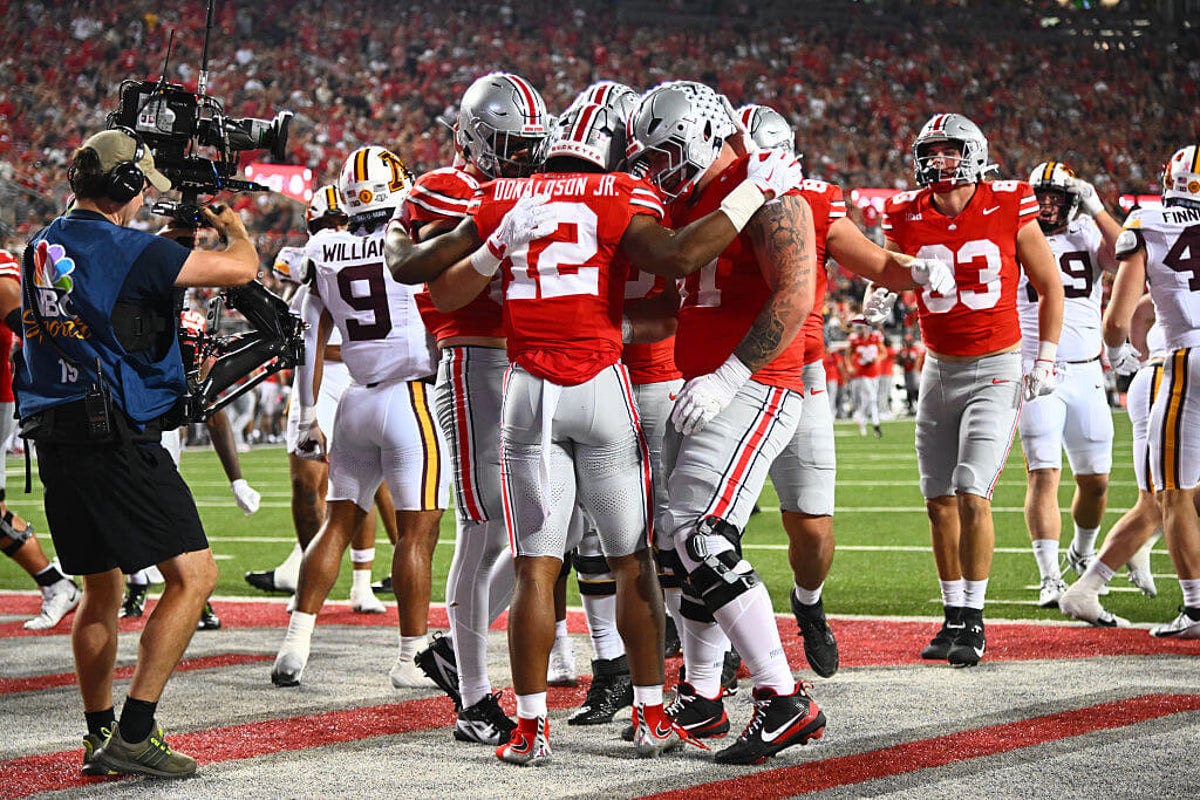
The Buckeyes ranked No. 2 on our earlier list and have maintained a consistent presence, both on the ground and in protection. Veteran center Carson Hinzman has been great this season, as has junior Austin Siereveld. Third-year guard Luke Montgomery has taken perhaps the biggest jump of any Buckeyes lineman this season.
The defending champs keep rolling.
Record: 8-0 (5-0) | AP Rank: 2 | Stats: 494.5 yards per game (7.1 yards per play), .28 EPA/play (1.7 EPA/drive)
The Hoosiers have an argument for the No. 1 spot, as Indiana’s offense has hit its stride in recent weeks. The Hoosiers have gained 64.7 percent of all possible yards this season, third most nationally (“possible yards” divides the number of yards earned in a drive by the number of available yards from a team’s starting field position to the end zone). They also continue to be one of the best in America at limiting negative runs — they rank fifth in that metric, right behind Ohio State.
This is a true unit, led by veteran center Pat Coogan, but its star is senior left tackle Carter Smith. He has given up zero sacks and only three pressures while playing more than 530 snaps.
Hemby has the Hoosiers rolling 💥@IndianaFootball RB Roman Hemby’s second TD of the game makes it 28-0.
📺: FOX pic.twitter.com/tWyeZtaawV
— Big Ten Network (@BigTenNetwork) October 25, 2025
3. Utah
Record: 6-2 (3-2) | AP Rank: 24 | Stats: 476.9 yards per game (6.5 yards per play), .25 EPA/play (1.6 EPA/drive)
The Utes’ talented offensive line, anchored by tackles Spencer Fano and Caleb Lomu, continues to be one of the country’s most efficient run-blocking units. Utah trails only Air Force in yards per rush before contact (1.6), which illustrates how much push a line is creating at the point of attack.
Utah has also done a great job limiting negative plays and sacks — it leads all Power 4 teams with 2,137 rush yards.
Record: 7-1 (4-1) | AP Rank: 6 | Stats: 483.9 yards per game (7.4 yards per play), .25 EPA/play (1.5 EPA/drive)
Despite a less-than-stellar performance in a loss to Indiana, the Ducks have continued to get great work from their offensive line — one of the most talented in America. OT Isaiah World continues to flash first-round traits while junior center Iapani Laloulu has been very efficient.
At least part of Dante Moore’s emergence this season has been that he’s playing behind a good O-line, and with a sound run game. The Ducks rank No. 2 in EPA/rush (.25), trailing only Navy.
Record: 8-0 (5-0) | AP Rank: 8 | Stats: 472.5 yards per game (7.3 yards per play), .19 EPA/play (1.1 EPA/drive)
One of this season’s great stories, Georgia Tech also has had one of college football’s most entertaining offenses for, really, the last two years. QB Haynes King being a unique talent certainly helps, but Georgia Tech’s front has done a great job. Its five starters (Keylan Rutledge, Ethan Mackenny, Harrison Moore, Malachi Carney and Joe Fusile) have combined to allow just three sacks.
Record: 7-1 (5-0) | AP Rank: 17 | Stats: 437.6 yards per game (7.4 yards per play), .31 EPA/play (1.8 EPA/drive)
The Bearcats arguably have the best pass-blocking offensive line in America through eight games, as the starting unit of Joe Cotton, Deondre Buford, Evan Tengesdahl, Taran Tyo and Gavin Gerhardt has not allowed a sack. Cincinnati QB Brendan Sorsby is having a fantastic year (19 TDs to one interception), too. Being able to work from clean pockets has been a big part of that success.
Record: 5-2 (3-1) | AP Rank: 23 | Stats: 530.9 yards per game (7.9 yards per play), .34 EPA/play (2.1 EPA/drive)
Lincoln Riley’s offense has really taken off — the Trojans lead the country in possible yards gained (68.3 percent). QB Jayden Maiava and WR Makai Lemon’s connection in the pass game has been a huge deal, but the Trojans’ run game is also starting to click.
Making things more impressive is that USC has had to do some O-line shuffling, notably due to the injury of starting center Kilian O’Connor. Either way, the Trojans have kept moving the ball.
Record: 6-1 (2-1) | AP Rank: 10 | Stats: 411.1 yards per game (6.1 yards per play), .18 EPA/play (1.1 EPA/drive)
Miami just missed the cut last time but, despite a poor showing in a loss to Louisville, continues to boast one of the best pass-blocking outfits in America. The Hurricanes lead the country in pressure rate allowed at just 16.2, more than four points better than Ohio State.
It’s no coincidence Carson Beck’s worst outing of the season came during the one game in which Miami’s front wasn’t awesome in protection — Beck was pressured a season-high 12 times that night. When Miami is consistently pounding the rock, its offense is at its best. Impressive 2026 NFL Draft prospect Francis Mauigoa and company are worth betting on.
Record: 6-2 (3-2) | AP Rank: 14 | Stats: 510.1 yards per game (7.0 yards per play), .23 EPA/play (1.4 EPA/drive)
The Vols’ offense has really only had one off day, a 37-20 loss to Alabama. Tennessee might be the best two-loss team in the country.
And it’s staying in the playoff hunt because the offense continues to be more than a product of Josh Heupel’s vertical-pass offense. This unit ranks eighth in rush success and 10th in yards before contact per rush. The spread formations don’t hurt, but Tennessee’s front has been fundamentally sound for a while now.
10. Vanderbilt
Record: 7-1 (3-1) | AP Rank: 9 | Stats: 433.6 yards per game (7.2 yards per play), .30 EPA/play (1.7 EPA/drive)
The Commodores claimed a spot on this list in September, and they’ve been the real deal since. Vanderbilt ranks No. 3 in EPA/rush attempt (.24), and its offensive line, anchored by center Jordan White, has given up just three sacks.
Diego Pavia and Eli Stowers have been electric, but the rejuvenation of this program under Clark Lea absolutely has included improved offensive line play. It’s probably no coincidence the Commodores have gone 14-6 since Lea hired veteran O-line coach Chris Klenakis.
LET’S GO
MK YOUNG pic.twitter.com/ALBrvrE7BW
— #9 Vanderbilt Football (@VandyFootball) October 18, 2025
11. Texas A&M
Record: 8-0 (5-0) | AP Rank: 3 | Stats: 459.3 yards per game (6.7 yards per play) .19 EPA/play (1.0 EPA/drive)
One of the most complete football teams in the country, Texas A&M has gotten off to an 8-0 start with the assistance of new faces in the right spots (WR KC Concepcion), big-time defensive performances (edge Cashius Howell) and a playmaker at QB (Marcel Reed). But the foundation is in a core group of offensive linemen who have been with program for a minute: OTs Dametrious Crownover and Trey Zuhn, guards Ar’maj-Reed Adams and Chase Bisontis and center Mark Nabou Jr.
Record: 6-1 (4-1) | AP Rank: 5 | Stats: 428.4 yards per game (5.9 yards per play), .17 EPA/play (1.1 EPA/drive)
Young, talented and tough, Georgia’s offensive line — like the rest of Kirby Smart’s club — battles for 60 minutes every week. There have been hiccups, which were to be expected with the Bulldogs starting true freshmen at guard (Dontrell Glover) and tackle (Juan Gaston).
But Georgia has gotten great work in the run game from veterans Drew Bobo and Micah Morris, while hulking junior left tackle Monroe Freeling has helped anchor a protection unit that’s allowed just one sack.
Record: 6-2 (4-1) | AP Rank: 21 | Stats: 410.9 yards per game (6.5 yards per play) .12 EPA/play (.7 EPA/drive)
Michigan has had to do some shuffling up front this season due to injury, but its run game continues to surge forward. The running back duo of Justice Haynes and Jordan Marshall has been terrific, and the offensive line has improved quite a bit, as well.
This is also a relatively young group — sophomores Andrew Sprague (RT), Jake Guarnera (RG) and Blake Frazier (LT) plus junior Nathan Efobi (LG) all have earned starts this year. Michigan’s offense could be very good over the next few years, with Bryce Underwood at QB.
Record: 6-2 (3-2) | AP Rank: n/a | Stats: 438.6 yards per game (6.8 yards per play), .28 EPA/play (1.9 EPA/drive)
Stud running back Jonah Coleman is on pace for another 1,000-yard season, and he’s already eclipsed his rushing total from last season. The Huskies had protection issues against Ohio State and Michigan, but they’ve run the ball well in just about every game. Consistency will be critical over the next month, including in the home finale against Oregon on Nov. 29.
Record: 7-1 (3-1) | AP Rank: n/a | Stats: 495.8 yards per game (6.8 yards per play), .24 EPA/play (1.4 EPA/drive)
Eric Morris’ version of the Air Raid has been the main event during his successful three-year North Texas run, but the improvement in the Mean Green’s run game has made a big difference this season. North Texas ran it well last year, too, but progress has continued — this unit ranks sixth in EPA/rush (.21) and seventh in percentage of possible yards gained (62.3).
Just missed the cut: Ole Miss, Arkansas, Iowa, Notre Dame, Missouri, USF, Virginia, Texas Tech, Texas State