
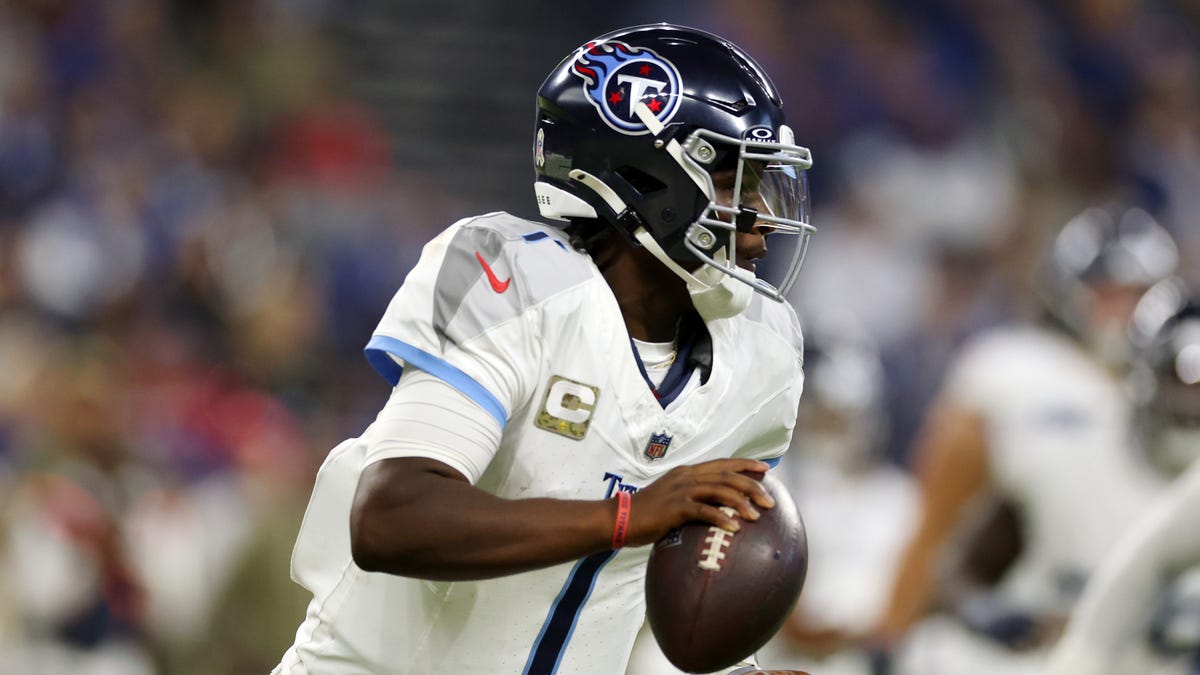
The only question that matters now, and for the rest of the Tennessee Titans‘ season, is if Cam Ward is getting better.
Ward, the No. 1 pick in the 2025 NFL Draft and the centerpiece of the team’s plans, is hardly lighting up the league. He heads into the Week 9 game between the Titans (1-7) and Los Angeles Chargers (5-3) ranked No. 24 in USA Today’s NFL quarterback power rankings, No. 30 in CBS Sports’ rankings and a seemingly impossible No. 33 in The Ringer’s rankings.
Among qualified NFL passers, he ranks 32nd in passer rating and QBR, 31st in success rate and 30th in yards per attempt. If Pro Football Focus grades are your thing, Ward ranks 33rd among qualified quarterbacks in passing grade, 35th in offense grade and 38th in adjusted completion percentage.
Those, of course, are raw numbers. None of that adjusts for where Ward started, or what trajectory he’s on.
So, to the root of the question: Is Ward getting better?
“We saw some things that he did better this game and the same thing two weeks ago,” Titans interim coach Mike McCoy said of Ward on Oct. 29, a few days removed from his Week 8 loss to the Indianapolis Colts. “And the great thing about Cam is he wants to be great and he wants to be coached hard. I think they’ve done a great job there with helping him get to where he is today.”
As for what Ward thought: “I think I improved every game from an operation standpoint, from a play call standpoint, to getting in and out of huddle, to knowing where guys are, to being an NFL quarterback. I think every game has got better.”
Knowing growth isn’t linear, let’s try to find some proof of Ward’s week-over-week progress, and gauge whether that progress is notable compared to other rookies who’ve been in his position.
Cam Ward’s growth: A statistical analysis
For this exercise, we’ll be using the statistic EPA as our guide. EPA, or “expected points added,” is a nifty calculation that measures how many expected points are gained or lost based on the outcome of any given play.
In short, based on league-wide data, the stat can tell you how many points an offense is expected to score on any given play given field position, down and distance, time remaining and score deficit.
The league-wide data also assigns point values to outcomes. For example: We know how many expected points a 3-yard gain on first-and-10 adds compared to a 6-yard gain. If you subtract the first value from the second value, you get EPA for a play.
Or in our case, a playmaker.
Let’s now look at data scraped from the SumerSports database “SumerBrain.” According to the database, Ward has been the central figure in 52 plays that resulted in a 1.0 or better EPA increase, and 76 plays that resulted in a -1.0 or worse EPA decrease.
Put another way, 16% of Ward’s dropbacks this season resulted in a significantly positive outcome, and 24% was significantly negative.
It’s not a surprise that the quarterback who ranks 34th in the NFL in EPA/play is hurting his team more than he’s helping. But consider the game-by-game trends here:
Week 1 at Denver: 5 positive plays, 8 negative plays (38.5% positive-to-negative rate)Week 2 vs Los Angeles: 7 positive plays, 10 negative plays (41.2% +/- rate)Week 3 vs Indianapolis: 8 positive plays, 12 negative plays (40% +/- rate)Week 4 at Houston: 4 positive plays, 8 negative plays (33.3% +/- rate)Week 5 at Arizona: 6 positive plays, 9 negative plays (40% +/- rate)Week 6 at Las Vegas: 7 positive plays, 11 negative plays (38.9% +/- rate)Week 7 vs New England: 6 positive plays, 8 negative plays (42.9% +/- rate)Week 8 at Indianapolis: 9 positive plays, 10 negative plays (47.4% +/- rate)
There, concretely, is a little bit of proof. Ward’s two best games this season when it comes to high-impact positive plays versus high-impact negative plays have been his past two. And his most recent game is also the one where he made the most high-impact positive plays. That’s a nice trend.
Cam Ward’s stats compared against recent rookies
Let’s get the bad news out of the way. Here’s a quick ranking of how many positive-to-negative ratios of 50% or better a few recent quarterbacks have posted through their first eight starts:
C.J. Stroud (2023): 7/8Jayden Daniels (2024): 7/8Bo Nix (2024): 6/8Drake Maye (2024): 6/8Bryce Young (2023): 5/8Caleb Williams (2024): 3/8Cam Ward (2025): 0/8
Ward’s starting point is undeniably lower. For what it’s worth, he’s also in last place among the seven in total high-impact positive plays and last among the seven in total high-impact negative plays. But now consider these rankings, which show the difference in positive-to-negative high-impact play rate in the passers’ first four starts compared to the next four:
Bo Nix (2024): +17.2Caleb Williams (2024): +12.5Cam Ward (2025): +4C.J. Stroud (2023): +0.1Drake Maye (2024): -1.8Bryce Young (2023): -3.8Jayden Daniels (2024): -17.1
Growth isn’t always linear, and an eight-game sample isn’t end-all, be-all. But documenting provable growth week-over-week is most crucial for Ward, who is considered by many evaluators to be the most raw prospect of any of these passers. And it’s an interesting trend worth following as he heads into the second half of his rookie year.
Nick Suss is the Titans beat writer for The Tennessean. Contact Nick at nsuss@gannett.com. Follow Nick on X @nicksuss. Subscribe to the Talkin’ Titans newsletter for updates sent directly to your inbox.