
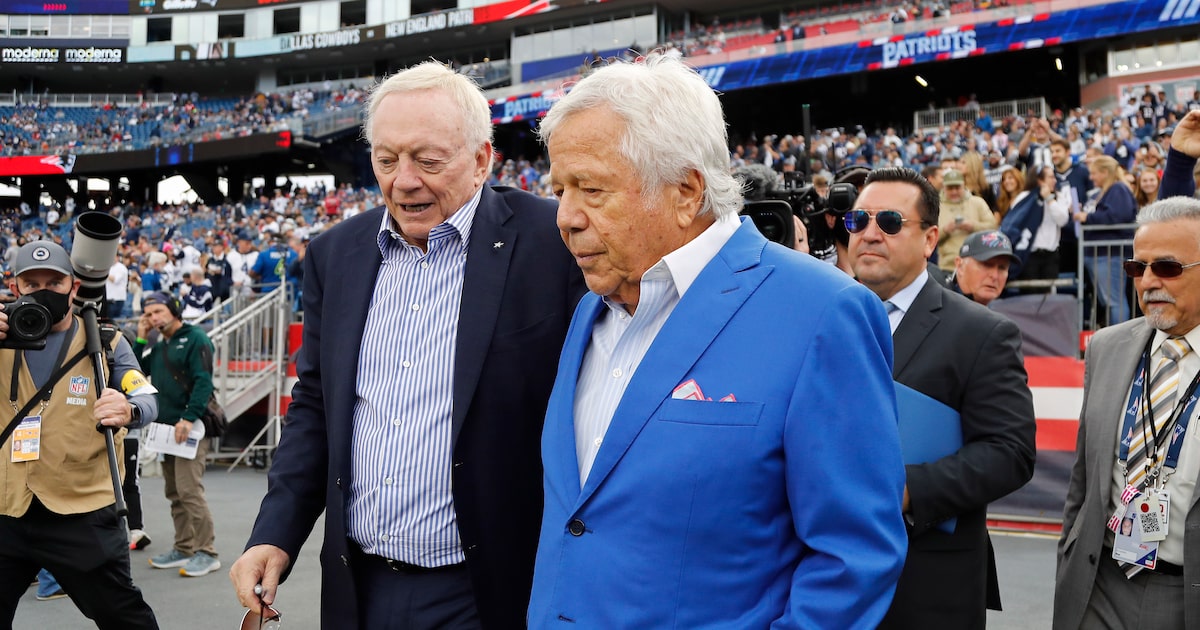
When Jerry Jones surveys the NFL these days, he sees a business that bears little resemblance to the one he encountered when he bought the Dallas Cowboys 36 years ago.
The undisputed king of sports leagues last year generated north of $23 billion; claimed 13 of the world’s 20 most valuable sports franchises; and two years ago boasted 93 of the top 100 most-watched television programs. The NFL’s high-octane financial engine shows no signs of slowing down.
The sizable role Jones played in helping transform the league into an economic behemoth is at the heart of a new book, “Every Day is Sunday,” by Ken Belson. The longtime New York Times sports business reporter offers a vivid peek behind the league’s shield, so to speak, exploring how three prominent figures — Jones, New England Patriots owner Robert Kraft and NFL Commissioner Roger Goodell — turned the NFL into a cultural and economic juggernaut.
The Dallas Morning News caught up with Belson, who pinpointed the most important league achievement Jones had his fingerprints on, why he is a “unicorn” among owners and how he’s on the frontlines of turning the NFL into a “lifestyle brand.”
Business Briefing
Ever the marketer and promoter, Jones, whose Cowboys are the world’s most valuable sports team, helped change the way the NFL does business. To that point, Carmen Policy, the former president of the San Francisco ’49ers and Cleveland Browns who at times butted heads with Jones, thanked the Cowboys owner in the book because Jones “force-fed us on the way to make money in the league that we weren’t focusing on, or even thinking about.”
The interview has been lightly edited for context and clarity.
Q: How much credit does Jerry deserve for shaping the NFL’s modern-day business strategy?
Belson: “He is on the Mount Rushmore of owners when it comes to growing the NFL as a business. Carmen Policy is quoted in the book saying Jerry ‘taught us how to make money.’ When he came into the league in 1989, you had a work stoppage in 1987, you had these owners who were almost violently opposed to free agency. Some were losing tons of money, and you had quite a few owners who inherited their teams and weren’t necessarily businessmen in and of themselves. Jerry came in. He was a serial entrepreneur. He was a risk-taker.
“He had guts. He still has guts. He understood the NFL was an incredibly powerful brand that was being sort of under-marketed, and he ran with it right away, partly out of necessity — the Cowboys were losing, by his estimation, a million dollars a month. There was a bank crisis in Dallas and an oil boom and bust. So fans had sort of turned away. He had a lot of work to do at home, but he quickly realized, ‘We need to not just increase revenue in North Texas, we have to increase revenue across the league.’ So Jerry gets, I think rightfully, a lot of credit for bringing Rupert Murdoch [and FOX] to the table in 1993. For many years, the media deals were a very cozy negotiation. You had CBS, ABC and NBC for three packages, and Jerry said, ‘Why aren’t we running an auction here?’ … It changed not just the NFL trajectory, but it changed all of sports television marketing and network rights.”
Q: You think about the growth of the league the past 36 years, what’s the single most important thing Jerry had his hand in? Was it playing a role in the first FOX deal?
Belson: “I would say yes, because not only did it change the trajectory of the league. Every other major pro league saw this and did the same thing … The broader impact of what Jerry did is massive. The second thing he did, which was much more controversial, at least within the NFL, is that he wanted to market, or he wanted the rights to market or sell his own sponsorships in the Dallas region.
“Another one that he did that was significant was he really pushed for the Rams to go to LA over the Chargers and the Raiders. Jerry was right. Stan Kroenke, he had the money. He spent $5 billion on the new stadium. It’s hosted Super Bowls. He did see if we’re going to move to LA, the entertainment capital of the world, it’s got to be in a big way.”
Q: In Jerry’s eyes, as you wrote, the “worst sin” is being boring. Not all owners, clearly, endorse that approach. How is he perceived among owners, and how has that perception evolved?
Belson: “When he came in, he really ruffled feathers. The old-timers didn’t really know what to make of him. He is sort of bold and risk taking, but Jerry’s got a, how should we say, rather syncopated style of talking? He’s bubbling with enthusiasm. And certainly back in the ’80s, this was an old-boys’ network. Jerry was a whole cut above there, because he wasn’t just unusual and quirky. He was looking to make money. And make money in a way that, an order of magnitude more than the other owners.
“When [Raiders owner] Al Davis died — he was the Darth Vader of owners over the years, he really gave everybody fits — he had to be buried in 48 hours, which is Jewish custom. The only owner who showed up was Jerry Jones. It’s remarkable to me. And Jerry absolutely admired Al’s willingness to buck convention and, in some cases, sue the league for what they believe to be the greater good of the league. So Jerry took a lot away from some of the older owners — and particularly Al.”
Q: The NFL is quite deliberate, even conservative, when it pursues new business ventures, as we’ve seen when it entered private equity waters. How does that philosophy square with Jerry’s approach?
Belson: “If Jerry ran the league, we’d have deals all over the place. I think one of the successes, or the hallmarks of the NFL, is that it actually is slow or deliberate. One of the perceptions of the league is that, because it’s the biggest, there’s this notion they must be the most progressive. I would never use that word to describe the NFL business techniques or style. Shad Khan is quoted in the book, the owner of the Jaguars, saying, ‘It’s like D-Day — you let others storm the beaches and then we come in afterwards.’ And that’s true with gambling, it’s true with international [growth], it’s true with private equity. The NFL is willing to use its leverage and its size to take its time.
“I’ve seen Jerry with many types of owners, with Robert Kraft, of course, with Stan Kroenke and even Dan Snyder. Jerry’s not political in the purest sense. He just loves getting to a deal. And he’s happy to work with any owner who’s willing to do that. And he’s got a gift for doing it.”
Q: Where do Jerry and Kraft differ in strategy and philosophy?
Belson: “In substance, they both are eager to make money for the NFL and to find new business opportunities. They also would love both to take credit for it. You know when they were courting Apple TV at various points … they were both, from what I heard, they were both talking to Apple. I’m sure Tim Cook was probably confused, like ‘Who the hell is running this thing?’
“In terms of style, they are just very different. Jerry is always on the phone. Last I saw, he had a flip phone. Still he’s a schmoozer, but he’s a salesman. Robert is much more like a diplomat. There’s a great scene in the book. In 2006, Jerry is at a golf club. I think it was like Preston Hills. John Madden is there, and Dick Ebersol and Jerry. This is three years before AT&T Stadium opens, and Jerry takes out an easel at a dinner and has renderings of the stadium. Three years before this thing is opening, he’s already selling it to NBC executives at a dinner with his wife in a private room at a golf club. He’s a salesman. He cannot not be a salesman, whereas Robert is more of a negotiator.”
Q: Kraft gave you this gem: “Jerry could talk a dog off a meat truck.” Is there a young owner even remotely comparable to Jerry in style or substance?
Belson: “Jerry’s a unicorn. Besides having the biggest team or most popular team and most valuable team, just his style of business, the energy he has for coming up with deals even at his age, you would think he’d be sitting back a little more. The fact that he helped negotiate the Skydance NFL venture to bring more sort of Hollywood-style content to light, then volunteers himself for the first project, which is the 10-part Jerry Jones [Netflix documentary], not too many owners would do it that way. But that’s Jerry. I don’t know how they replace him. Stephen Jones is wonderful. He’s very friendly. Sons of owners often have a hard time matching their dads, so I don’t see anybody replacing Jerry.
“I don’t know whether you’ve noticed this, but I certainly have even in the years I’ve been doing this — the owners, both the type of owners and the ownership circles, it’s just gotten tighter and tighter and harder for the media to get access to them. This may be true in other settings, they are just very wealthy people who generally don’t need or want to deal with the media. Jerry’s never seen a camera he didn’t like.”
Q: Whenever the Cowboys do win big again — be it one, two, five years — how may that impact their valuation?
Belson: “There’s a funny anecdote in the book where Jerry’s in the South of France on his yacht. Shad Khan has his yacht, somewhere in the pier there in Monaco. And Dan [Snyder] and Jerry come over and say, ‘Hey, can we check out your yacht?’ So they come on, they party for two days. Shad doesn’t own a team [then], but he wants to get one anyway. Shad was picking their brains. Jerry says, ‘Mark my words, the teams will be worth a billion dollars.’ Shad was laughing. He says, ‘Jerry, c’mon, get over it.’ Jerry knew exactly where it was going. If anything, he completely underestimated the value of teams.”
Q: What is the next business frontier for Jerry to either conquer or influence with the Cowboys or, broadly, with the league?
Belson: “One of the things he did when we were in the helicopter flying around [The Star a decade ago], Jerry tapped the pilot on the shoulder, and said, ‘Go up the highway a couple of stops.’ And at that point, he owned the land on that highway two more stops north. I think it was called Prosper. It was just a bunch of fields. And he says, ‘I bought all this land and I’m going to put housing out there.’ He says, ‘It is going to be like Cowboys-branded [affiliated] real estate?’ And sure enough, that has mostly filled in with thousands of homes.
“Jerry is among the owners now aggressively looking at how to turn the NFL into almost a lifestyle brand … You want to be in proximity to the team even if you can’t buy a ticket. That’s where this is going. You have to remember all these real estate things are off the books. You don’t share this revenue with the other owners. So that’s a big motivation. ‘I can use the Cowboys brand any way I want, and if it gets somebody to buy a townhouse, I’m making money off it.’ That’s sort of NFL 3.0. Jerry is among the owners pushing the envelope on this one.”
 Mavs, Stars set to duke it out in the Texas Business Court. What is that?
The state’s answer to Delaware’s Chancery Court will see two pro-sports heavyweights fight over the future of their arena-sharing arrangement.
 Betting is changing American sports
The industry is incentivized to foster addiction.
 The private equity rush that could ruin college sports
My firm offers a new way that’s better than the deal Texas A&M just signed.