
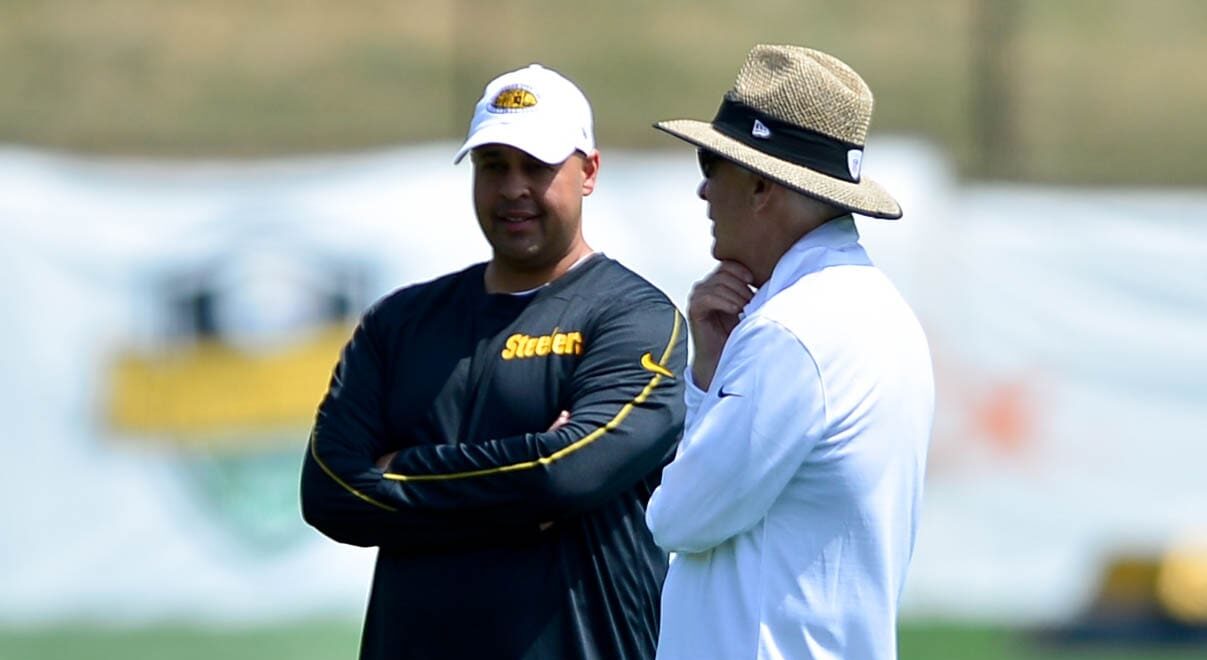
 Pittsburgh Steelers general manager Omar Khan and president Art Rooney II during training camp on July 26, 2024. — Ed Thompson / Steelers Now
The Pittsburgh Steelers did not make a trade at the trade deadline on Tuesday, with general manager Omar Khan choosing to stand pat — a move that has seemingly upset a lot of Steelers fans that were apparently unaware of what has been happening with the franchise.
So, let’s catch people up.
To start, we need to go back to 2021. The Steelers decided before that season that 2021 would be Ben Roethlisberger’s final year in black and gold, and the 2021 NFL Draft class was supposed to be the beginning of the effort to build a bridge to the next contending Steelers team.
The idea was that the Steelers already had an elite defense, led by T.J. Watt, Cam Heyward, Minkah Fitzpatrick and company — a defense that had just dragged Duck Hodges to the verge of the playoffs and a post-arm-injury Big Ben to a 12-4 record.
With the defense looking solid, the Steelers then planned to rebuild the offense, with the 2021 NFL Draft being the start of that. Najee Harris, Pat Freiermuth, Kendrick Green and Dan Moore were supposed to form the base of an offense that they would later add a quarterback to.
The following season, Big Ben retired and the Steelers followed through on the idea of the previous draft, adding Kenny Pickett, George Pickens and Calvin Austin III to what form what was hoped to be the basis of a future offense.
It was a clear effort at an offensive rebuild. At the same time, the Steelers were not tanking. They had been a good team, even with below average offenses in the recent past. They didn’t need the young unit to be elite right away to be pretty good, they just needed to be good enough.
So the Steelers were still trying to compete, but don’t confuse that with pushing all their chips in.
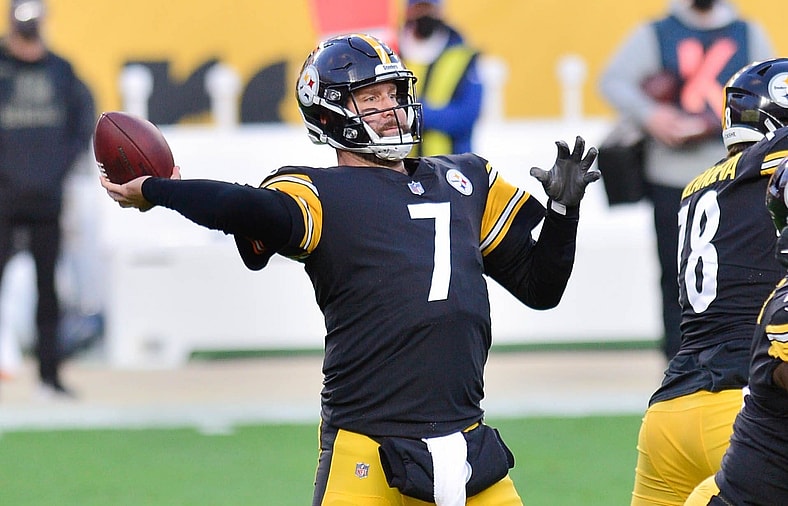 Pittsburgh Steelers quarterback Ben Roethlisberger in a game against the Cincinnati Bengals on Nov. 15, 2020. — Ed Thompson / Steelers Now
Under Kevin Colbert in the late stages of Roethlisberger’s career, the Steelers frequently over-spent the cap by restructuring contracts and kicking the can down the road to attempt to eke as many wins out of each season as possible. They also made win-now trades like sending out a first-round pick to Miami for Fitzpatrick. They were unusually active in free agency, almost never receiving comp picks as a result. It was clear the Steelers were making a big push to get Big Ben one more title before he retired.
That all came to a head in 2020-21, when a COVID-reduced salary cap forced the Steelers’ hand, and they lost a couple of players they wanted to keep, most notably Javon Hargrave and JuJu Smith-Schuster. That cap reduction, with the Steelers’ proclivity for overspending at that time, was the death knell of that era.
In the post-Ben years, all of that behavior has stopped. The team has not been overspending the cap. In the past few offseasons, they’ve had carryover cap space, and they’ve done that while leaving potential restructures on the table.
But — as Roethlisberger himself recently pointed out — the first steps in the rebuild did not go well. Of the two drafts at the end of Kevin Colbert’s tenure in 2021 and 2022 that were supposed to help reset the offense, only Freiermuth and Austin remain on the team.
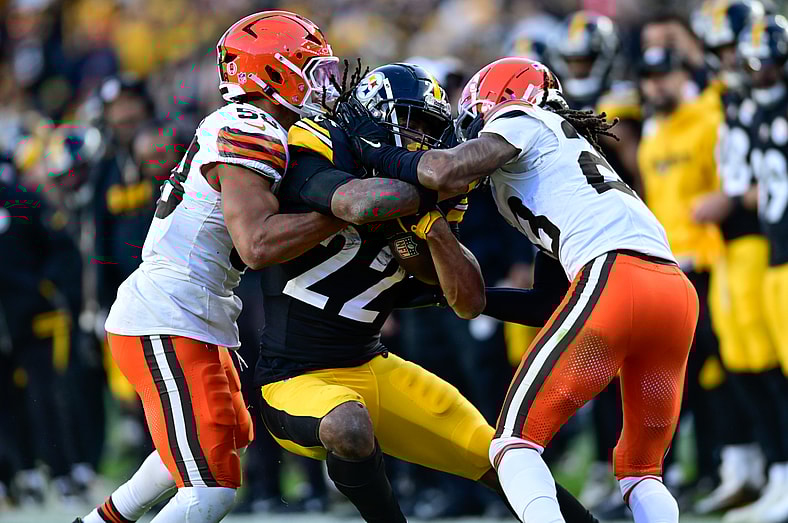 Pittsburgh Steelers running back Najee Harris is tackle by two Cleveland Browns on Dec. 9, 2024. — Ed Thompson / Steelers Now
It was clear almost immediately in that prioritizing skill position players over the offensive line in his offensive rebuild that Colbert had put the cart before the horse. Harris never had running room. Pickett never had time to throw, and when combined with a lackluster offensive coordinator hire in Matt Canada, never even really had a chance to develop here.
When Omar Khan, along with Andy Weidl, took over before the 2023 draft, they basically started that offensive rebuild over — with a focus on on the offensive line modeled after the Philadelphia Eagles, the team Weidl had previously helped build.
The Steelers drafted Broderick Jones in 2023 and Troy Fautanu, Zach Frazier, Mason McCormick in 2024, completely revamping that unit — a process that is just starting to bear fruit.
 Pittsburgh Steelers offensive tackle Troy Fautanu blocks against the Seattle Seahawks on Sept. 14, 2025. — Ed Thompson / Steelers Now
But of course, with the offensive timeframe being reset, the Steelers could no longer count on that defense still being dominant by the time the offensive rebuild came to fruition. So in 2025, they turned their eyes to the defensive trenches, adding Derrick Harmon, Jack Sawyer and Yahya Black to the fold.
In terms of year-over-year draft strategy, they finally appear to be ready to turn back to skill positions in 2026, which happens to coincide with an unusually deep quarterback class — something that was well known ahead of time.
But that set up a potential conflict as the team continued to compete, outside of that draft strategy. The better the team would be in 2025, the worse the the draft pick would be.
I asked Mike Tomlin about that conflict all the way back in January.
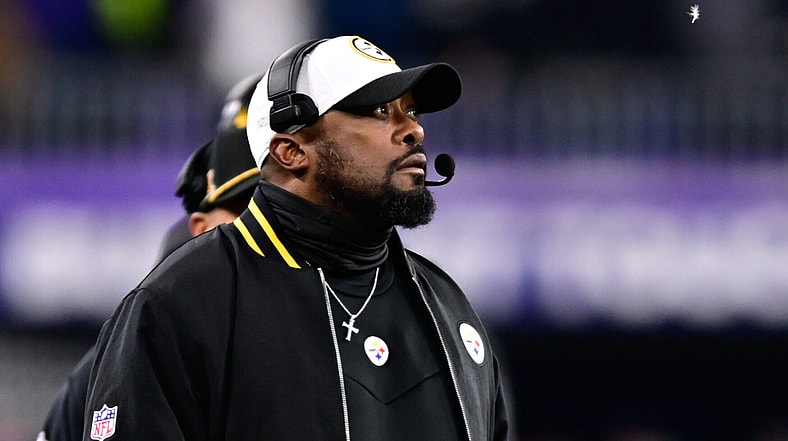 Pittsburgh Steelers head coach Mike Tomlin in a game against the Baltimore Ravens on Jan. 11, 2025 — Ed Thompson / Steelers Now
Here’s the interaction between me and Tomlin, just a few days after the Steelers’ 2024 season ending with a playoff loss to the Baltimore Ravens.
PSN: “When you look at the teams that are still playing, a lot of these quarterbacks are taken way at the top of the draft. You guys very rarely pick there. How do you see a way forward? Russ (Wilson) is 36 and obviously, not a long-term plan to getting back to elite play at the quarterback position. Is potentially having a season where you have to take a step back part of that equation?”
MT: “Lamar (Jackson) wasn’t taken in the top of the draft. (Jalen) Hurts wasn’t taken in the first round. So, I don’t know that I necessarily agree with the question.”
Tomlin is certainly not wrong. And you can add to that list that Jordan Love went later in the first round. Josh Allen and Patrick Mahomes were both drafted after their teams traded up. Sam Darnold was signed as a free agent. Jared Goff and Matthew Stafford were traded for one another. Of the top 10 quarterbacks in passer rating this season, only one — New England’s Drake Maye — was drafted with top 10 pick by the team where he is currently playing, without a trade-up. Justin Herbert makes two in the top 15.
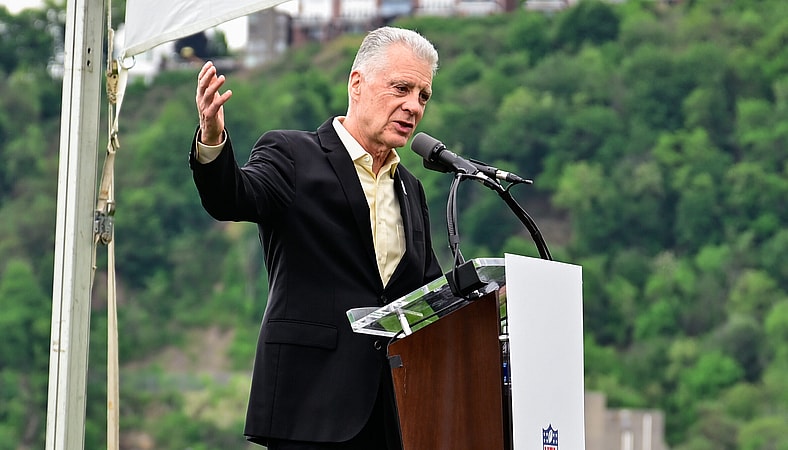 Pittsburgh Steelers president Art Rooney II speaks at the 2026 NFL Draft clock reveal on May 12, 2025 — Ed Thompson / Steelers Now
Besides that, there are other reasons that’s not a path the team has ever gone down. It’s antithetical to the way the Rooney Family has run the team over the years a rock of stability and consistency, both to the fans and to players.
Strategies like tanking rarely work in the NFL. In order to be a team truly bad enough to land a top draft pick, especially one that already had a lot of the necessary championship pieces on its roster, then a lot of those pieces have to under-perform.
The general manager can put his finger on the scale by not making necessary additions, but it should be clear by the failure rates of top draft picks around the NFL that developing young players in the conditions of putting a miserable team around them is not a best business practice.
Look at the careers of Darnold, Daniel Jones and Baker Mayfield after they’ve all left the moribund franchises that drafted them, only to have much more success elsewhere. There are plenty of reasons for their delayed success, but a big one is that losing breeds more losing. A fanbase and a team with such proximity to the Cleveland Browns should not need any further reminders of that.
Establishing that tanking wasn’t an option didn’t, however, resolve exactly what the Steelers’ plan would be entering the 2025 season. That became abundantly clear during free agency, when Khan made obvious his strategy of attempting to maximize the team’s compensatory draft pick return.
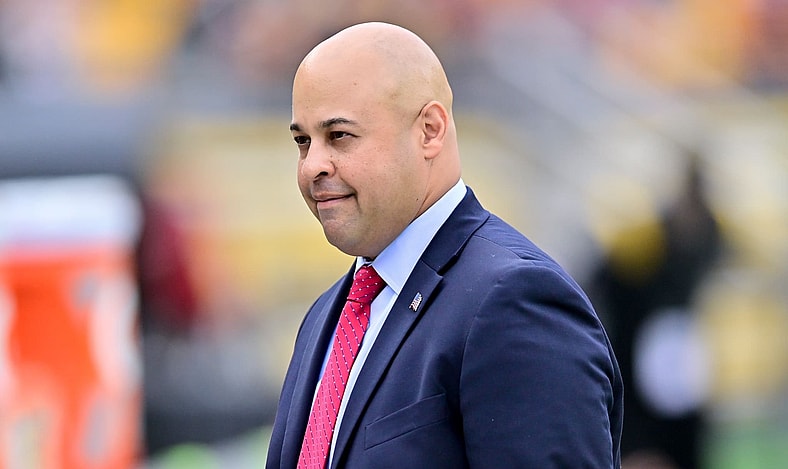 Pittsburgh Steelers general manager Omar Khan before the team’s game against the San Francisco 49ers on Sept 10, 2023. — Ed Thompson / Steelers Now
The Steelers let seven countable free agents walk in the offseason, and signed only three, choosing to make their most significant additions by trade (DK Metcalf, Jalen Ramsey, Jonnu Smith) or by adding players released by other teams (Aaron Rodgers, Darius Slay, Juan Thornhill).
That is not the most efficient or effective way to build an NFL roster to compete in the upcoming season. Khan navigated free agency with one hand tied behind his back. The reason he did so was that he was, already before the 2025 offseason started, looking ahead to the 2026 NFL Draft.
When he finally found a buyer for Pickens, what did Khan demand in return? You guessed it: 2026 NFL Draft capital. He even sent a 2027 pick with Pickens to Dallas to increase the 2026 return.
When he wanted to add Ramsey and Smith from the Dolphins, Khan absolutely could have made that deal for just draft picks. But he had no interest. Instead, he sent Fitzpatrick packing.
That certainly didn’t help the team this year one bit. The only reason to do it that way is because the team is far more focused on the future than the present.
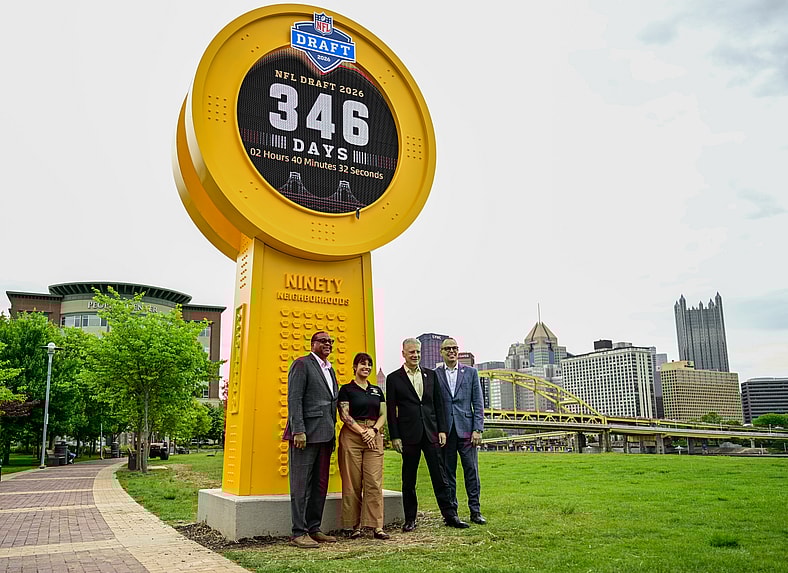 Clock counting down to the 2026 NFL Draft in Pittsburgh on May 12, 2025. — Ed Thompson / Steelers Now
Between the Pickens trade and the compensatory draft picks headed this way, Khan added two third-round picks, a fourth-round pick and two more later day three picks. That, combined with the team’s usual allotment of picks in 2026 and 2027 should be more than enough for the team to trade up from wherever they finish this year into the range they’ll need to be in to land a quarterback.
Khan solved the dilemma. Working around the comp pick rules was difficult, but at the end of the day, the Steelers now have the ability to recoup whatever they might lose in draft capital by winning more games this season and then some.
The fact that many of the Steelers additions this offseason were older players — something cited by those erroneously assuming the term was all in on this season — was purely a coincidence. When you’re restricted to trades and players cut by other teams, the talent pool skews older.
That’s why the Steelers signed Slay instead of a similarly priced younger player, and it was a significant benefit to picking Rodgers over other options at quarterback.
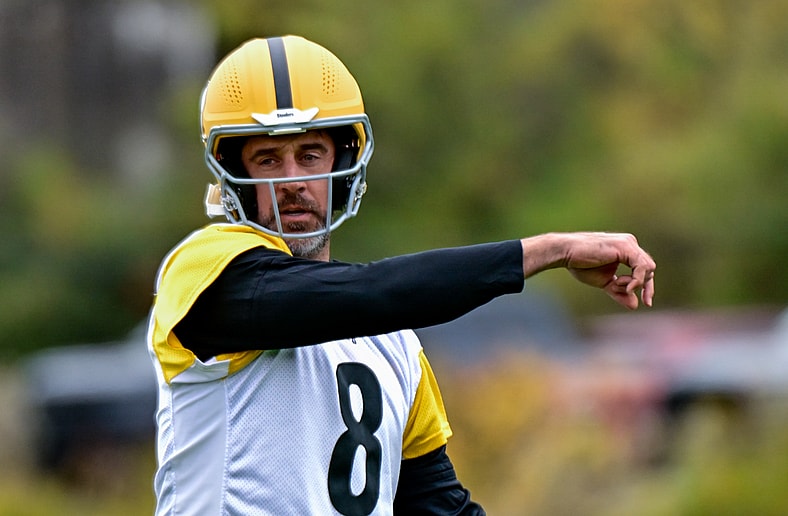 Pittsburgh Steelers quarterback Aaron Rodgers at practice on Oct. 24, 2025. — Ed Thompson / Steelers Now
The trade of Pickens opened up a hole that Khan was never able to fill this season — the second straight year the team went into the season without a quality second wide receiver.
That’s not the kind of thing any responsible general manager attempting to push all his chips in on the 2025 season would do — especially one with as much stacked-up draft capital and potential salary cap space as Khan. But for a team that is more focused on the future, and acquiring that potential franchise quarterback in next year’s draft class than outright maximizing the wins and losses for 2025? That makes perfect sense.
Finally, we come to Tuesday’s trade deadline, where Khan was presented with some options in terms of wide receivers available in a trade. While he did due diligence on the group and extended at least one offer, no deal was reached. It wasn’t due to a lack of a desire for the Steelers to upgrade their wide receiver position, but of a lack of ability to meet at a price point with another team.
If you’re more focused on the future than anything else, even those mid-round draft picks (Jakobi Meyers was traded for a fourth and a sixth, Rashid Shaheed for a fourth and a fifth) become precious. A fourth- and a fifth-round pick aren’t going to help Khan trade up from the mid 20s to the single digits to realize the team’s quarterback-centric plan, but they will serve as a stand-in for the rest of the draft class.
It probably doesn’t hurt that Khan and Weidl have done exceptionally well with early day three draft picks. Nick Herbig looks like a future star. McCormick was a starter as a rookie and has continued to progress. Jack Sawyer and Yahya Black have shown promise in their first year. Which two of those does it make sense to trade for two months of a wide receiver?
Let’s say the Steelers win a playoff game and end up drafting 25th this year. To get pick No. 10, according to the Rich Hill draft pick value model at Drafttek.com, they’d have to trade their second and their third to make the move. Let’s say the overall scarcity of quarterbacks and the competitiveness of teams looking to trade up makes it more expensive. Maybe they have to trade all three of their third-round selections to make it happen — a perfectly reasonable projection and not at all too much to pay.
But then what? The Steelers are not simply a quarterback away from Super Bowl contention — another reason it’s silly to suggest they should have been all in on the 2025 season. They, as has been widely noted, need a wide receiver. Slay is barely holding onto his job for 2025, and 2026 appears to be totally out of the question. Isaac Seumalo is on an expiring contract and appears to be nearing the end of his run here.
This can’t be a Ricky Williams situation, where the Steelers trade their entire draft class for one player. They need more than that. And so the picks in Khan’s coffers that he had to make a deal with are precious. Would he have traded some for the right move? Of course. He made a pick swap the week before to add Kyle Dugger to the defense. If there was a value addition to be made, he would have made it. But the team’s focus on the future, compared to say, the Indianapolis Colts, who appear to be going all in with Jones at quarterback, made those picks much more dear to him than others.
The team is building, and putting one foot in front of the other. It’s not a dramatic rebuild, where they tear the whole thing to the ground. It’s a deck being replaced one board at a time. They took care of the offensive line. Then the defensive line. It seems likely that quarterback is next.
Maybe the not-as-dramatic nature is why people have had a hard time recognizing what’s truly been going on here.
The plan is not foolproof. They’ll have to hit on the quarterback, always a big question mark in today’s NFL, and any championship run always involves a healthy dose of luck.
But that’s the plan, and if you’ve been paying close attention, it’s been obvious for a while. And if you haven’t been, well, I’m glad I was here to help.
Mentioned In This Article: Omar Khan Pittsburgh Steelers Steelers top