
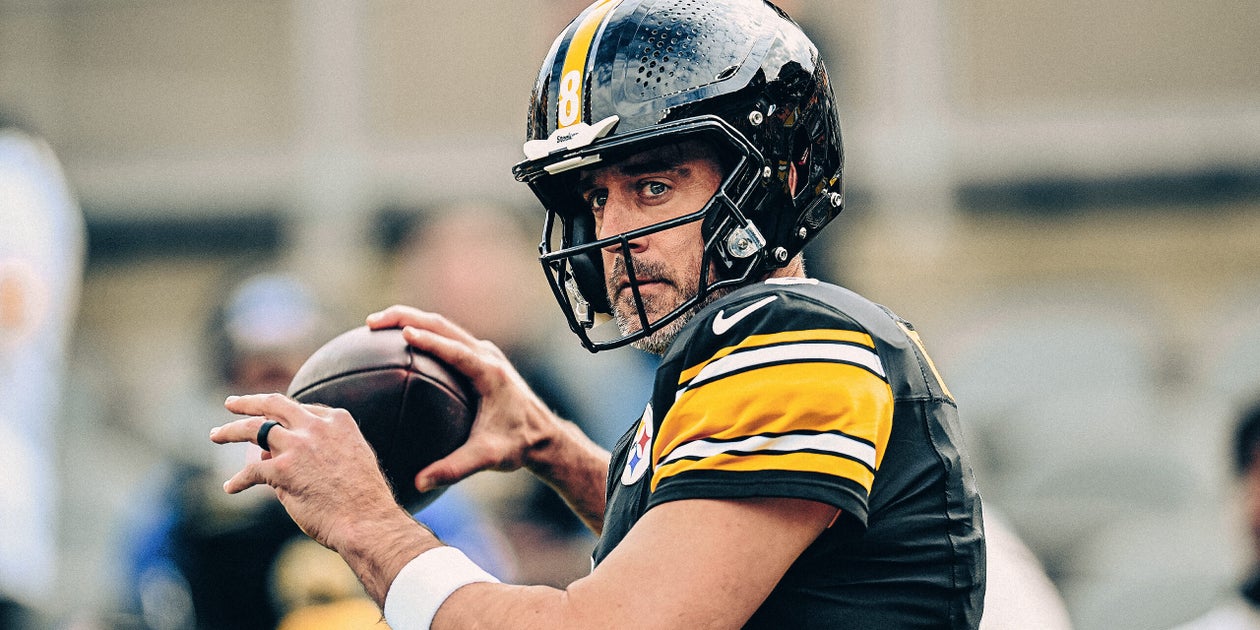
PITTSBURGH — Shortly after Aaron Rodgers signed a one-year deal with the Pittsburgh Steelers last June, the future Hall of Fame quarterback joined “The Pat McAfee Show” to address his decision — and his future.
“I’m pretty sure this is it,” Rodgers said. “That’s why we just did a one-year deal, the Steelers didn’t need to put any extra years on that or anything. This was really just about finishing with a lot of love and fun and peace for the career that I’ve had.
“It’s been a long run and I’ve enjoyed it. What better place to finish than in one of the cornerstone franchises of the NFL with Mike Tomlin and a great group of leadership, great guys and a city that expects you to win.”
For Rodgers, Pittsburgh presented an opportunity to end his career on a positive note after two tumultuous seasons with the New York Jets. For the Steelers, the one-year deal provided the team with a veteran voice of leadership — and a bridge to a 2026 NFL Draft full of quarterback talent.
Well, at least that was the initial plan.
At the midpoint in the season, Rodgers has already won as many games with the Steelers as he did in a full season with the Jets. Pittsburgh sits atop the AFC North at 5-3, with a two-game lead over the Baltimore Ravens. And most importantly, Rodgers’ play has significantly improved after one of his worst statistical seasons in 2024.
Could both sides reconsider and decide to run it back in 2026? While it’s too early for Rodgers and Steelers to have those conversations (the team has a long-standing policy of not negotiating contracts in-season), let’s examine how this marriage has gone to this point, and what it could mean for the future.
A return to form
When Rodgers joined the Steelers, it was fair to wonder if he’d look more like a 41-year-old QB than a four-time MVP and Super Bowl champion.
During his 2024 season with the Jets, Rodgers logged a career-worst passer rating (90.5). His EPA per dropback had been positive in every complete season through 2021 and was as high as 0.40 in the mid-2010s, but it was negative in his previous two full seasons, in 2022 with the Packers (-0.03) and 2024 with the Jets (-0.02). His completion percentage (63.0) was the fourth-lowest of his career. And he posted a -0.08 EPA per dropback against the blitz, according to TruMeda, the worst of any quarterback with a minimum of 300 attempts.
In virtually every statistical category, Rodgers has bounced back significantly — that includes a passer rating of 103.1, which is actually slightly better than his career mark of 102.6, the second-highest of all-time behind only Lamar Jackson (103.5).
He’s no longer doing regular appearances on McAfee’s show — where he regularly made headlines, for better but often for worse, during his two years with the Jets. The fact that the team is winning has smoothed over minor moments of drama, like when he sharply criticized the condition of Acrisure Stadium’s turf, or when he suggested the team should have departed for an overseas trip to Dublin in Week 4 earlier than it did. He appears to be genuinely enjoying his time in Pittsburgh and has made some real friendships while fitting into Mike Tomlin’s culture. And Rodgers’ leadership, built around a detailed, demanding approach, has been well-received by young teammates.
“Aaron’s the ultimate competitor. If you mess up in practice, he’s gonna be on your ass,” receiver Ben Skowronek said. “I think that’s a great thing to have a quarterback like that, to have a leader like that. It sets the standard, not only for the offense, but for the defense, special teams and everything.”
How is he doing it?
Several other quarterbacks in their late 30s or 40s — including Peyton Manning, Drew Brees, Tom Brady and Ben Roethlisberger — enjoyed success by relying on experience and accuracy to lead quick, efficient passing games. That’s exactly the Steelers’ formula.
Rodgers, who still has an elite release, is throwing the ball shorter and quicker than just about anyone else in football. His 5.7 air yards per attempt is the lowest mark in the NFL, and more than a full yard less than his previous career lows in 2024 and 2017 (6.9). He has also attempted a career-low 2.75 percent of his attempts with 20-plus air yards.
His time to throw (snap to pass or sack) is fastest of his career at 2.5 seconds, per TruMeida. Among QBs who have started the bulk of their team’s games through Week 9, only Tua Tagovailoa (2.49) has a lower time to throw.
The Steelers have also limited Rodgers’ exposure, to a degree, by featuring a balanced offense after he attempted the second-most passes in the league last year (584). Rodgers is averaging a career-low 33 dropbacks per game and career-low 30.4 pass attempts per game; that puts him on pace for about 70 fewer pass attempts this season. Rather than putting it all on Rodgers to be the entire offense, the Steelers are simply asking their quarterback to be an effective pocket passer to elevate the playmakers around him.
More mobility
A ruptured Achilles tendon ended Rodgers’ season in the first game of the 2023 season. The aftermath of that injury, along with reported knee and hamstring issues, limited his mobility in 2024. Anecdotally, watching Rodgers through training camp and into the season, it seems his mobility continues to get better with every game.
“You look around the league on third down how many plays are converted off of play extensions, even in the red zone when people play drop coverages?” offensive coordinator Arthur Smith said. “Sometimes if one’s not there, there a lot of big plays created. Aaron’s always been able to do that. He certainly doesn’t look his age the way he’s moving around.”
The stats back up the eye test. According to NFL Next Gen Stats, Rodgers has thrown on the run (moving 8 mph or faster at release) on 13.6 percent of his passes. That’s up from 13.4 percent in 2024 and 12.5 percent in 2022. His average speed at throw (4.15 mph) is faster than both of his last two complete seasons (he averaged 3.95 miles per hour in 2024 and 3.87 mph in 2022).
Some aging quarterbacks have to play flatfooted from the shotgun. However, Smith and his staff felt Rodgers could play under center and execute the numerous play-action keepers and rollouts in the offense. So far, Rodgers has played under center on 34.6 percent of snaps, his highest rate since 2021 (38.5%). The Steelers have used designed rollouts on 9.1 percent of his dropbacks — that’s up from 7.2 percent with the Jets in 2024 and 6.8 percent with Green Bay in 2022, according to NFL Next Gen Stats. Perhaps the most telling stat: Rodgers has been sacked on 5.8 percent of dropbacks, lower than his career average of 6.5 percent.
Will it continue?
While the Steelers probably couldn’t ask for more out of Rodgers, the biggest question is: Will it continue or will the veteran regress as the weather gets colder and wear and tear adds up?
Last season, the Steelers were in a similar place with an aging quarterback. After Russell Wilson won six of his first seven starts to put the Steelers in first place in the AFC North, Pittsburgh was seriously considering re-signing the veteran or using the transition tag to retain him.
In many categories, Wilson was actually playing better football at this point last season than Rodgers is now. Through seven starts, Wilson’s EPA per attempt (0.27) was twice as good as Rodgers. His EPA per dropback (0.11) was more than twice as good as Rodgers (0.05) and his passer rating of was a few ticks higher (103.9) than Rodgers’ (103.1).
For Wilson, the wheels fell off down the stretch, the Steelers lost four consecutive games to end the regular season and were blown out by the Ravens in a wild-card playoff game.
At the same time, the outcome of this season could impact Rodgers’ thinking. If the Steelers can capitalize on their early lead in the division and make some noise in the playoffs, perhaps Rodgers will be interested in seeing if he can push the team over the top in 2026. But if they fall apart down the stretch, miss the playoffs or have another early exit, Rodgers may be content to call it a career.
What’s next?
The Steelers have been stockpiling draft capital with the plan of moving up in the first round. They currently have seven draft picks, plus an additional third-round pick from the George Pickens trade and as many as four compensatory picks. While the comp pick calculations will be done after the season, the Steelers are anticipating between 10 to 12 draft choices in 2026, when they just so happen to be hosting the draft in Pittsburgh.
The team has been diligently scouting and evaluating all of the quarterbacks in this year’s draft. Right now, even if the Steelers might be willing the keep the door open for Rodgers, the veteran quarterback shouldn’t alter their approach.
In fact, even if Rodgers returns, there could be some value in drafting a quarterback in the first round who can learn behind the future Hall of Famer. Rodgers was a willing mentor for rookie QB Will Howard this summer. He did the same for Jordan Love in Green Bay. In that way, maybe Rodgers would still be the bridge to the future — the bridge will just be longer than initially anticipated.
Rodgers’ call
Rodgers has shown time and time again that he marches to the beat of his own drum; this will probably be his decision more than anyone else. That said, Rodgers waited months before committing to the Steelers. He also flirted with retirement for years in Green Bay before joining the Jets.
Maybe Rodgers has had such a good experience that he’s willing to give the Steelers’ an immediate commitment after the season, but that shouldn’t be expected. Given the way things have unfolded in the past, the Steelers shouldn’t anticipate a signature on the dotted line until after OTAs.
Pittsburgh should still be making an aggressive push to land its future franchise QB in 2026. But if Rodgers decides he wants one more year, so long as he continues to play at this level, right now there’s little reason to say no.