
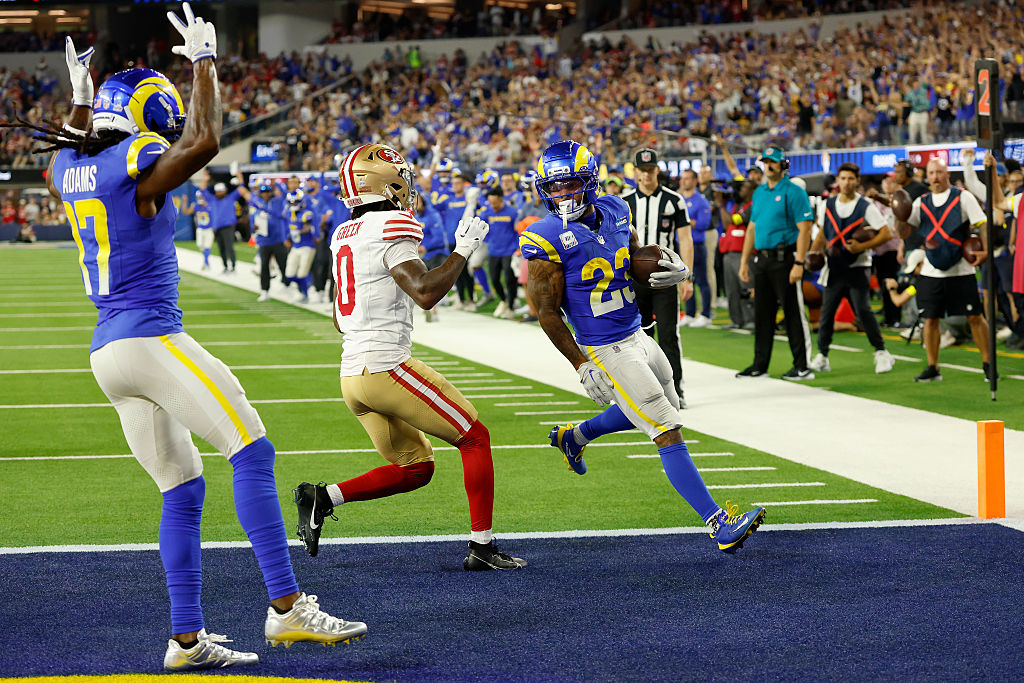
Dan Johnson takes you through his preview, prediction, and pick for NFL Week 10’s game between the San Francisco 49ers and the Los Angeles Rams.
Levi’s will shimmer in dry autumn light as Los Angeles hunts separation and San Francisco protects standing and memory. The rivalry still crackles from that Week 5 26–23 overtime, a small scar that sharpened both rooms and rewired urgency. The bowl will inhale on thirds, exhale on challenges, and hold its breath through the middle eight as tiebreakers and reputations tighten every snap. Sean McVay arrives with rhythm and range, a script that widens grass, compresses angles, and dares a battered front to tackle in space. Kyle Shanahan counters with craft and extra rest, a chess player with home-field oxygen who will squeeze tempo, test discipline, and let a patient crowd harden into pressure when the scoreboard narrows. Below is my prediction for NFL Week 10’s game between the San Francisco 49ers and the Los Angeles Rams.
Here’s how I’ll play it. I’ll be pumping out these predictions for individual games all season, with plenty of coverage here on DraftKings Network. Follow my handle @dansby_edits for more betting plays.
The numbers frame the lane with clarity. Los Angeles sits third in total DVOA at +36.5%, with +23.7% on offense and −15.1% on defense. San Francisco lands 15th near −0.3%, with +10.5% on offense and +8.0% on defense. EPA backs the split. The Rams sit at +0.07 EPA per play with a 48.2% success rate. Their pass game hums at +0.20 EPA per dropback and punishes static leverage. The 49ers defense has allowed +0.09 EPA per pass and sits +0.04 overall, a meaningful slide from its usual steel. San Francisco’s offense holds +0.03 EPA per play with a 47.1% success rate, steady yet not overwhelming. Raheem Morris’s unit answers with a top-ten success-rate defense near 41% and only two rushing touchdowns allowed. The trench math narrows choices and magnifies precision.
Matthew Stafford drives the axis with layered answers and cold economy. He sits at twenty-one touchdowns against two interceptions with a 66.5 QBR powering that +0.20 EPA/pass profile. Play-action spikes to +0.32 EPA, and screens add +0.17, which freezes safeties and warps pursuit. He just stacked four scores on New Orleans and authored five in London, spreading completions to ten teammates without Puka Nacua. That range travels like a heat lamp. Davante Adams already owns six touchdowns, and Los Angeles weaponizes him in condensed space with motion-reset leverage. He wins late hands at the pylon and punishes single when help drifts. Puka Nacua returns healthy, averages about nine targets, and becomes the fulcrum for stacks, jets, and slot switches that shake zone rules loose. San Francisco’s corners will face hide-and-seek across formations; the plan forces coverage rules to declare before the ball ever leaves Stafford’s hand. Tyler Higbee stays available off flood and sail if the boundary draws extra help. Los Angeles converts around 45% on third down while San Francisco allows about 43%, tilting high-leverage snaps toward cadence and eye discipline.
San Francisco’s heartbeat still throbs through Christian McCaffrey. Los Angeles checked the ground game in Week 5, holding the 49ers to seventy-four rushing yards at 2.7 per carry, and still has allowed only two rushing scores. That history encourages duo fits and inside cross-keys, with interior rules spilling runs to rallying help. Brock Purdy stabilizes timing, yet San Francisco’s pass efficiency meets a defense that tackles and squeezes air yards. George Kittle brings historic sting—66 yards per game against Los Angeles and six touchdowns across thirteen meetings—so bracket rules and reroutes must land early. Deebo Samuel stresses edges and forces perfect angles; the Rams have minimized missed tackles this year, which trims yards after catch and blunts San Francisco’s usual surge.
Rams vs. 49ers pick, best bet
The counter carries weight and context. Levi’s grants extra prep, and the head-to-head ledger under Shanahan has tilted red. Bryce Huff adds juice to the rush group while depth pieces fill snaps with urgency. Yet the refutation lives in proportional math. Los Angeles ranks top-six in both offensive and defensive EPA tiers; San Francisco’s defense sits 24th by DVOA and +0.04 by EPA/play. The Rams’ red-zone defense allows a 47.1% touchdown rate, which converts sustained 49ers drives into threes and steals expected points. If Los Angeles forces five red-zone trips and concedes two touchdowns, the possession race favors horns.
Market context aligns with the chart and the tape. The number rose from −3.5 to −4.5 on superior efficiency and split confidence. Los Angeles stands 5–3 ATS and 3–1 ATS away; San Francisco sits 4–4–1 ATS in a season marked by defensive attrition and lineup churn. The total rests at 49.5 after a string of overs in recent meetings, yet today’s shapes lean toward moderated explosives: Rams red-zone stinginess against a 49ers defense that bends more than it breaks at home. Field goals do not scare the favorite when down-to-down efficiency stays lopsided.
I expect the script to hinge on early downs and formation stress. McVay will throw on first down, layer under-center play-action from condensed splits, and press quick game to blunt the rush. Duo and sift will appear just enough to punish light boxes before boot flips leverage for Stafford to climb clean pockets. Shanahan will probe C-gaps with McCaffrey, then pivot to glance, screen, and mid-cross to blunt interior disruption. Purdy will chase that 47.1% success rate with tempo toggles and formation tells. Los Angeles will bracket Kittle on money downs and rally-and-tackle on Samuel, trusting pursuit to erase YAC windows. Hidden yards will swing the middle eight; the Rams’ drive-finish rate plus red-zone defense keeps the lever tilted when sequences stack.
The trench conversation decides comfort and cadence. Los Angeles must shade help to protect edges without wrecking route timing. San Francisco must manufacture interior wins without selling out structure. If Los Angeles reaches four sacks or equivalent drive-killing losses, the possession math pushes toward chalk. If San Francisco steals a short field, the red-zone ledger still demands conversion at a clip it has not sustained against this defense.
Turnovers and special teams sit as quiet arbiters. The first meeting produced two giveaways per side; parity there opened the door to overtime. Replicate even turnover math, and the Rams’ superior per-snap efficiency becomes decisive. One clean return or a touchback decision at the wrong hash can turn a sweaty cover into a settled one.
I trust the stronger baseline and the wider runway. The Rams own the pass efficiency edge at +0.20 EPA/pass against a defense allowing +0.09 per pass. The defense limits success near 41% and has surrendered only two rushing touchdowns, compressing McCaffrey’s red-zone dominion. San Francisco sustains; Los Angeles finishes. If the rush stirs, McVay’s motion and spacing toolbox forces off coverage, and Stafford harvests hitches, glance, and crossers until the roof lifts.
The Rams have been covering this year, strangely. It’s a reasonable number, here, and I like Mevis better than I did Karty as we’re evaluating spreads with field goal dividends.
Final: Rams 20, Vikings 20. Stafford is King of the NFC West.
Best bet: Rams -5.5 (-115) at 49ers
Tail it with me in the DKN Betting Group here!
For a prop lean, George Kittle anytime touchdown at plus money fits the math and the memory. He averages 66 yards per game with six touchdowns in 13 against Los Angeles. San Francisco’s pass game sits at +0.10 EPA/dropback with Brock Purdy and sustains a 47.1% success rate. Los Angeles allows touchdowns on 47.1% of red-zone trips and only two rushing TDs all season, which funnels finishes through the air. Shanahan will script condensed play-action and choice routes inside the 10; I expect 2–3 red-zone looks, which makes the price worth the swing.
Best prop lean: George Kittle to score a touchdown (+150)
Tail it with me in the DKN Betting Group here!