
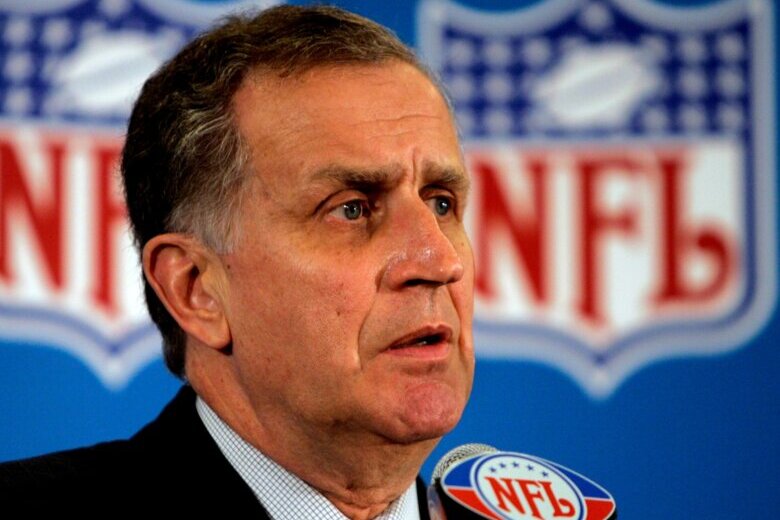
Former NFL Commissioner Paul Tagliabue died Sunday at his home in Chevy Chase, Maryland. He was 84.
Charley Casserly, the former general manager of Washington’s football team, joins WTOP to discuss how former NFL Commissioner Paul Tagliabue was really like. Tagliabue died Sunday at the age of 84.
Former NFL Commissioner Paul Tagliabue died Sunday at his home in Chevy Chase, Maryland. He was 84.
Tagliabue did his undergraduate years at Georgetown and went on to get a law degree from New York University, and then moved down to D.C. to practice law until joining the NFL in 1989.
WTOP spoke with Charley Casserly, the former general manager of Washington’s football team, who talked about what Tagliabue was really like.
This interview has been lightly edited for clarity.
Steve Dresner:
Former NFL Commissioner Paul Tagliabue has died at the age of 84. Many may not know that Tagliabue was born in New Jersey but eventually laid down roots in the D.C. area.
He even received an athletic scholarship to play basketball at Georgetown University.
Charley Casserly:
Well, Hall of Famer, and I know he’s in the Hall of Fame, but it took him a while to get there. Every commissioner has their own challenges. OK, thinking back right now, I’m doing this off top my head, the number one thing he had to face was labor unrest. So he was able to settle the labor situation down. They went to court. The players sued the NFL and then came out with a brilliant system, the salary cap system we have with free agency.
So baseball doesn’t have anything like this. I don’t think the NBA has anything like this. So it was a real good compromise where both sides won. The players got free agency and the NFL owners got some sort of a cap, and the players got a percentage of the revenue, which was unheard of.
And, as Gene Upshaw said, the owners know how to make money, so you’re going to make money. And you can see the cap is just, you know, exploded through the years. So that’s number one.
Number two, he worked to try to expand the game worldwide with, you know, having preseason games and exhibition games, you know, in different countries. He started NFL Network. Why? First, FOX came in and they made the decision to go with FOX, away from CBS, and the revenue exploded. Well, so then the NFL starts their own network, OK? And now they got — the other people got competition, too.
So, you know, the labor unrest was huge. If you think about the impact of the game today, a free agency, but there’s a cap. It’s best system in football.
Steve Dresner:
Charlie, is it a correct statement in making what he did, expanding the league with the teams, and he also went through the Modell situation, moving Cleveland to Baltimore and all. But, as I mentioned on air, was also a little surprising how quickly he got a team back to Cleveland. But, overall expanding the league, is it a correct statement to say he had just a lot to do with it, didn’t he?
Charley Casserly:
Where did they expand to? Charlotte and Jacksonville. OK, you know, you think about that. Those weren’t cities that people were thinking about. The other thing he did, and I’m glad you brought up the Baltimore thing, is, we had stadium free agency, franchise free agency.
In other words, what’s Houston do? They go to Jacksonville, and then they go back to Houston say, ‘Well, if we, if you don’t improve the Astrodome, we’re going to Jacksonville.’ They approve the Astrodome. What’s he do? He then goes to Nashville a couple years later, and the Houston people say to ‘heck with you,’ and Houston lost football.
But he got, he got football back into Houston. OK, with an expansion team. So, but what he did was he started — I don’t remember the exact term for it. I’m guessing g3 but that might be wrong on that. But it was a stadium funding plan where teams, OK, could stay in their own market and get funding from the league, which they would repay back with revenue from the stadium. Like the club seat revenue, OK.
So, that stopped all the moving of the franchises. So all of a sudden now you have franchise stability, which was huge. And you look at all the new stadiums that came up, and he had a tremendous part to do with that, with coming up with this idea of the league fund — having a pool where teams could borrow from and then pay it back.
The other thing he did is the Rooney Rule, where you had to interview minority candidates. And you saw the number of minority head coaches rise. So, there’s so many different things that he did that — he handled the problems of the time excellently, just as (Roger) Goodell is handling the problems that he has, which aren’t necessarily inherited, but there’s different problems in different eras. So you have different accomplishments that occur.
Steve Dresner:
Finally, Charley, can you put your executive hat on for a minute? GM hat on for a minute. Short, quick descriptions on Paul Tagliabue, the person, just observations, working with him and so on, coming from an NFL exec like yourself.
Charley Casserly:
I use the term smartest guy in the room, but, you know, there’s other smart people in the room, too. The guy was brilliant. He was a visionary. He was always thinking down the line and in the future. He never was satisfied with today being the ultimate answer.
So I think those two things — very smart guy, a very dignified guy, but always thinking into the future. You know, I knew him for being on the Competition Committee. He put me on the Competition Committee twice. So, I got to know him there. Of course, he lived local.
And then when I was — came back and I started teaching at Georgetown, of course, he was on the board of directors. So, I had him come to class a couple of years there, and, you know, teach a class. So we got to know each other pretty well during the time. A lot of respect for him.
Get breaking news and daily headlines delivered to your email inbox by signing up here.
© 2025 WTOP. All Rights Reserved. This website is not intended for users located within the European Economic Area.