
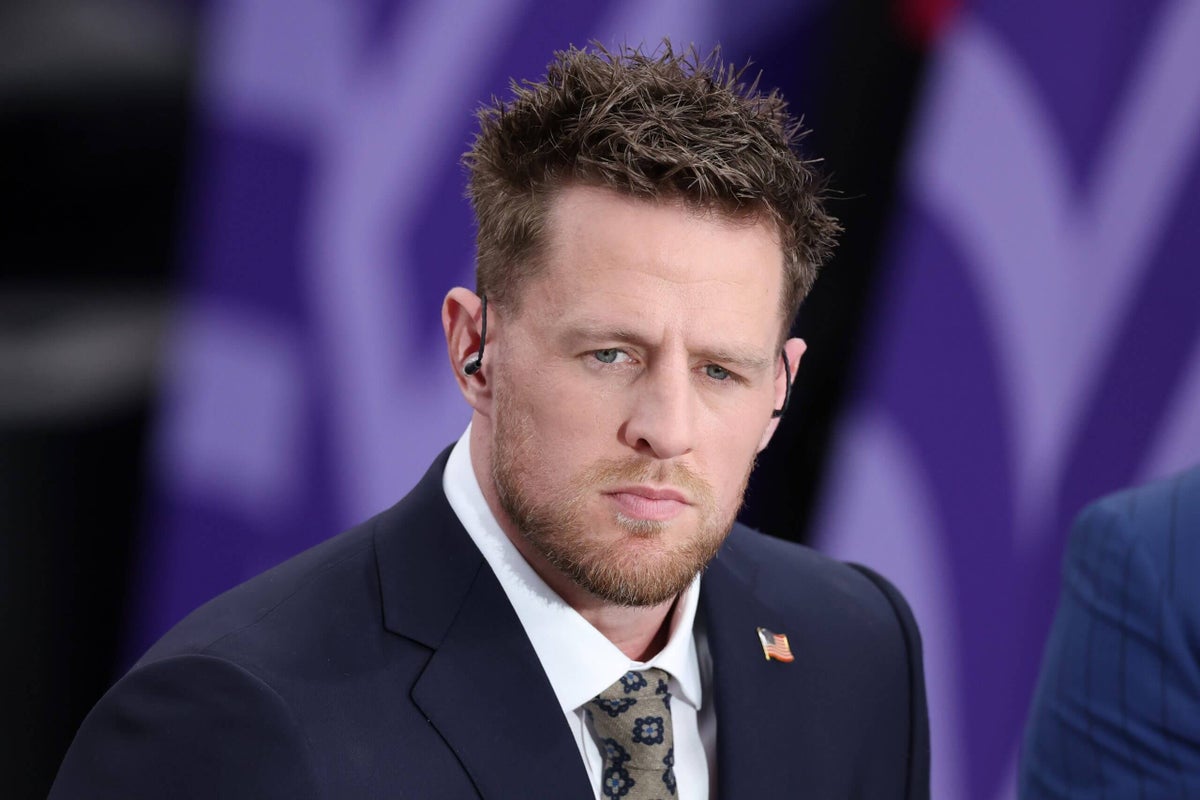
During a recent conversation about defensive players calling NFL games, Fred Gaudelli, the executive producer of NBC’s NFL coverage and the last lead producer John Madden worked with during his NFL broadcasting career, recalled Madden frequently harping that an NFL broadcast was too often from the point of view of the offense.
As Madden would repeatedly tell Gaudelli: There’s not enough for the viewer about defense.
“He’d hit you in the middle of the game and say, “Hey, you know there’s 22 guys out here, right?” Gaudelli recalled this week. “That was the cue to start talking and showing defense. With that as a backdrop, I think defensive players can add a perspective seldom heard on game broadcasts. On Sundays, I’m constantly quizzing [NFL Football Night In America studio host] Devin McCourty about how teams approached certain quarterbacks, wide receivers, schemes, and how defenses change each week. I think that if this new group is able to share those types of insights, they’ll make the audience smarter and bring a fresh approach to the broadcast.”
That new group includes CBS NFL analyst JJ Watt, who this season became a full-time game analyst after working in the studio on “The NFL Today.” Former Patriots defensive back Jason McCourty is part of a CBS crew featuring Andrew Catalon and Charles Davis (himself a college defensive back at Tennessee). Logan Ryan, who played cornerback in the NFL for 11 seasons, is also a CBS NFL game analyst this season. FOX’s roster of NFL game analysts includes Adam Archuleta (a former NFL safety) and Jonathan Vilma (a former NFL linebacker). ESPN uses Louis Riddick, a former NFL safety, on NFL game coverage when it has doubleheaders
I was curious if Watt offered a different perspective for NFL viewers, given his 12 seasons in the NFL as an All-Pro defensive end and sack-accumulating menace. So on Sunday I watched the Jaguars-Texans game, where Watt was working with steady-hand play-by-play announcer Ian Eagle. The game turned out to have a wildly entertaining final quarter, as Houston outscored Jacksonville 26-0 in the last 15 minutes for a 36-29 victory.
My takeaway from watching Watt on Sunday was that his broadcast was indeed a slightly more defensive-oriented broadcast than others. That made for interesting analysis at times.
For instance, on a second quarter roughing-the-passer penalty on Jacksonville defensive lineman Travon Walker, Watt said, “I’m going to be honest with you: As a defensive lineman, if your face mask is up, you don’t drop the crown of your head. It’s very tough. You can’t go low. You can’t go high. I understand it by the letter of the law. I just know how frustrating that is as a defensive lineman.”
Earlier in the game, after Texans defensive end Denico Autry was called for a 15-yard unnecessary roughness penalty on a Jacksonville field goal attempt, Watt explained why the 15-yard penalty occurred. “That center is protected,” Watt said. “You can’t go in there and hit him in the head or neck area and clearly he gets a piece of him there.” Watt also alerted viewers prior to a play that Will Anderson Jr. had one-on-one coverage, and Anderson nearly got to quarterback Trevor Lawrence after beating his lineman.
Olsen told The Athletic in 2023 that he had learned to love the intricacies of defense and made it a point to inject that in his broadcasts. “I always knew from studying defenses what they were doing, but I was never sitting in meetings with defensive coordinators asking something like, “How do you break down pass protections?” Now I’m getting those answers and able to provide defensive analysis,” Olsen said. “You don’t always have to tell the viewer where the ball started and where the ball ended up. You can bring in the other elements that make football complicated but also so cool.”
One thing Watt did not do much on Sunday was offer what the offense might be thinking prior to snaps, something we see regularly from quarterback-centric analysts such as Aikman and Romo and a very valuable thing for viewers.
When he did so on Jacksonville’s final drive — telling viewers to watch for Lawrence using his legs on the drive — he was rewarded when Lawrence ran for 21 yards on a broken play with 22 seconds left. He also offered interesting insight on why Texans rookie wideout Jayden Higgins kept a reception above his head (as opposed to bringing it to his body) late in the fourth quarter, given that a Jaguars defender had wrapped him up by the stomach.
Watt remains a work-in-progress, which is exactly what he should he in his first full year as a game analyst. He’s aided by a great game-caller in Eagle, as well as not being forced to do the top games each week. I’d like to see him lean into humor more. For instance, he delivered a great one-liner on Texans kicker Matthew Wright who had designs on being an aerospace engineer if football did not work out.
“Those are very different roles,” Watt deadpanned. “Kicking a football and building rockets.”
He also had a good back-and-forth with rules analyst Gene Steratore about being a ref in the NFL.
Watt would be aided long-term by being more assertive on penalty calls. Viewers want to know definitively if you think the call was good or not. He used the word “we” at least once when referring to the Texans (he played 10 seasons in Houston), but the broadcast came off as neutral to my ears.
Game analysts have historically mostly been former quarterbacks or coaches — and almost certainly an offensive player. The current No. 1 game analysts for the main TV rights-holders include former quarterbacks ESPN’s Troy Aikman, Fox’s Tom Brady, CBS’s Tony Romo, and Prime Video’s Kirk Herbstreit (who played quarterback in college), along with NBC’s Cris Collinsworth, the lone No. 1 analyst with a non-quarterback background. (As a former NFL wide receiver, he brings an orientation of experience playing offense.)
Sure, there have been some notable non-quarterback exceptions over the years in the No. 1 chair: Greg Olsen, a tight end during his playing career, was Fox’s No. 1 game analyst before Brady came to town. Former NFL offensive lineman Dan Dierdorf was a No. 1 NFL analyst for ABC’s “Monday Night Football” for 12 seasons. In the 1970s and 1980s, on its top announcing teams, NBC featured Bob Trumpy, an AFL and NFL tight end, and Pro Football Hall of Fame defensive end Merlin Olson. (They called six Super Bowls between them.) Tom Brookshier (CBS) and Al DeRogatis (NBC) were defensive players during their NFL careers before becoming lead game analysts. Pat Summerall, a game analyst before moving to play-by-play, was a placekicker. (No doubt I’m missing some, including however we would describe Dennis Miller and Tony Kornheiser.)
When asked about Watt, Eagle told The Athletic this week that the positional background of his NFL analyst does not have much of an impact on how he calls a game, outside of getting a feel for what his partner is comfortable discussing over the course of a season.
“Instinctually, you figure out which direction you can go on certain plays,” Eagle said. “JJ acknowledges that he never played quarterback, but he does have a ton of experience getting inside the mind of a quarterback. Thousands of hours of film study trying to understand what a QB is thinking and how to best defend it provides the viewer with unique insight. When you view it through a different lens, it can often elicit some non-traditional opinions. Quarterback is the most important position on the field, but it doesn’t necessarily mean only people that played it are qualified to thoughtfully discuss it.”
This is true. Watt is just 36 years old. We may be hearing his perspective for some time.