

Republic analyzes what went wrong in Cardinals’ loss to Seahawks
Arizona Republic writers Theo Mackie and Greg Moore discuss the Cardinals’ Week 10 loss to the Seattle Seahawks and the team’s long-term future.
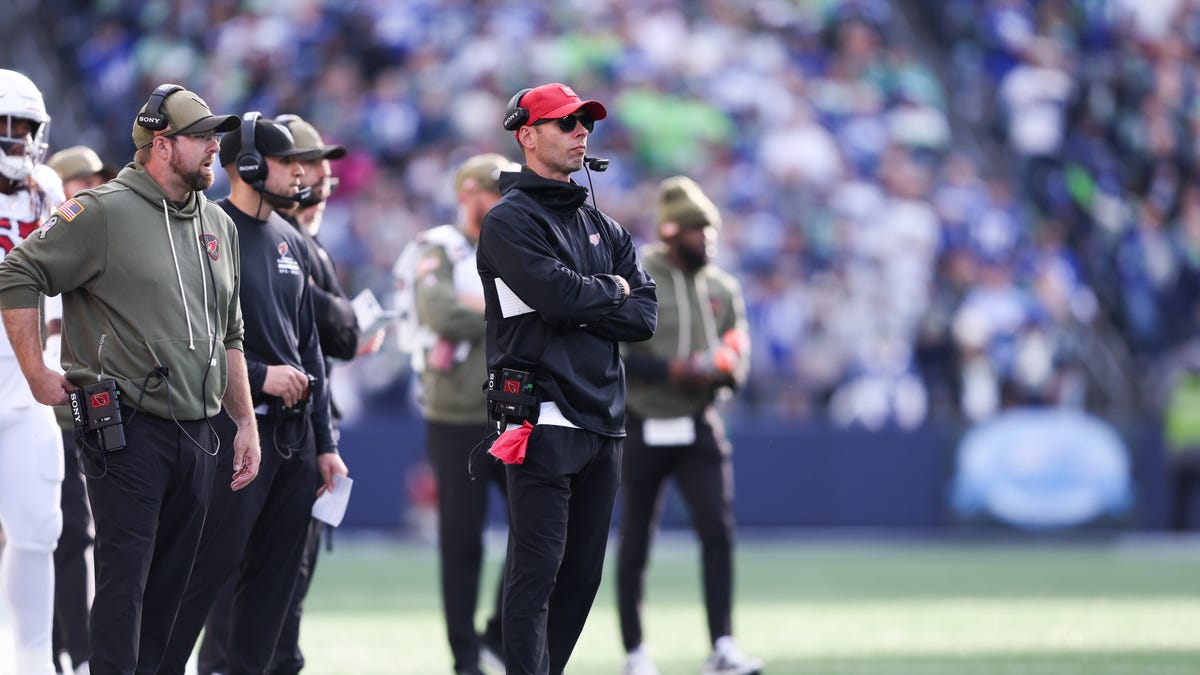
A lopsided 44-22 loss to the Seattle Seahawks exposed familiar weaknesses in the offensive line, defense, and coaching.Head coach Jonathan Gannon took responsibility for the loss, which highlighted the team’s struggles against top NFC West coaches.
SEATTLE — The optimism this week in Arizona was not about Jacoby Brissett. Not really. Not at its core.
Brissett played three excellent games, passing for 860 yards, six touchdowns and one interception. He stabilized the Cardinals quarterback position in a way no one had since Kyler Murray was at his best in 2021. He earned the starting job of his own volition, by snapping a five-game losing streak on Monday Night Football in Dallas.
All of that is true. But Brissett is a 10-year journeyman on a two-year, $12.5 million deal. He was not signed to be a reclamation project, like Baker Mayfield or Sam Darnold or Daniel Jones. He was signed to be one of the league’s most reliable backups, because that is what a decade of evidence has proved that he is.
Three encouraging performances did not change that. Brissett was never likely to be the Cardinals’ long-term solution at quarterback. At most, he could be a bridge option next year as the Cardinals piece that puzzle together in what seems destined to be the aftermath of the Kyler Murray era.
Instead, the optimism this week was about everything around Brissett.
With a traditional, pocket-passing quarterback, the Cardinals had unlocked the under-center, play-action game favored by offensive coordinator Drew Petzing. Their offensive line looked more cohesive because Brissett trusted it, instead of bailing at the first sign of pressure.
Trey McBride was dominant with the new quarterback, and Marvin Harrison Jr. was finding his groove. Even secondary options, like Michael Wilson and Zay Jones, were proving valuable, because Brissett is better than Murray at going through his reads.
It was contagious, too.
With stability at quarterback, the defense had its best performance of the season in Dallas. The pass rush got after Dak Prescott, and the secondary held up against CeeDee Lamb and George Pickens.
“Sometimes, when you have a lapse in one phase of the game, the other two have to carry the burden of it,” Jones said this week.
With Brissett, that hadn’t been the case. The pieces were falling into place, up and down the roster. So even if Brissett himself wasn’t the future, his stabilizing presence made it easier to have confidence in everything else — from head coach Jonathan Gannon on up to general manager Monti Ossenfort. For the first time this season, the Cardinals’ rebuild seemed viable again.
By the time the Cardinals fell behind, 35-0, against the Seahawks, it was harder to maintain that long-term optimism. Despite some cosmetic work in the second half, the final product — a 44-22 loss — told the same story.
“Not our brand of ball today,” Gannon said. “Got beat pretty damn good.”
Too often this season, it has been the Cardinals’ brand of ball. Other than Brissett’s two strip-sack touchdowns, the biggest problems in Seattle were all familiar.
Up front, the Cardinals struggled mightily with the Seahawks’ creative blitz schemes.
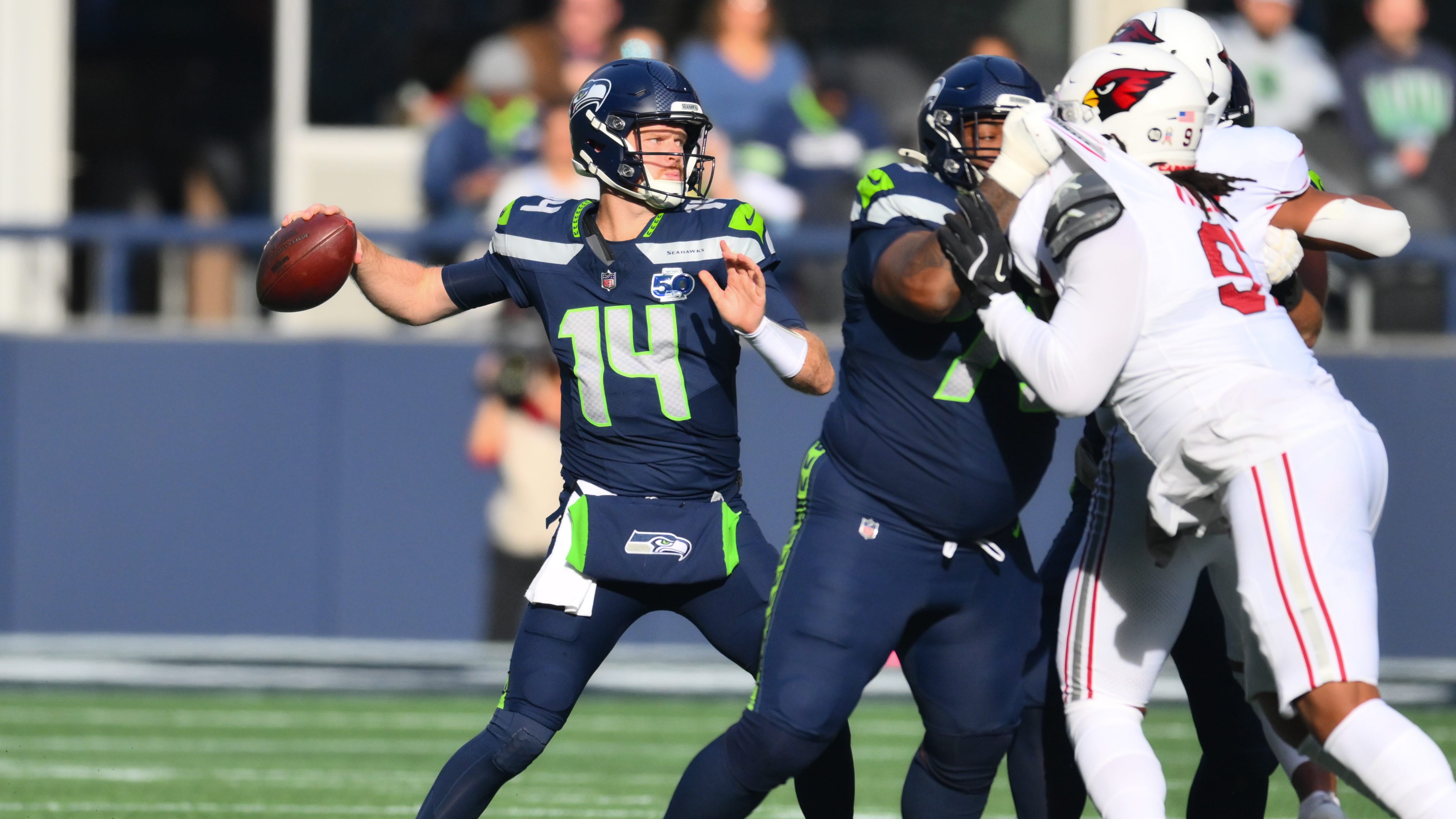
On Brissett’s first strip sack, the Seahawks showed five rushers and brought six, despite dropping an edge rusher into coverage. The Cardinals slid their protection the wrong way and ended up overloaded on the left side. On his second, the Seahawks showed six and brought just five, again creating a mismatch. This time, running back Emari Demercado whiffed on the blitz pickup, again putting Brissett under duress.
“That’s what they do,” Brissett said. “They cause a lot of confusion and put a lot of guys around the line of scrimmage and drop in and drop out.”
But in the modern NFL, that’s what all the most innovative defenses do. Not handling those pressures falls on the quarterback, the offensive line, the running backs and the coaching staff.
And it was only the tip of the iceberg.
Cardinals receivers struggled to get open, most notably Harrison. He finished with just three catches on his 12 targets after a career day in Dallas.
Their defensive line generated minimal pressure. On one play, Seahawks quarterback Sam Darnold initially had nowhere to go with the ball, but two of the Cardinals’ four pass rushers were pancake-blocked into the turf, enabling Darnold to find Cooper Kupp for a 67-yard reception off a broken play.
Their secondary struggled mightily. On the first drive alone, Darnold was 4-for-4, with two of those completions occurring because Cardinals’ cornerbacks lost to Jaxon Smith-Njigba in man coverage. Another came when nickel Garrett Williams was slow to attach to Kupp on a third down in zone coverage.
The run defense was no better, allowing a combined 5.4 yards per carry to Kenneth Walker and Zach Charbonnet — a duo that entered averaging 3.8 yards per carry. Like when the Seahawks traveled to Arizona in September, the Cardinals struggled to secure the perimeter all afternoon.
“It’s hard to win when you give up 200 yards rushing,” veteran defensive lineman Calais Campbell said.
Underpinning it all was the coaching.
“It falls on me,” Gannon said repeatedly.
His job, after all, is to construct a game plan that puts the players in the best possible positions. Instead, this staff is now 0-4 against Seattle’s Mike Macdonald, 1-3 against Los Angeles’ Sean McVay and 2-3 against San Francisco’s Kyle Shanahan.
As Campbell noted, standing by his locker, none of this is final, not yet.
“You don’t want to overreact on big losses,” Campbell said, speaking with 18 years of NFL experience. “It sucks, but at the end of the day it’s one loss.”
Maybe it was just one of those days. Brissett handed the Seahawks two touchdowns early, and the game was effectively over from there. It was a brutal day against an excellent team, when everything that could go wrong did go wrong. There’s a new opportunity over the horizon, seven days away against the 49ers — an opportunity to return to the stability of their three previous games.
It’s an opportunity that the players know they need to maximize.
“The margin for error,” Campbell said, “is officially zero.”
Because if the Cardinals make a habit of performances like this one, it will become difficult to feel good about anything to do with their future, no matter who the quarterback is.