
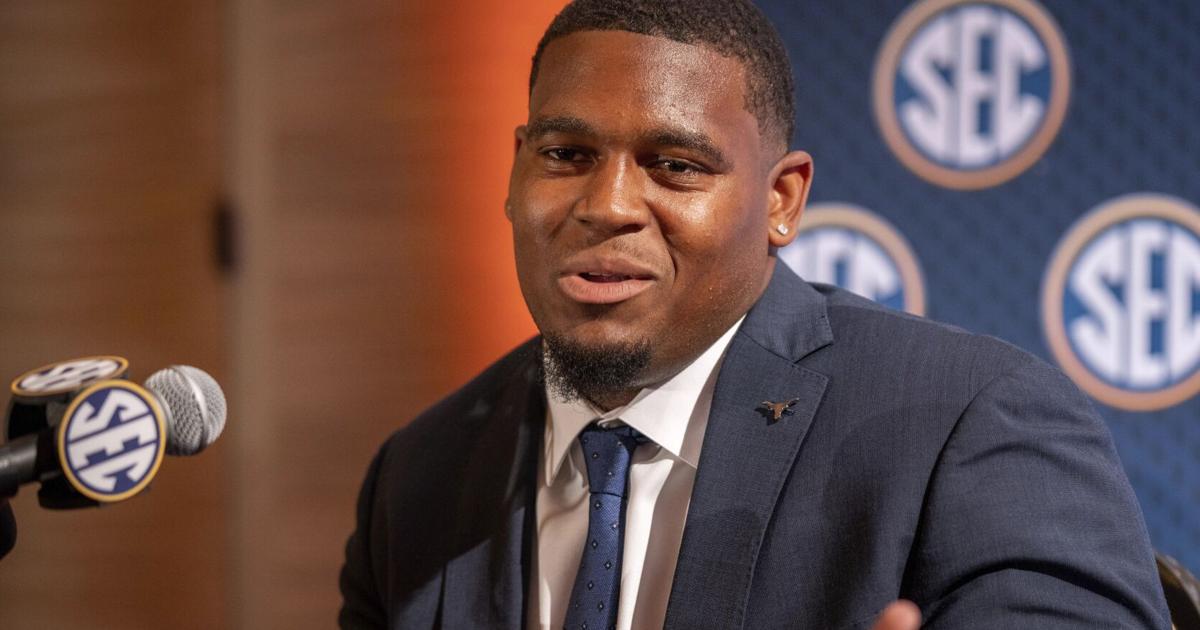
Three years ago, Kelvin Banks Jr. didn’t enroll at the University of Texas until the summer.
This usually wouldn’t be a big deal, but for high-profile recruits, it has become common to graduate high school early and arrive on campus as soon as possible. The coaches can begin coaching, and the kids get more time to acclimate to the program.
So when Banks finally got the chance to step on the practice field as a five-star freshman that July and work against the other athletes that had a months-long head start, offensive coordinator Kyle Flood went over to chat with coach Steve Sarkisian.
“All right, that’s our left tackle,” Flood told him. “It took about two days.”
From Day 1 — or Day 2, to be precise — Banks was a dominant player who coaches relied on as a program cornerstone. At the start of Banks’ three-year tenure, the Longhorns were coming off a 5-7 season. By the end of it, Texas had made the College Football Playoff.
That sort of transformation requires a much larger buy-in than just one lineman, but Flood said for that to happen, a team’s best players have to lead the way. And Banks was among Texas’ best players, if not the outright best.
Banks made the kind of impact the New Orleans Saints are hoping to get by drafting the 21-year-old with the ninth overall pick in this year’s NFL draft on Thursday.
In terms of filling a need, Banks should help provide immediate answers upfront. That could be at left tackle, a spot that would allow last year’s starter — Taliese Fuaga — to move back to his natural position of right tackle. Or it could be at guard, the biggest question mark for the offensive line.
But don’t lose the significance of Banks becoming the Saints’ first draft pick under new coach Kellen Moore. In New Orleans, Moore will need a new generation of leaders to set a tone and pave the way to help the organization become annual contenders again. And the Saints believe they’ve started that process with Banks, a two-time captain at Texas who Sarkisian called “the perfect Longhorn.”
“It gives them somebody who went through it,” Flood said. “Kelvin was a big part of what we had to do here in changing this organization.”
***
Banks said he became a man early in his college career.
Facing Will Anderson and Dallas Turner of Alabama — two of the nation’s top pass rushers who are now both in the NFL — in the second game of your collegiate career will do that. Banks didn’t back down.
It also set the stage of what he’d see over the next few years.
“It just meant a lot,” Banks said, “having to grow up fast.”
Not many freshmen are thrown into the fire, but perhaps even more rare was the lack of surprise when it happened. Flood said what unfolded in the summer of 2022 made the Texas coaching staff more than comfortable trusting him to hold his own. And even in Banks’ own family, they knew he was up to the task.
What makes someone ready for that stage?
“I always told him to perfect his craft,” Kelvin Banks Sr. said.
He wanted his son to have a normal childhood. He wanted him to have the freedom to explore his interests, which have come to include fishing and reviewing barbecue restaurants.
But the father, who was an offensive lineman who played indoor football with the Conroe Storm, football was part of their family. So naturally, his took a liking to the sport — and dad did the best he could to prepare him.
Those early lessons included studying film. When his son was 9 or 10, the Bankses would pore over film of Banks Jr.’s games, study upcoming opponents and watch the best from the NFL.
“He took that and made it his own,” Banks Sr. said. “He ran with it. And that’s the type of person he is. He’s a professional.”
Banks Jr.’s physical gifts also allowed him to be ready for the challenge. Flood, who also serves as the Texas offensive line coach, said the lineman has “great natural length and power.” But the tackle’s most underrated trait? His core strength, Flood said.
By having a strong core, Banks is “very rarely off balance.” And when he is occasionally knocked off his spot, he can recover quickly to sustain contact and finish plays. According to Pro Football Focus, Banks allowed only five sacks in 42 career games.
Then there’s the mental component.
Flood said Banks has a “unique ability” to focus on the game, no matter the stakes. The lineman is able to concentrate, whether his team needs a four-minute drive to seal the victory or come from behind with a two-minute drill.
“In the NFL, every game is competitive,” Flood said. “I mean, all the games. There’s so many games every week to come down to a two-minute drill. Yeah, he’s absolutely ready for that.”
At Texas, Banks also went through a challenging family situation that he rarely talked about until last season. His mother, Monica, fought a life-threatening illness that caused her to collapse after one of Banks’ games during his freshman year and later put her on a ventilator in 2024. That same year, Monica’s doctors discovered she needed gallbladder surgery, which ended up saving her life.
These days, she’s doing well. As a result of her illness, Monica had to relearn how to walk and speak. During the saga, Banks Sr. remembers how his son wouldn’t let it “deter” him. Neither of his parents would have it any other way.
On draft night, Monica was there on the couch when Banks got the call that he was a member of the Saints.
“She was very proud,” Banks Sr. said, “and I’m glad she got to be here to see it.”
***
At an LSU coaching clinic last month, Saints offensive coordinator Doug Nussmeier stood in front of a room of high school coaches and spoke about culture. He told them that culture — football’s favorite buzzword — isn’t a matter of quotes on a wall or a page in the team’s playbook.
“The players have to live it,” Nussmeier said.
Speaking over the phone, a day after Banks was drafted, Flood reiterated the same idea. And Banks, he said, made that a reality for Texas.
Flood would often notice how Banks interacted with younger teammates, not afraid to pull them aside to say “that’s not how we do it here.” The tackle wasn’t loud or boisterous, but he helped set the standard.
For that standard to take root, Banks had to be reliable. And he was. Banks’ durability was a strength for the Longhorns as the lineman missed only one game for an injury over his last three years, and that is undoubtedly appealing for a Saints team that was ravaged upfront last season.
“Just through his process, he’s everything you want your organization to represent,” Moore said after the Saints drafted Banks.
On draft night, Moore left the door open about whether Banks would play tackle or guard at the next level. Scouting reports from The Athletic and the NFL Network suggest Banks, because of his shorter 33-inch arms, may be better suited for the inside. On the broadcast, The NFL Network’s Daniel Jeremiah said he thinks Banks could “hold up” at tackle, but that he’d be “hell on wheels” at guard.
Banks said he’ll play anywhere.
Asked about his thoughts on the debate, Flood said he doesn’t have “any doubt” that Banks could thrive at tackle in the NFL. Just like he saw during Banks’ first two days all those years ago.
“I know it sounds disingenuous when I describe what Kelvin’s like, but this is really what he’s like,” Flood said. “He’s a no-flaw kid.”